
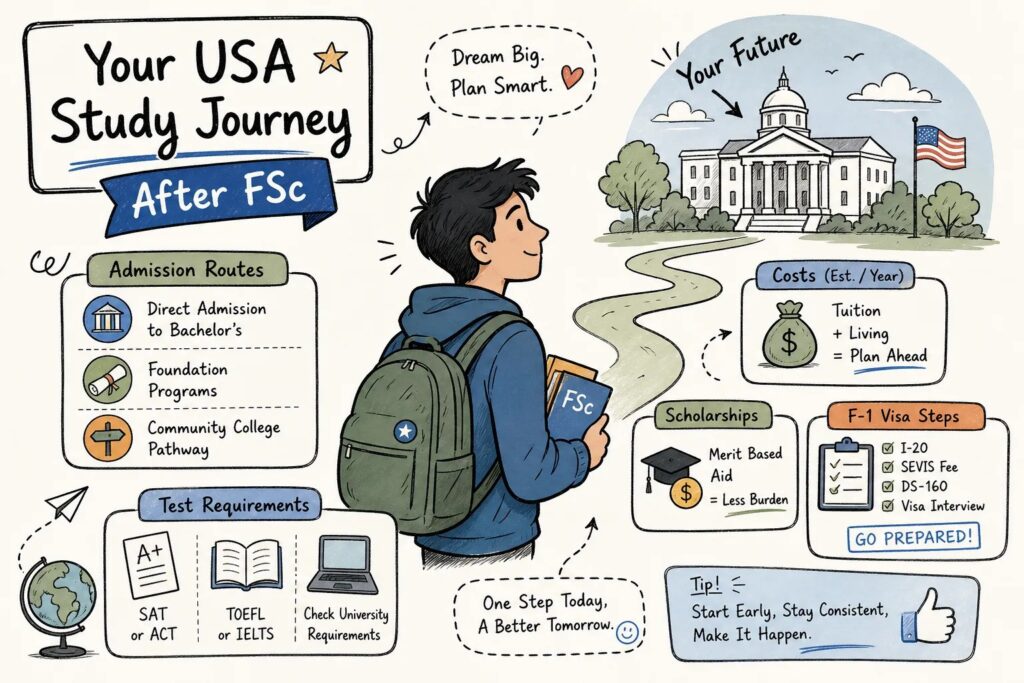
Study in USA after FSc Pakistan is a goal that many students share, yet most hit the same wall quickly: vague warnings that their qualification is not “recognised,” or rumours that 12 years of schooling is insufficient for American universities. Both concerns are largely unfounded, and understanding why will change how you approach this process entirely.
FSc, Matric plus two years of Intermediate, gives you exactly 12 years of formal schooling. That meets the standard entry threshold for US undergraduate programmes. Unlike Germany or the UK, where 13 years are often expected, the American system is built around 12 years, which puts FSc holders on equal footing with most international applicants. At MUSAFAT Student Consultants, our team has been guiding students through US admissions for over two decades, and the qualification itself is rarely the problem. Planning, preparation, and paperwork are what make or break applications.
This article covers the full picture: which routes are available to you, which tests you need, how credential evaluation works, what everything costs, and what the F-1 visa interview actually requires.
Study in USA After FSc Pakistan, does FSc actually qualify you for direct bachelor’s admission?
What the “12 years of schooling” rule means for FSc holders
US universities require 12 years of formal schooling for undergraduate entry, and FSc completes precisely that. This is a meaningful distinction because many European destinations reject FSc outright or mandate a foundation year. In the USA, no such gap exists. Some universities request an IBCC (Inter-Board Committee of Chairmen) equivalence certificate to formally confirm your qualification maps to a US high school diploma, particularly if the admissions office is unfamiliar with the Pakistani board system. Request this certificate from IBCC early, as it adds a useful layer of official documentation to your application.
Which universities admit FSc students directly
A wide range of public universities and private institutions accept FSc for direct bachelor’s entry without requiring additional qualifications. California State University San Marcos, DePaul University, Florida Atlantic University, Texas A&M University-Corpus Christi, and George Mason University are among the institutions with clear international admission pathways for FSc holders. The highly selective top-20 universities are a different matter entirely, but the majority of mid-tier state universities have well-defined processes for Pakistani applicants pursuing a BS after FSc in the USA.
When FSc marks become the deciding factor
Your aggregate percentage matters significantly once you are past the eligibility question. Most undergraduate programmes expect a minimum 60% aggregate for consideration, while scholarship-level admission typically requires 75% or above. The GPA equivalent of 75% on the US 4.0 scale sits at approximately 3.7, which is genuinely competitive for merit-based aid at a broad range of state universities. A handful of institutions, such as the University of Oregon, require A-level subjects alongside GCSEs and treat FSc as insufficient on its own, so always verify requirements directly with each university’s international admissions office before applying.
How Pakistani FSc students can study in the USA, three realistic routes
Not every FSc student has the same grades, budget, or timeline. As you read through the routes below, consider which combination of academic standing, available funds, and preferred timeline best fits your situation, that will quickly narrow down where to focus your energy.
Study in USA after FSc Pakistan: direct entry into a 4-year university
For students with strong FSc marks of 75% or above, a competitive SAT score, and financial documentation in order, direct admission to a 4-year bachelor’s programme is the fastest route. Many universities do operate rolling admissions for international applicants, but practices vary widely, always check each target university’s admissions calendar directly, as some close windows earlier than expected. This path requires the most complete application package upfront, including standardised test scores, a Statement of Purpose, recommendation letters, and financial proof. Meeting HSSC undergraduate requirements for the USA early is the key to keeping your options open.
The community college 2+2 route
Starting at a community college is a legitimate and well-trodden path for students with lower marks, tighter budgets, or no SAT scores. The “2+2” model means two years at a community college earning an Associate degree, then transferring to a 4-year university for the final two years. Annual costs at Midwest community colleges typically run around $26,000, considerably lower than direct university entry. Colleges such as Northern Virginia Community College, Green River College, and Houston Community College System have formal articulation agreements with four-year universities, including guaranteed transfer pathways to state flagship institutions.
University pathway and bridge programmes
Some US universities partner with providers such as INTO, Shorelight, and Study Group to offer structured transition programmes for international students who meet academic requirements but want additional English language or academic preparation. Programme length and structure vary by university and provider, INTO and Shorelight both publish details on their respective partner university pages, so verify the specifics before enrolling. These programmes generally feed directly into the first year of a bachelor’s rather than functioning as full foundation years in the UK sense. They suit students who are academically eligible but want a confidence-building transition before committing to a full academic year.
Tests you need and the score ranges that actually matter
SAT and ACT: required or optional?
The shift towards test-optional policies at many US universities is real, but submitting a strong score still improves scholarship prospects at the majority of institutions. For mid-tier public universities ranked between 50 and 100, an SAT score of 1,200 to 1,400 is competitive. The top 50 institutions typically expect 1,400 to 1,500 or above. Based on applications reviewed at MUSAFAT, most Pakistani applicants tend to score in the 1,050 to 1,100 range, which means a score above 1,200 places you clearly ahead of the typical applicant pool at most realistic target universities. Even at test-optional schools, a strong score can trigger automatic merit scholarship consideration.
English proficiency: TOEFL vs IELTS
Most FSc programmes in Pakistan are English-medium, which can allow a waiver at some institutions, but you must confirm this directly with each university before assuming it applies. Where a proficiency test is required, the standard threshold for admission is TOEFL iBT 80 to 90 or IELTS 6.5. Scholarship eligibility typically requires TOEFL 100 or above, or IELTS 7.0. Always check the specific university’s international admissions page for the current requirement rather than relying on general figures, as policies do change.
Documents, credential evaluation, and your application timeline
WES credential evaluation for FSc transcripts
WES (World Education Services) provides the formal credential evaluation that many US universities require to assess your FSc marks against American academic standards. The Course-by-Course evaluation is the standard option for university admission, check the current fee on the WES website directly, as pricing is updated periodically. The process involves creating a WES account, obtaining a reference number, and having your Board of Intermediate and Secondary Education send official mark sheets directly to WES in a sealed envelope. The critical point is timing: end-to-end processing can extend considerably because verification depends on your board’s response speed. Start this process as early as possible. It cannot be rushed from your end.
Building your full application package
A complete application for a US university includes FSc transcripts and mark sheets for both Part I and Part II, English proficiency test scores, SAT or ACT scores where applicable, two or three letters of recommendation, a Statement of Purpose, a valid passport, and financial documents showing liquid funds sufficient to cover at least the first year of study. Some universities request course descriptions to verify subject-level equivalence with the 12-year standard, so keep these ready.
Targeting the right intake cycle
US universities operate on two main admission cycles: Early Decision on November 1 and Regular Decision on January 1, both for September intake. For students currently completing FSc in 2026, the September 2026 cycle is effectively closed. September 2027 is the next realistic target, and it provides sufficient lead time to sit tests, complete WES evaluation, gather financial documents, and submit a polished application. Students who begin preparing now have a genuine advantage.
What US education costs and how to fund it realistically
Annual cost breakdown for Pakistani students
Public universities are the realistic starting point for most Pakistani families. Tuition ranges from $18,000 to $35,000 per year, with living costs adding $12,000 to $20,000 on top. Total annual costs at a mid-tier public university typically fall between $30,000 and $55,000 USD, convert this at the prevailing rate closer to your application date, as exchange rates shift considerably. Community colleges in the Midwest can bring this down to roughly $26,000 per year. Private universities in major cities frequently exceed $85,000 annually and are rarely financially viable without substantial scholarship support.
Merit scholarships that are genuinely achievable
Full undergraduate funding in the USA is uncommon, but partial merit scholarships are within reach for well-prepared students. Universities such as the University of Alabama, Arizona State University, Purdue University, and Ohio State University offer automatic tuition reductions of $5,000 to $30,000 per year based on GPA and SAT scores, with no separate scholarship application required. Applying early, keeping FSc marks strong, and submitting a solid SAT score are the factors squarely within your control. A handful of need-blind institutions, including Harvard and Princeton, provide substantial need-based aid for international students, but admission to these is fiercely competitive and cannot be relied upon as a primary funding strategy.
Offsetting living costs through on-campus work
F-1 visa holders can legally work up to 20 hours per week on campus during the academic year. Depending on the role and location, this translates to roughly $1,000 to $2,500 per month. It won’t cover tuition, but it meaningfully reduces daily living expenses and eases the financial burden on the family over a four-year degree.
The F-1 visa and where MUSAFAT fits into your plan
F-1 visa requirements Pakistani students must meet
Once your university accepts you, it issues an I-20 form, which is the foundation of your F-1 visa application. You will need the I-20, proof of SEVIS fee payment, your English proficiency test scores, and, most critically, financial documentation showing liquid funds sufficient to cover at least the first year of studies. Consular officers place the greatest weight on liquid financial evidence: bank statements, sponsorship letters, and consistent financial history carry the most influence. Pakistani applicants are also assessed on ties to their home country. Evidence of family assets, property ownership, or an established family business can support your case, though these are considered supplementary to clear financial proof rather than a substitute for it.
Common reasons F-1 visas are refused for FSc applicants
Insufficient financial documentation is the most frequent cause of refusal. Consular officers need confidence that the student will return home after completing their degree. Weak ties to Pakistan, inconsistent bank records, or an unconvincing explanation of study plans during the interview all contribute to refusals. A prior visa refusal does not permanently disqualify you from reapplying, but the new application must directly address the specific grounds for the original decision with stronger evidence and a more coherent narrative.
How MUSAFAT Student Consultants guides you through every step
This is where having the right adviser makes a measurable difference. MUSAFAT Student Consultants combines immigration law expertise with education counselling under one roof, serving FSc students across Punjab. The founder is an Advocate High Court and a British Council Trained Agent with US immigration law training, that legal background means visa documents are reviewed for consistency and compliance, not just completeness. From university shortlisting based on your academic profile, to SOP writing, financial document organisation, F-1 visa preparation, and pre-departure briefing, the team handles the complete process. Students in Gujranwala, Hafizabad, Wazirabad, and surrounding cities can access this support without the need to travel to Lahore or Islamabad, reach out to confirm current service arrangements.
Your next step starts now
If you want to study in USA after FSc Pakistan, the path is more straightforward than most students realise once it is laid out clearly. The routes covered above, direct entry, community college transfer, and pathway programmes, offer genuine options across different academic starting points and budgets. The tests, documents, costs, and visa steps are all manageable when you approach them in the right sequence with enough lead time.
September 2027 is your next realistic intake target if you begin preparing now. That means sitting IELTS or TOEFL, registering for the SAT if your target universities benefit from a strong score, initiating WES evaluation early, and getting your financial documentation structured well ahead of the deadline.
Book a profile assessment with MUSAFAT Student Consultants to get a clear picture of which universities match your marks, which scholarships are realistic for your profile, and how to build an F-1 visa application that stands up to scrutiny. The preparation starts today, reach out and we will tell you exactly where you stand.