
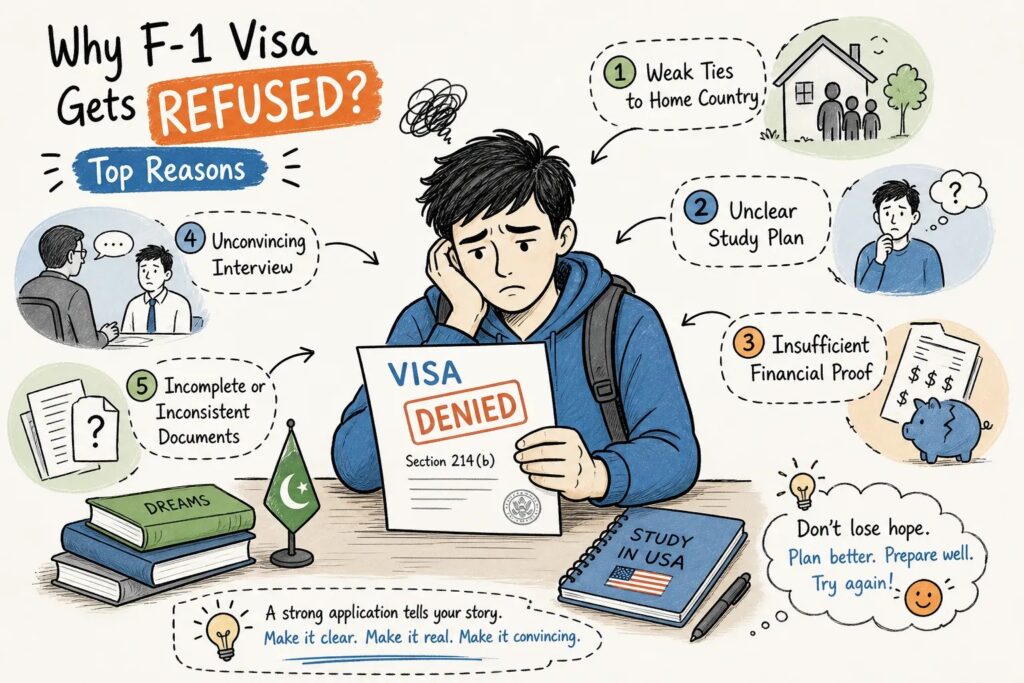
If you are asking what are the most common reasons for F-1 visa refusal from Pakistan, you are probably staring at a 214(b) code with no explanation attached. Pakistan’s F-1 visa refusal rate sits somewhere between 65% and 71%, depending on which period you look at. Most applicants who get refused walk away with two words: “214(b).” No explanation. No checklist of what went wrong. Just a code and a closed window.
At MUSAFAT Student Consultants, we have worked on student visa cases since 2004. We have seen the same refusal patterns repeat themselves across hundreds of applications. The refusals are not random. They follow a predictable logic, rooted in specific legal standards that consular officers apply consistently, and once you understand that logic, you can build an application that addresses it directly.
This article breaks down the common reasons for F-1 visa refusal for Pakistani applicants, what each one means in practice, and what a stronger application actually looks like.
What are the most common reasons for F-1 visa refusal from Pakistan?
Before getting into the specifics, it helps to understand the legal framework that drives every refusal decision. The causes cluster around three recurring problems: a weak ties argument, financial documents that raise more questions than they answer, and an interview that contradicts the written file. Each one is preventable. None of them are random.
The 214(b) presumption: why Pakistani applicants start at a disadvantage
Most applicants walk into the interview without understanding the legal starting point. Under Section 214(b) of the US Immigration and Nationality Act, every non-immigrant visa applicant is presumed to be an intending immigrant until they prove otherwise. The burden of proof falls entirely on you, not on the consulate to demonstrate that you plan to stay.
Pakistan draws heightened scrutiny for practical reasons. The country has documented rates of student overstays and significant immigration pressure, which means consular officers apply the 214(b) standard more rigorously than they would for applicants from low-risk countries. This is not unfair treatment; it is a legal framework applied consistently, and understanding it changes how you prepare.
What 214(b) means in plain language
The officer is not evaluating whether you are academically qualified or a genuine student. They are asking one question: will you leave the United States when your programme ends? If anything in your file creates doubt, the application is refused under 214(b). There is no appeal and no formal explanation beyond the code itself, which is why reapplying without fixing the underlying problem produces the same result almost every time.
Why 221(g) is a different situation entirely
A 221(g) notice is not a refusal. It means the consulate needs additional documents or is running a background check before issuing a decision. Pakistani applicants in STEM fields and certain technical disciplines encounter this more frequently, and processing can range from a few weeks to several months. Knowing which outcome you received determines your entire next move, so it is worth confirming before you do anything else.
Weak ties to Pakistan: the single biggest F-1 visa refusal trigger
Section 214(b) refusals almost always trace back to a single issue: insufficient evidence that you have genuine, verifiable reasons to return to Pakistan after your degree. The concept sounds straightforward, but most applicants underestimate how specifically it needs to be documented before the interview.
What consular officers count as a strong tie
Ties to home country fall into three broad categories: family obligations such as dependants, elderly parents, or a family-owned business; financial assets including property, land, or investments registered in your name or your sponsor’s; and professional commitments such as a confirmed job offer, a family business you are expected to join, or a structured post-study training programme in Pakistan. Vague statements about wanting to serve your country carry no weight without concrete evidence attached to them.
Why young, unmarried applicants face more scrutiny
A 21-year-old with no dependants, no assets in their name, and no waiting job in Pakistan fits the profile most statistically associated with overstaying. That is not a personal judgement; it is a documented pattern that shapes consular behaviour. It does not make approval impossible, but it means your career narrative and post-graduation plan must be unusually specific and verifiable. Saying “I’ll see what opportunities come up” is essentially volunteering a 214(b) refusal in verbal form.
Proof of funds that convinces the consulate, not just checks a box
Pakistani families often have the money to fund a US education. The problem is in how it is presented. A large deposit appearing in the account three weeks before the interview is a red flag, not proof of financial stability. Consular officers want to see consistent financial behaviour over time, not a number strategically placed on a page shortly before the appointment.
Documents that work versus documents that raise questions
Original bank statements covering twelve months of consistent activity are far more convincing than a statement showing a sudden spike before the application date. Fixed deposits from established Pakistani banks such as HBL or NBP, paired with a bank letter confirming liquidity, carry genuine weight with officers.
Property documents, by contrast, are specifically discouraged by the US consulate because they are not liquid assets and are difficult to verify quickly. The typical first-year cost benchmark for a US degree sits between US$45,000 and US$60,000, and your documentation needs to demonstrate access to that figure clearly and credibly.
The sponsorship letter trap
A sponsorship letter without supporting documentation proves nothing on its own. What makes sponsorship credible is the full package: three years of the sponsor’s tax returns, their employment or business documentation, and their own bank statements showing consistent balances. If the sponsor is based in the US, Form I-864 and IRS transcripts are required. Incomplete sponsorship files are one of the most common and most avoidable causes of student visa denial for Pakistani applicants, yet they appear repeatedly in applications that come to us after a denial.
Interview red flags that close the door in minutes
The F-1 interview typically runs four to six minutes. A consular officer can detect inconsistency within the first sixty seconds. Most interview refusals are not caused by difficult questions; they are caused by answers that contradict something the applicant already submitted in writing.
The questions that carry the most weight
Four questions determine most outcomes: Why this university? How are you funding your studies? What exactly will you study? What will you do when you finish? Vague answers to any of these signal that the applicant has not thought seriously about returning home. Mentioning OPT as a preferred post-graduation outcome is not a neutral statement; it tells the officer you are planning to extend your US stay, even temporarily, which is grounds for refusal under 214(b).
Consistency across every document in your file
One contradiction is enough to end the application. If your DS-160 lists you as unemployed but you mention running a family business during the interview, the officer notes it. If your social media profiles suggest you are seeking permanent work in the US while your Statement of Purpose declares you plan to return to Pakistan, those inconsistencies surface during administrative processing. Every document in your file, from the DS-160 to the SOP to the sponsorship letter, must tell exactly the same story. A file that is coherent from start to finish is significantly harder to refuse.
What to do after a refusal: reapplication done properly
Reapplying immediately after an F-1 refusal without changing anything is the most common mistake Pakistani students make. There is no mandatory waiting period, so many applicants rebook an interview within days. The result is almost always another refusal on the same grounds, which then creates a record that the next officer will review before your new interview even begins.
What to fix before you reapply
In our experience, a minimum of six to eight weeks between a refusal and a new application gives you enough time to build a materially stronger file. Use that time deliberately: gather twelve months of updated bank statements, secure clearer documentation of home ties, and revise the career narrative in your SOP to be more specific and verifiable.
A letter of explanation is not required. In practice, it is frequently the factor that shifts the outcome. Showing the officer that something has materially changed is the only basis for a different decision.
When legal expertise makes the difference
Most standard education consultancies can help with university selection and documentation checklists. What they cannot do is analyse a refusal from a legal standpoint and construct a reapplication strategy around the specific grounds of denial. That requires immigration law expertise, not just process knowledge. The distinction matters most after a refusal, when the stakes are higher and the margin for error is smaller.
Build the application properly the first time
F-1 visa refusal reasons in Pakistan follow a predictable pattern. They come from the same root causes: an underdeveloped ties argument and financial documents that raise more questions than they answer. And then an interview that contradicts everything submitted in writing. Understanding the pattern is step one. Fixing it properly, before the interview and not after, is where most applicants fall short.
At MUSAFAT Student Consultants, our founder Majed Akbar is an Advocate High Court, a British Council Trained Agent, and holds formal training in US immigration law from the University of Pennsylvania. This is not a consultancy that fills out forms and sends students to the interview window hoping for the best.
When we build an F-1 application, we build it as a legal case, with every document and every piece of financial evidence working together as a coherent argument. If you have received a refusal, or want to apply with the rigour that prevents one, reach out to our team. We work with students from across Punjab and Pakistan and have been doing so since 2004.