
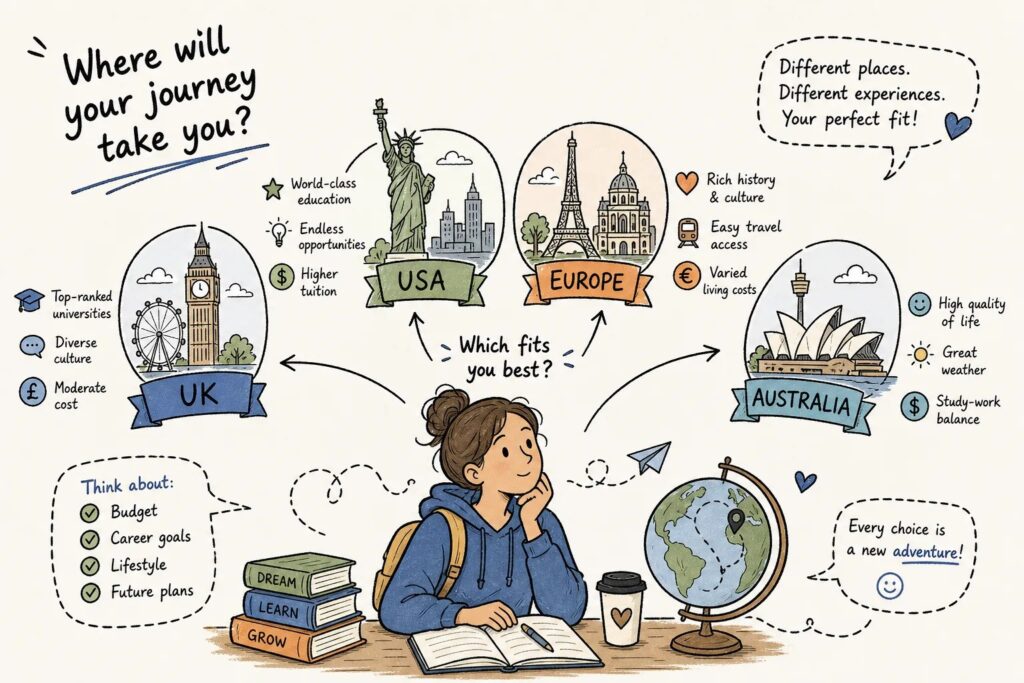
Most Pakistani students pick a study destination the wrong way. They follow a friend, chase a brand name, or go wherever the first consultant they met happened to have a partnership. The result is a mismatch between expectation and reality, sometimes discovered only after arrival.
The fix is not complicated: a proper study abroad destination comparison, done systematically across the factors that actually determine whether a destination suits you, cost, visa accessibility, scholarships, and post-graduation prospects. At MUSAFAT Student Consultants, we have spent years helping students in Gujranwala and across Punjab work through exactly this decision. In our experience, students who compare destinations methodically tend to build stronger applications, encounter fewer surprises, and arrive with clearer goals. This article gives you that framework across six destinations: the UK, USA, Finland, Turkey, Cyprus, and Germany.
Why the typical approach to picking a destination backfires
Chasing university rankings is the most common version of this mistake. A high global ranking tells you very little about whether a country’s student visa process is realistic for your academic profile, whether you can afford to live there without financial strain, or whether your degree leads anywhere meaningful after graduation. Rankings measure research output, not your personal outcome.
The single-factor trap shows up in other forms too. Students who focus only on tuition often miss the living costs that can double the real figure. Students who focus only on visa approval rates often end up in countries with no meaningful career pathway after graduation. Neither approach constitutes a genuine comparison of study destinations, both leave critical variables out.
A useful international student country comparison looks at four things in parallel: total cost including living expenses, visa accessibility from Pakistan, available scholarships, and post-study work rights. When these four factors are mapped together, a destination that looks expensive on tuition alone can become affordable once scholarship funding is applied. Equally, a destination that looks easy to enter can turn into a poor investment if there is no viable career path at the end.
Study abroad destination comparison: costs across six countries
Cost is almost always the first filter, and rightly so. But too many students look only at tuition, which is half the picture at best. The full cost of living for international students, including rent, food, transport, and insurance, can often match or exceed tuition over a full academic year. For context, country-specific research shows total yearly outlays ranging from roughly €12,000 in Germany to well above £40,000 in London.
Tuition fees by country
Germany, Turkey, and Cyprus represent the affordable end of this study abroad destination comparison. Germany’s public universities charge little to no tuition for international students, with semester contributions typically between €150 and €400. Turkey and Cyprus offer tuition ranging from approximately $3,000 to $8,000 per year at private institutions, figures that broadly reflect advertised fee schedules at representative universities in both countries, though you should confirm current rates directly with each institution.
Living costs
Finland sits in the middle ground. After eliminating free tuition for non-EU students in 2017, Pakistani applicants now pay between €6,000 and €18,000 annually depending on the programme and university. Living costs outside Helsinki are manageable at roughly €900 to €1,200 per month, and institutional scholarships can substantially reduce the tuition burden. Student living costs in Turkish cities such as Ankara and Istanbul, and in Cypriot cities such as Nicosia and Famagusta, remain modest compared to Western European capitals.
Typical yearly budget by destination
The UK and USA occupy the premium end. UK undergraduate tuition for international students runs from £12,000 to £38,000 per year, and London living costs reach £1,300 to £1,800 per month, pushing total annual expenditure well above £40,000. The USA is comparable or higher: private university tuition can reach $60,000 per year, with New York living costs adding another $2,400 to $3,500 monthly. Both countries are financially viable, but only with a clear and verified funding plan in place before you apply.
Study abroad destination comparison: visa routes and real difficulty
Visa difficulty is not just about paperwork. It is about the probability of approval given your specific academic profile, financial standing, and ties to Pakistan. Some destinations are unforgiving of documentation gaps; others are more contextual in their assessment.
The UK and USA require the strongest documentation. The UK Student Visa requires a Confirmation of Acceptance for Studies (CAS) from a licensed sponsor institution, an approved English language test at the relevant CEFR level, many programmes expect IELTS around 6.0 to 6.5, though requirements vary by course and sponsor, so always check the institution’s conditions, and proof of funds held in your account for 28 consecutive days. As of 2026, UK visa refusal rates for Pakistani applicants sit at around 41%, which is significant by any measure. Strong documentation and coherent reasoning that connects your academic background to your chosen course are non-negotiable.
The USA’s F-1 visa demands demonstrated financial self-sufficiency, a credible academic purpose, and convincing evidence of intent to return to Pakistan after graduation. The consular interview is where many Pakistani applications fall apart, not due to dishonesty, but due to vague or inconsistent answers. Thorough preparation matters far more than most applicants realise.
Turkey and Cyprus operate considerably more accessible visa processes for Pakistani nationals. Documentation requirements are generally less intensive, and private universities in both countries tend to maintain higher acceptance rates; confirm the precise documentation list with the relevant consulate before applying. Finland’s student visa, processed through the Finnish Immigration Service (Migri), is considered moderately straightforward provided you hold an unconditional admission letter, proof of funds, and valid health insurance. Germany is methodical: a blocked bank account holding at least €11,208, a confirmed admission letter, and health insurance are the core requirements. The process is predictable once you understand it fully.
Scholarships Pakistani students can realistically access
Scholarships change the financial equation entirely. The challenge is knowing which ones are worth your time and which are largely inaccessible given your profile.
For the UK, the Chevening Scholarship covers full tuition, living costs, and return flights for one-year Master’s programmes and is open to Pakistani applicants with relevant work experience. For Germany, the DAAD operates HEC Pakistan partnerships for postgraduate and PhD study. For the USA, the Fulbright Programme covers full Master’s and PhD costs and is one of the most competitive yet most accessible government-funded routes available to Pakistani students. Finland’s institutional scholarship schemes, administered by universities such as the University of Helsinki and Tampere University, offer 50% to 100% tuition waivers; Tampere’s Global Student Award also provides €7,000 per year towards living costs, making it a rare option that covers both.
Beyond government schemes, merit-based university awards are available across all six countries. At some private universities in Cyprus and Turkey, tuition reductions of 25% to 75% are available to international students with strong academic records. These awards are not always prominently advertised, so it is worth enquiring directly with the admissions office of each institution you are considering.
Matching funding to your academic profile matters more than chasing the most prestigious scholarship on the list. A student with strong STEM grades is better positioned for a DAAD or Fulbright application. A student with a business or social science background may find more practical value in a merit-based award from a Cypriot or Turkish institution. Identifying which scholarships are realistic for your specific profile is precisely where experienced guidance makes a tangible difference.
Post-graduation work rights: what comes after your degree
Where you study determines what happens immediately after graduation. This factor is consistently underweighted during the excitement of the admissions process, yet it has a direct bearing on whether the overall investment pays off.
The UK currently offers a two-year post-study work visa known as the Graduate Route, which requires no job offer to activate. From January 2027, this reduces to 18 months for Bachelor’s and Master’s graduates, though PhD holders retain three years. Transitioning to long-term residency requires securing a Skilled Worker Visa and completing five years of skilled employment. The route exists and works, but it is not automatic and it is becoming more competitive.
Germany offers one of the clearest post-study pathways in this comparison. The 18-month job-seeker permit allows graduates to remain in Germany while searching for employment. Settlement Permit eligibility begins after 21 months of skilled work with a B1 German language level, or 33 months with A1. For the USA, the OPT programme grants one year of work authorisation, three years for STEM fields, on an F-1 visa, but transitioning to long-term residency requires employer H-1B sponsorship, which involves a lottery system and significant waiting periods.
Finland offers a one-year job-seeker permit with active graduate recruitment in technology, engineering, and healthcare. Turkey and Cyprus offer regional career experience and networking opportunities within local markets. Crucially, neither country currently provides an automatic post-study work visa; graduates generally require employer sponsorship to remain and work, which limits their value as a gateway to international careers. For students seeking affordable education followed by regional employment, both are practical destinations. For students focused on global career mobility, they are better understood as a first step rather than a final destination, offering accessible entry and lower costs at an earlier stage of the funding journey, with the understanding that onward mobility will require additional planning.
Quick comparison: six destinations at a glance
| Country | Est. Annual Cost (Tuition + Living) | Visa Difficulty (Pakistani Applicants) | Key Scholarships | Post-Study Work Rights |
|---|---|---|---|---|
| UK | £30,000, £55,000+ | High (~41% refusal rate) | Chevening, university awards | 2 yrs (reducing to 18 months from Jan 2027) |
| USA | $45,000, $90,000+ | High (interview-dependent) | Fulbright, university aid | 1, 3 yrs OPT; H-1B lottery thereafter |
| Germany | €12,000, €15,000 | Moderate (structured requirements) | DAAD, HEC partnerships | 18-month job-seeker permit; clear PR pathway |
| Finland | €17,000, €30,000 | Moderate (Migri process) | Tampere Global Student Award, university waivers | 1-yr job-seeker permit; active tech/engineering recruitment |
| Turkey | $8,000, $18,000 | Lower (accessible process) | Institutional merit reductions (25, 75%) | Employer sponsorship required; no automatic route |
| Cyprus | $9,000, $20,000 | Lower (accessible process) | Institutional merit reductions (25, 75%) | Employer sponsorship required; no automatic route |
Figures are indicative ranges drawn from representative university fee schedules and cost-of-living data. Verify current rates with institutions and official government sources before applying.
How to build your personal shortlist from this study abroad destination comparison
This comparison gives you data. What follows is a way to use it. Ask yourself four questions in sequence: What is my realistic annual budget, including living costs? What is my current English language test score and academic profile? What field am I studying, and where are the strongest graduate outcomes for that field? What does my five-year career plan look like after graduation?
Map your answers against the six destinations. Germany and Turkey lead on cost. The UK and USA lead on prestige and career networks. Finland and Cyprus sit in the middle on both dimensions. The right answer varies by person, not by trend, and not by what the most popular choice in your city happens to be this year.
If you have faced a prior visa refusal, your shortlisting process needs to account for that directly. It does not close doors, but it does require a more careful documentation strategy and, in some cases, a different destination sequence. At MUSAFAT Student Consultants, we work through post-refusal cases with students across Punjab. The framework in this article is a solid starting point. For a personalised assessment of your profile, a one-to-one consultation can help you move from months of uncertainty to a clear, viable application plan, get in touch to book your free session.
The right destination fits you, not the current trend
No destination is universally the best, lists of the best countries to study abroad rarely tell the whole story. The UK offers prestige and post-study work rights. Germany offers affordability and a structured residency pathway. Finland offers quality education with scholarship access. The USA offers career networks that are difficult to match anywhere else. Turkey and Cyprus offer accessible entry and affordable costs for students at an earlier stage of their funding journey.
What makes a destination right for you is how well it aligns with your budget, your academic record, your field of study, and your career goals. Use this study abroad destination comparison as a filter, not a ranking. Shortlist two or three destinations, verify your eligibility for each, and begin your scholarship search before your applications go in. The students who make this decision well are the ones who made it deliberately, not by default.