
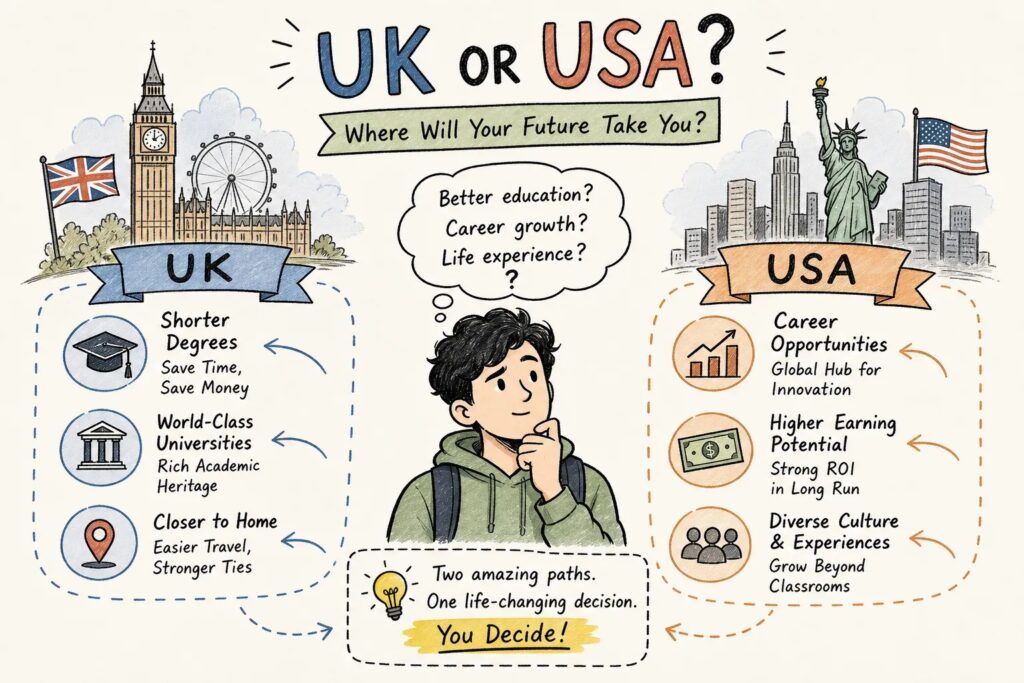
UK vs USA.Many Pakistani students frame this as a prestige question. UK or USA? Russell Group or Ivy League? It sounds like a comparison of ambitions, but it is actually a comparison of strategies. The right destination depends on what you need your degree to do: finish quickly, cost less, survive a visa process, or open a specific career door after graduation. If you are weighing whether to study in the UK or the USA from Pakistan, this guide walks through costs, visa routes, post-study work rights, and scholarships so you can make a decision grounded in your actual situation rather than someone else’s ranking table.
Both destinations are genuinely strong. Choosing between them is not about picking the more impressive name. It is about matching your academic profile, your budget, and your post-graduation plan to the destination that actually delivers. At MUSAFAT Student Consultants, we have been guiding Pakistani students through exactly this decision since 2004. What follows is the honest breakdown we walk through with every student who sits across from us.
Study UK or USA from Pakistan: what you will actually spend
UK tuition and living costs in 2026
For Pakistani students at UK universities in 2026, annual tuition typically falls between £12,000 and £20,000 for a Bachelor’s degree, and £12,500 to £25,000 for a Master’s. Living costs add £12,000 to £14,000 annually outside London, or £15,000 to £18,000 if you are based in the capital. International fees for the 2026/27 academic year have risen by approximately 7%, and a new £925 levy has been introduced, so budget planning needs to account for these increases.
US tuition and living costs in 2026
In the USA, public out-of-state universities charge $25,000 to $45,000 in tuition annually, while private non-profit institutions run from $48,000 to $78,000. Add living expenses and the total annual cost lands between $35,000 and $90,000 depending on university and city. At current exchange rates of approximately 278 to 280 rupees per US dollar (as of mid-2026), that translates to PKR 9.7 million to PKR 25.2 million per year. Before you even enrol, SEVIS and visa fees add another $1,500 to $2,000 upfront.
The real cost question: duration matters
Annual figures tell only half the story: a UK Master’s programme typically completes in one year, whereas a comparable US programme takes two. Even if the annual costs appear similar on paper, the total expenditure can be double in the USA once you account for the additional year of tuition and living expenses. For a Pakistani family managing education finances across international exchange rates, that distinction is not a footnote. It is often the deciding factor.
Admission requirements and English language scores
What UK universities expect from Pakistani applicants
UK undergraduate admissions run through UCAS. Universities typically accept A-Levels, FSc equivalency, or equivalent qualifications. English proficiency requirements sit at IELTS 6.0 to 6.5 for most programmes, with top universities and Russell Group institutions requiring 6.5 to 7.0. The process follows a clear sequence: apply, receive an offer, receive your CAS (Confirmation of Acceptance for Studies), then apply for the visa. It is structured and comparatively straightforward.
What US universities expect
US admissions are considerably more layered. Undergraduate applicants need SAT scores, personal essays, letters of recommendation, and often a documented extracurricular profile. Graduate applicants may need GRE or GMAT scores, though many programmes dropped these requirements post-pandemic. TOEFL scores of 80 to 100 iBT, or IELTS 6.5 and above, are standard. The application cycle is longer and significantly more document-heavy than its UK equivalent.
IELTS vs TOEFL: which to prioritise
Most Pakistani students prepare for IELTS, and for good reason: it is accepted by both UK and US universities, making it the more flexible investment. TOEFL remains strongly preferred by many US institutions, particularly at the postgraduate level. For applicants targeting only the USA, TOEFL preparation may yield a better result. Those keeping both options open will generally find IELTS the safer and more versatile choice.
Visa routes: UK Student Route vs US F-1
How the UK Student Route works for Pakistani applicants
The UK Student Route does not require an in-person interview. Once you have your CAS, you apply online, submit a TB test certificate from a UKVI-approved clinic in Pakistan, and demonstrate that you have held sufficient maintenance funds for 28 consecutive days: £1,136 per month outside London, or £1,483 per month in London. The visa application fee is £524 (as listed on the UK Visas and Immigration fee schedule), payable separately from the Immigration Health Surcharge. Decisions typically take around three weeks. When documentation is in order, the process is well-structured and relatively transparent.
How the US F-1 visa process works
The F-1 visa requires an I-20 from your US institution, documented proof of financial ability to cover the full cost of attendance, payment of the SEVIS fee, and an in-person interview at the US Embassy in Islamabad or Karachi. Pakistani applicants face heightened scrutiny historically, and administrative processing times can extend well beyond the initial interview. The interview itself is the critical point: officers assess whether the applicant has genuine ties to Pakistan and a credible intent to return after graduating.
What most visa refusals come down to
For both routes, the most common refusal reasons are weak financial documentation, inability to articulate study intent clearly, and inconsistencies between the application and supporting documents. According to analyses of Home Office data, the UK Student Route refusal rate for Pakistani applicants surged to approximately 39 to 41% in early 2026, up from around 11% in 2025, driven by a tightened compliance regime, though full official 2026 statistics are not yet published. Based on available estimates from US Embassy reporting, the F-1 rejection rate for Pakistani applicants has hovered around 65 to 71% in recent years; these figures are estimates rather than officially published rates. In both cases, professional legal guidance, not just general consultancy, makes a concrete difference to how a file is prepared and presented. At MUSAFAT Student Consultants, visa files are built with the rigour of immigration law practice. The founder holds advocacy credentials at High Court level and has received US immigration law training. That legal foundation means your application is constructed to withstand scrutiny from the outset.
Post-study work rights and long-term career pathways
UK Graduate Route: what you get (and what is changing)
After completing your degree, the UK Graduate Route gives you two years of unrestricted work rights for Bachelor’s and Master’s graduates, and three years for PhD graduates. No job offer is required, no employer sponsorship, and you can work in any sector. However, a critical change takes effect from 1 January 2027: for applications made on or after that date, the post-study work period for Bachelor’s and Master’s graduates reduces to 18 months. If you are planning to use the Graduate Route, applying for September 2026 entry keeps you under the current two-year rule.
US OPT and the H-1B lottery
After graduating in the USA, you receive Optional Practical Training (OPT): one year for non-STEM fields, three years for STEM programmes. During that window, you need an employer willing to sponsor your H-1B visa. The H-1B has an annual cap and a lottery system. In FY 2026, the selection rate improved to approximately 35%, up from 26% in FY 2025, but this still means roughly two in three registrations are not selected. If you are not selected, you must leave the USA unless you secure an alternative visa pathway. That is a significant variable to carry into a career plan.
Which destination offers more certainty post-graduation
The UK Graduate Route, under current rules, offers near-certain access to two years of work for eligible graduates. The US OPT offers a longer window for STEM graduates but introduces genuine lottery uncertainty at the H-1B stage. For Pakistani students who want a reliable post-study work pathway in 2026, the UK is the lower-risk option. If long-term US residency is the goal, the lottery-dependent pathway is a trade-off you need to accept going in.
Scholarships available for Pakistani students in 2026
Major UK scholarships: Chevening, GREAT, and university awards
The Chevening Scholarship provides full funding: tuition, approximately £18,000 in living allowance, and flights for postgraduate study. It requires two or more years of work experience and a commitment to return to Pakistan for two years after graduating. The GREAT Scholarships are more accessible, offering £10,000 to £15,000 in tuition reductions at participating universities for one-year Master’s programmes. Individual universities including Manchester, Newcastle, Birmingham, and Cardiff offer Pakistan-specific awards ranging from £5,000 to £15,000, making partial scholarship stacking a realistic strategy for many applicants.
Major US scholarships: Fulbright and USEFP programmes
The Fulbright Program, administered in Pakistan through USEFP, is the flagship fully-funded option. It covers tuition, a monthly stipend, health insurance, and return flights for Master’s and PhD study. The Global UGRAD programme covers one semester of undergraduate exchange. US university merit scholarships exist but are highly competitive and rarely cover full costs for international students without a Fulbright-level award. For most Pakistani students without Fulbright funding, the USA remains significantly more expensive than the UK even after partial scholarship reductions.
How funding changes your destination decision
If you secure Chevening or Fulbright, the cost comparison largely disappears, both fully-funded programmes make their respective destinations financially viable. For students who do not qualify for fully-funded awards, partial UK scholarships combined with a one-year programme duration often make the UK the more financially manageable destination in real terms. A common partial-scholarship scenario would be a £10,000 GREAT award applied to a £20,000 tuition fee, leaving a net annual cost well below the equivalent self-funded US option even before living expenses are factored in.
Study UK or USA from Pakistan: how to decide what is right for you
Map your decision against four honest questions:
- What is your total budget per year? If it is below £30,000 (use a current GBP-to-PKR conversion rate when planning, as exchange rates shift), the UK is a more realistic option for most programmes as an illustrative benchmark.
- What is your programme length preference? If you want to finish a postgraduate degree in 12 to 15 months, the UK is the clear answer.
- How strong is your financial documentation? The US F-1 requires demonstrating full cost of attendance, often $50,000 to $80,000, in accessible funds.
- What is your post-study goal? Flexible work experience or a long-term pathway to US residency? Your answer to that last question changes everything else.
Visa strategy is not something to leave to guesswork or a quick online comparison. Choosing between the UK Student Route and the US F-1 based on your academic profile, financial documents, and study history requires someone who understands immigration law, not just admission procedures. The two are not the same thing, and the difference shows up precisely when a file is under scrutiny.
There is no universally right answer here
The UK and USA are both legitimate, high-quality study destinations for Pakistani students. The difference is not prestige. It is fit. Budget, timeline, visa risk appetite, and post-graduation plans all point toward different conclusions for different students. Start from your actual constraints, work backwards to which destination serves them, and resist the temptation to let a university’s global ranking make the decision for you.
For Pakistani students still weighing whether to study in the UK or the USA, the visa and eligibility side of this comparison is often where clarity matters most. At MUSAFAT Student Consultants, we have been navigating these decisions since 2004, and the honest conversation about which destination actually works for your profile is where we start. Reach out to us in Gujranwala, or get in touch online, before you commit to either route.