
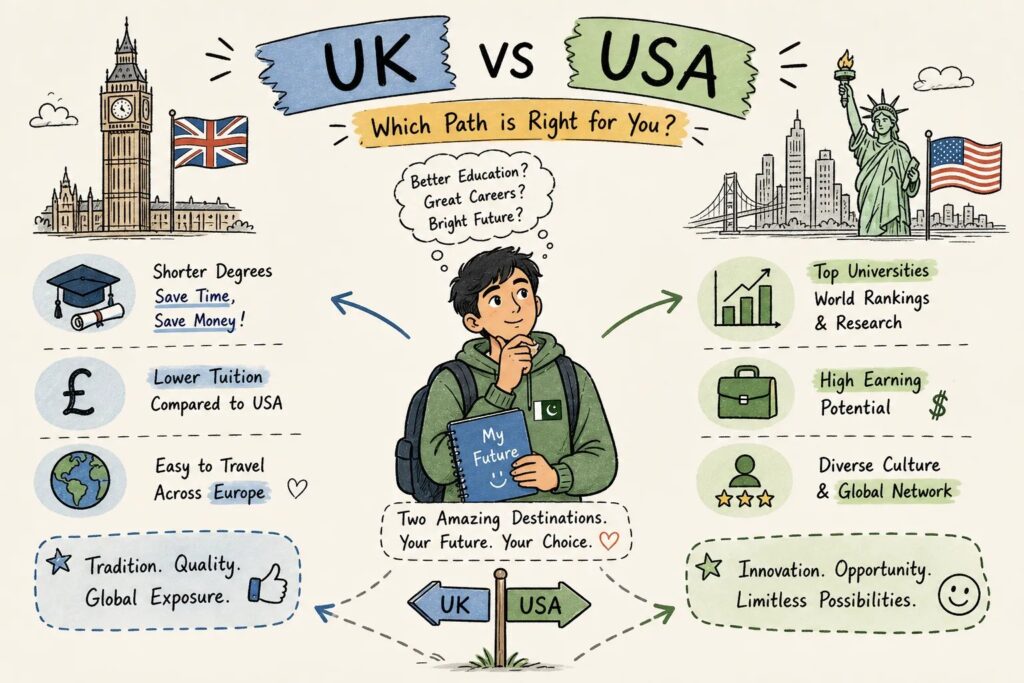
UK vs USA, which is better for international students from Pakistan? It is the question that lands on our desk at MUSAFAT Student Consultants every single week. Both are legitimate, life-changing choices. But they are not interchangeable, and what works brilliantly for one student can be entirely the wrong call for another.
We have been guiding Pakistani students to both destinations since 2004. What you will read here is grounded in over two decades of real case work, not brochure copy or generic rankings. By the end, you will know how the two countries compare on tuition costs, student visas, scholarships, and post-graduation work rights, and you will have a clear sense of which one fits your specific situation.
Tuition and living costs: where does your money actually go further?
The annual fee comparison is straightforward enough. UK international undergraduates typically pay £12,000 to £25,000 per year, and postgraduates pay £13,000 to £28,000 per year at most institutions. US public universities charge international students $25,000 to $48,000 per year, while private universities range from $35,000 to $78,000, with elite schools pushing well past that. On an annual basis, the UK looks cheaper for most subjects.
But annual fees are the wrong unit of comparison for postgraduate students, and this is the number most guides miss entirely. A UK-taught Master’s takes 12 months. A US MS typically takes two years. Even if the annual fee difference were small, the total programme cost for a UK MSc can be half that of a US MS. For a family in Pakistan financing this from savings or a loan, that one-year difference often decides the matter before anything else is discussed. When weighing up the UK vs USA for international students from Pakistan, this 1-year MSc UK vs 2-year MS USA distinction is frequently the most decisive financial factor on the table.
Living costs follow a similar pattern. Outside London, a student in a UK city like Manchester or Birmingham spends roughly £950 to £1,250 per month on rent, food, and transport. London pushes that to £1,400 or more. In the US, regional cities like Chicago or Atlanta cost $1,200 to $2,000 per month, while New York or Boston can reach $2,200 to $3,500. One practical detail that often gets overlooked: car-dependent cities, think suburban Atlanta, large parts of Texas, or most mid-sized Midwestern campuses, add roughly $200 to $300 per month to your budget, a cost that a UK student card and city metro typically replaces. That is not a universal rule, but it applies often enough to factor into your planning.
Student visa UK vs F-1 visa USA: which process is more forgiving for Pakistani applicants?
The UK Student Visa process is procedurally predictable. You receive a CAS (Certificate of Acceptance for Studies) from your university, prove that you have held the required funds in your account for 28 consecutive days, complete a TB test at an approved clinic, and attend a biometrics appointment. There is no interview. Under standard processing, a decision comes in roughly three weeks. The main reasons Pakistani applications get refused are well-documented: funds not held long enough, a CAS with errors, or a course that does not logically follow from the applicant’s academic history. These are avoidable problems with proper preparation.
The US F-1 visa is a different exercise entirely. It requires an in-person interview at the US Embassy in Islamabad, and appointment slots can take weeks to months to secure. After the interview, most visas are issued within three to five days, but administrative processing, security checks, can extend that to 60 days or more with no guarantee of an outcome. Pakistani applicants should plan for a three to six month lead time before their course start date.
The core challenge with the F-1 is Section 214(b) of the US Immigration and Nationality Act. Applicants are presumed to be potential immigrants and must convince the visa officer that they will return to Pakistan after completing their studies. Vague study plans, unconvincing financial evidence, and weak ties to Pakistan are consistently cited refusal triggers. A student with a clean academic record and a clear career rationale can present a strong case, but it requires preparation that goes well beyond assembling documents.
Scholarships in 2026: what is genuinely available for Pakistani students?
The UK has structured, named government schemes specifically open to Pakistani nationals. The Chevening Scholarship, funded by the UK Foreign, Commonwealth and Development Office, is fully funded and covers tuition, flights, and living expenses. It targets mid-career professionals with at least two years of work experience. Pakistan consistently produces successful Chevening scholars, and it remains one of the most credible fully funded routes available to Pakistani applicants. The Commonwealth Scholarship is similarly fully funded, aimed at Master’s and PhD students, and requires a 2:1 degree and demonstrated financial need.
For those who do not meet the Chevening work experience requirement, the GREAT Scholarship offers £10,000 towards tuition on a one-year postgraduate course. Several UK universities, including Glasgow Caledonian, the University of Birmingham, and Leeds Trinity, also offer partial scholarships of £2,500 to £4,000 specifically for Pakistani students. These are not life-changing sums on their own, but combined with a shorter programme, they make a real dent in the total cost.
The US scholarship picture is fundamentally different for Pakistani students. There is no major US government scholarship programme that targets Pakistani nationals for study in the USA in the way Chevening or the Commonwealth scheme does. The Rhodes and Gates Cambridge scholarships you may have heard of are for study at Oxford and Cambridge respectively, not US universities. For US study, Pakistani students must apply directly to individual universities for international merit awards. Top private institutions such as Harvard, MIT, and Princeton offer need-blind admissions with generous aid packages, but published acceptance rates at these schools sit well below 10%. At mid-tier US universities, partial fee waivers of $5,000 to $15,000 are realistic; full funding is possible but requires exceptional academic credentials and a strong application.
Post-study work visa UK vs OPT USA: who gives you more runway?
The UK Graduate Route currently allows Bachelor’s and Master’s graduates two years of open work permission after graduation, with no employer sponsorship required during that period. PhD graduates receive three years. This has been one of the most popular features of UK study for Pakistani graduates. After the Graduate Route ends, graduates can switch to a Skilled Worker visa if they secure a sponsored role, with a current general salary threshold of £41,700.
There is a time-sensitive detail that affects your planning right now. The Graduate Route change is tied to your application date, not your start date. Applications submitted on or after 1 January 2027 will receive only 18 months for non-PhD graduates. To illustrate: if you start a one-year UK Master’s in September 2026, you will typically graduate in autumn 2027 and apply for the Graduate Route after that point, which means your application falls after the 1 January 2027 cutoff, and you would receive 18 months rather than two years. If you are weighing up the UK vs USA as an international student from Pakistan, this distinction is worth factoring into your timeline now. Students targeting the January 2027 intake face the same calculation. This is not a reason to avoid the UK; it is a reason to plan carefully and move without unnecessary delay.
The US works differently, and the outcome depends heavily on your field. Standard Optional Practical Training (OPT) gives graduates 12 months of work authorisation after graduation. For students in designated STEM fields, a 24-month extension is available, bringing the total to 36 months. For non-STEM graduates, the comparison flips: 12 months of OPT is significantly less than the UK’s current Graduate Route. It is worth noting that UK PhD holders also receive 36 months under the Graduate Route, on a par with STEM OPT. For non-PhD STEM graduates, however, the US post-study work window is longer than what the UK currently offers. After OPT ends, transitioning to an H-1B work visa is possible but lottery-based and competitive; it is not something you can plan around with certainty.
UK vs USA: which destination fits your profile as a Pakistani student?
There is no universal verdict here, the right answer depends on your specific combination of budget, field, career plan, and visa history. Generic comparisons miss the variables that actually matter to your case. That said, clear patterns do emerge from the cases we handle.
The UK tends to be the better fit for Pakistani students in the following situations:
- Budget is a genuine constraint and you want to minimise total programme cost
- You are pursuing a non-STEM postgraduate degree and want a meaningful post-study work window
- Your visa history is clean and you prefer a simpler application process with no interview
- You are a mid-career professional who qualifies for Chevening
A student who wants to complete a Master’s, start earning in the UK, and build a career within two years of leaving Pakistan is often better served by the UK route.
The USA makes more sense in these circumstances:
- You are in a STEM field and the 36-month OPT window is central to your career plan
- Your academic profile is strong enough to attract a merit scholarship from a US university
- You are applying for a PhD with full funding and a stipend, US doctoral funding tends to be more widely available than at UK institutions
- Your target industry, technology, finance, or research, is predominantly US-based
The US is also the stronger choice if long-term settlement in North America is a genuine goal. The OPT-to-H-1B pathway, competitive as it is, exists as a defined route in a way that UK post-study options do not always replicate for every occupation.
Making this decision with confidence
Comparison guides are a useful starting point, but they only take you so far. A student with a prior visa refusal on record needs a different strategy than a clean-slate applicant. A business graduate and an engineering graduate face entirely different OPT and Graduate Route calculations. Your academic profile, financial capacity, chosen field, post-graduation plan, and visa history all feed into a decision that no generic article can make for you.
At MUSAFAT Student Consultants, we assess your academic history, budget, English test scores, and career goals before recommending a destination. Our founder, Majed Akbar, holds qualifications as an Advocate High Court and British Council Trained Agent, and has completed US immigration law training at the University of Pennsylvania. That legal background means we approach visa applications with a level of professional rigour that a standard consultancy typically cannot match. Whether you are starting fresh or rebuilding a case after a visa refusal, a one-on-one consultation saves you months of guesswork and avoids costly application errors.
The September 2026 and January 2027 intake cycles are the most relevant right now. The Chevening application window typically opens in August and closes in early November, check the official Chevening website for exact 2026, 27 cycle dates. GREAT Scholarships and university-specific awards open on varying timelines, so confirm deadlines directly with the institutions you are targeting. Early decisions on destination, university shortlisting, and English test preparation directly affect what options remain available to you.
The bottom line: UK vs USA, which is better for international students from Pakistan?
The UK offers lower total programme costs, a simpler student visa process, and solid post-study work rights under the current Graduate Route policy. The USA offers a larger job market, longer post-study authorisation for STEM graduates under OPT, and stronger research funding at doctoral level. If cost and visa ease are your priorities, the UK is the stronger fit for most Pakistani students. If STEM careers and long-term presence in North America are your goal, the US case is harder to argue against.
The worst outcome is choosing based on what a friend did or what a consultancy pushes without ever understanding your profile. Base this decision on your numbers, your field, and your plan. To get a clear answer for your specific situation, book a consultation with MUSAFAT Student Consultants and get a recommendation grounded in your actual profile.