
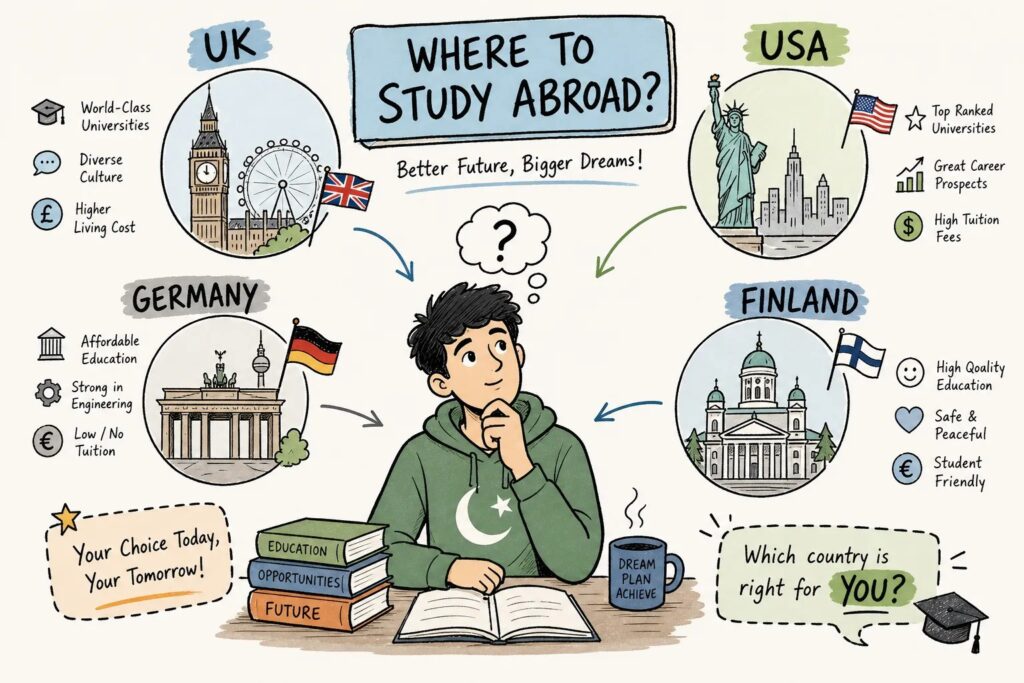
Four countries. Four completely different experiences for a Pakistani student. Same dream, but the price tag, visa process, and career outcome after graduation look nothing alike depending on which path you choose. Deciding between the UK, USA, Germany, and Finland for Pakistani students is not simply a matter of prestige, it requires a close look at actual fees, visa difficulty, scholarship access, and what happens after you graduate.
The wrong choice is not just a missed opportunity. It costs money your family may have spent years saving, and it costs you an intake cycle you cannot get back. A student who picks a country based on a YouTube video or a neighbour’s advice, without checking whether their profile, funds, and English score actually match, is setting themselves up for a refusal or a financial shock they were not prepared for.
At MUSAFAT Student Consultants in Gujranwala, we have been helping Pakistani families navigate exactly this four-way decision since 2004. The answer is never the same for every student. What this guide does is lay out the real numbers on tuition, scholarships, visa difficulty, living costs, and post-study work rights across the UK, USA, Germany, and Finland, so you can start matching the right country to your actual profile.
Tuition fees for Pakistani students in the UK, USA, Germany and Finland
One of these four countries charges international students nothing in tuition, and it is not the one most Pakistani families assume. Germany’s public universities levy zero tuition for almost all programmes. The only cost is a semester contribution of €150 to €350 for administration and student transport. The single exception is Baden-Württemberg state, where non-EU students pay €1,500 per year. That is still a fraction of what you will pay almost anywhere else.
UK and USA: prestige with a steep price tag
UK undergraduate fees for classroom-based programmes run from £15,000 to £22,000 per year. Engineering and laboratory-based degrees push to £30,000, and medicine or dentistry can exceed £58,000 annually. For a three-year bachelor’s degree, that is a serious financial commitment before you have even booked a flight. US public universities charge international students $25,000 to $35,000 per year for out-of-state tuition; private universities start at $40,000 and can reach $60,000 or more.
Germany and Finland: the affordable and the middle-ground
Germany at public universities is effectively free, making it the most underestimated option among Pakistani families. When it comes to studying in Finland for Pakistani students, the picture sits in the middle: non-EU students, who include Pakistanis, pay €6,000 to €15,000 per year for bachelor’s and master’s programmes. It is worth noting that many Finnish universities offer scholarship programmes that can reduce fees by 50% or 100%, institutions such as Aalto University and the University of Helsinki both run such schemes, though these awards are competitive and not guaranteed. If budget is the primary constraint, Germany and Finland are in a completely different category from the UK and USA.
Scholarships for Pakistani students abroad: what you can actually access
Most scholarship information online applies to “international students” broadly. Pakistani students face narrower eligibility windows and more competition than the headlines suggest. The other thing worth stating plainly: undergraduate scholarships are rare across all four countries. The majority of meaningful awards target master’s and PhD candidates.
The big fully-funded options and what they actually require
In the UK, Chevening covers full tuition plus living costs for a one-year master’s and is based on leadership potential rather than CGPA alone. Commonwealth Scholarships require a minimum 2:1 undergraduate degree and are similarly competitive. The GREAT Scholarship offers a £10,000 to £15,000 tuition discount rather than full funding, and the Bestway Foundation Scholarship covers £26,000 for science or technology master’s candidates with a financial need component.
For the USA, the Fulbright Programme administered through USEFP is the primary government grant for Pakistani students. It requires 16 years of education, a 3.0+ CGPA, and typically two or more years of work experience. Germany’s DAAD scholarship covers tuition where applicable, a monthly living stipend, travel, and insurance; it is globally competitive, not Pakistan-specific. In Finland, support comes from university-specific tuition waivers of 50% or 100% at institutions like Aalto and the University of Helsinki, but with no living stipend attached.
Where partial funding changes the calculus
A 50% tuition waiver in Finland brings annual fees down to €3,000 to €7,500, comparable to what some Pakistani students pay at private universities at home. Germany’s zero-tuition model means DAAD funding is commonly used to cover living costs and related expenses, making the full package genuinely sustaining. The honest reality is that most students will pay some costs themselves. The question is how much, and which scholarship reduces that burden the most for your specific profile and academic level.
Student visa requirements for Pakistani students: UK, USA, Germany, Finland
Visa difficulty is not just about assembling the right documents. It is about how much scrutiny your application will face and how long you will wait with your plans on hold. Pakistani applicants face specific challenges in each of these countries that go beyond what is written in official guidance.
UK and USA: high scrutiny, strict documentation
The UK Student Visa officially takes three weeks from biometrics. Pakistani applicants typically wait eight to twelve weeks due to additional checks and peak-season volumes. You need a CAS from a licensed university, a 28-consecutive-day funds hold of £1,020 to £1,330 per month depending on city, a TB test certificate mandatory for Pakistani nationals, and a Home Office-approved Secure English Language Test such as IELTS for UKVI. Financial documentation has been scrutinised more heavily in 2025 and 2026; the source of funds must be clearly established.
The US F-1 Visa requires a mandatory in-person interview at the embassy. Post-interview processing runs three to six weeks, but appointment wait times alone can exceed four to eight weeks during peak summer. The Form I-20 from your US university is the critical starting document. Consular officers scrutinise “intent to return” heavily, and this is the most common rejection reason for Pakistani applicants.
Germany and Finland: more process-driven than subjective
Germany typically takes four to twelve weeks, stretching to three or four months during the July to September peak. The biggest barrier for many Pakistani families is the blocked account requirement: €11,208 must be deposited before the application (this figure is reviewed annually by the German Federal Foreign Office, so confirm the current amount before applying). This upfront capital demand stops many otherwise strong applicants before they begin. Finland’s immigration service, Migri, processes applications in one to three months, occasionally four. You need €6,720 per year in a personal account, an admission letter, and health insurance with minimum €30,000 coverage.
The practical ranking by difficulty for Pakistani applicants: the USA is hardest due to the interview and intent scrutiny, the UK is strict with extensive documentation requirements, and Germany and Finland are more process-driven than subjective. A clean, well-documented application carries more weight in Berlin or Helsinki than in Washington.
Living costs and part-time work: what your money actually buys
Tuition is only half the story. Many Pakistani students underestimate how much living costs vary, not just across countries, but within a single city depending on where you rent.
In the UK, expect £850 to £1,050 per month in smaller cities like Sheffield or Hull, £1,000 to £1,300 in Manchester or Birmingham, and £1,400 to £1,900 in London. Rent accounts for 45 to 60% of total costs. For the USA, New York typically runs $3,500 to $5,800 per month while Boston sits closer to $2,300 to $3,000; smaller college towns are significantly more affordable. In Germany, Berlin averages around €950 to €1,400 per month, while Hamburg runs higher at roughly €1,200 to €1,600 and Munich higher still, all liveable given zero tuition. Finland costs €900 to €1,200 per month in Helsinki.
On part-time work: the UK allows up to 20 hours per week during term at a minimum of £11.44 per hour for students aged 21 and over. This covers food and transport but rarely full rent in major cities. US F-1 students are limited to 20 hours per week on campus with restricted off-campus access. Germany allows 120 full days or 240 half-days per year at €12 to €15 per hour; combined with zero tuition, the financial picture becomes genuinely manageable. Finland imposes no prescribed hourly cap on student working hours under the student residence permit, with typical earnings of €11 to €14 per hour, and the Finnish work culture is open to student workers in service and hospitality.
Post-study work: who gives you the best return after graduation
The post-study work landscape has shifted in 2026, and the window in one country in particular is closing quickly.
The UK’s Graduate Route currently offers two years of open work rights for bachelor’s and master’s graduates, three years for PhD holders. No employer sponsorship is required during this period. However, students who start courses from January 2027 onwards will likely receive only 18 months. September 2026 starters completing a one-year master’s will typically graduate in late 2027, after the January 2027 threshold, meaning they will receive 18 months rather than two years. PhD graduates are not affected by this reduction. After the Graduate Route, moving to a Skilled Worker Visa requires employer sponsorship and a minimum salary threshold.
The USA offers Optional Practical Training: one year for standard graduates, extended to three years only for STEM programme graduates. After OPT, you need an H-1B visa, which is employer-sponsored and lottery-based. This makes the US post-study pathway the most uncertain of the four. Germany provides an 18-month job-seeker visa with open work rights; once skilled employment is secured, permanent residency is achievable in as little as two years. Finland offers one year to find employment after graduation, but the Finnish job market is smaller and language skills give a real advantage in getting hired.
Which country actually fits your profile?
The data above is useful. But the right answer depends entirely on what a specific student brings: their CGPA, budget, field of study, English score, and where they want to be in five years. There is no single best country; there is only the best match for a specific profile.
- Budget is the primary constraint, strong academic record: Germany first, then Finland.
- Career outcome matters most, fees are manageable: UK for master’s entry, before the 2027 rule changes lock in the shorter work window.
- US career in STEM, strong proof of funds: USA, with a clear plan for the H-1B pathway.
- English-taught European education at moderate cost: Finland.
The mistake most students make is selecting a country based on prestige alone, without checking whether their CGPA, funds, or English score actually meets the visa threshold. A strong preference for the UK means nothing if the financial documentation cannot survive a Home Office review.
At MUSAFAT Student Consultants, this is exactly the work done before any application is filed: mapping a student’s academic profile, financial documents, and career goals against the visa requirements and scholarship windows of each destination. The founder is an Advocate High Court and British Council Trained Agent with US immigration law training from the University of Pennsylvania; visa preparation is therefore handled with legal rigour rather than guesswork. For Pakistani students in Gujranwala and across Punjab, that kind of honest, profile-specific evaluation is the difference between a successful application and a wasted intake cycle.
The decision comes down to three questions
The UK, USA, Germany, and Finland each serve a different type of student. Germany is the financial standout. The UK is the most immediate opportunity for those who can act now. The USA is the long game for STEM graduates who can navigate the H-1B system. Finland is the quiet middle path for those who want European education without the extremes of either cost or competition.
Three questions cut through the noise: what can you afford, what does your visa profile actually look like, and where do you want to be in five years? The September 2026 and January 2027 intakes are the immediate windows. For students eyeing the UK specifically, timing has become a real strategic factor.
If you are weighing up the UK, USA, Germany, or Finland as Pakistani students often do at this stage, the most useful next step is an honest read of what your documents can actually support right now. Contact MUSAFAT Student Consultants for a free profile evaluation. No generic advice. Just a clear assessment of your options based on what you actually have on paper.