
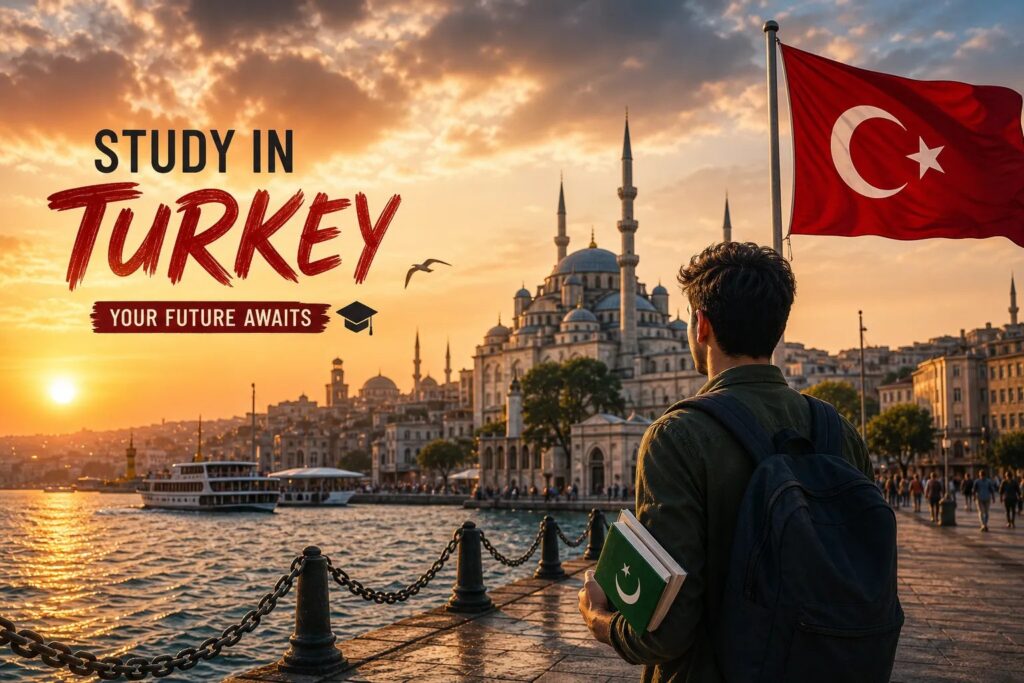
For Pakistani students weighing their options abroad, the opportunity to study in Turkey stands out as one of the most practical and affordable paths available in 2026. Turkey has grown steadily in popularity as a study destination among Pakistani students, sitting alongside Cyprus and Georgia as a credible, affordable alternative to the UK or USA. Unlike many emerging destinations, Turkey brings something genuinely useful to the table: internationally recognised degrees, a significant Muslim community, English-taught programmes at reputable institutions, and a major fully funded government scholarship programme in Türkiye Bursları.
At MUSAFAT Student Consultants in Gujranwala, we have seen a marked and consistent rise in enquiries for Turkey applications over the past two years. The driver is straightforward: Western university costs have climbed well beyond what most Punjab families can absorb, and Turkey offers a credible, fully developed alternative at a fraction of the price. This guide covers everything you need for 2026 and 2027: which universities to target, what scholarships exist, what it genuinely costs to live and study there, how to get your Pakistani documents recognised, and how to secure your student visa.
Why Turkey is pulling Pakistani students away from other destinations
The cost reality is stark. Public university tuition in Turkey starts at roughly $500 to $1,600 per year for English-taught programmes, compared to £10,000 to £20,000 in the UK and $9,000 to $15,000 in Cyprus for similar degrees. Over four years, that gap is not a minor saving. It is the difference between a manageable family investment and a financial burden that follows a graduate home. Georgia sits slightly cheaper than Turkey at the budget end, around $3,500 to $6,000 annually at public universities, but Turkey’s institutional prestige, scholarship infrastructure, and programme breadth make the marginal cost difference worth it for most students.
Beyond cost, Turkey works practically for Pakistani students in ways that often go unspoken. Halal food is widely available across all major cities, well-established Pakistani communities exist in Istanbul and Ankara, and the cultural environment shares enough common ground, in terms of religion, social norms, and dietary practice, that the transition is considerably smoother than moving to a Western country. Language outside campus and administrative processes will still require adjustment, but English-taught programmes eliminate the academic language barrier. Türkiye Bursları recipients also receive a free one-year Turkish language course as part of their scholarship package. The time zone (UTC+3) is practical for staying connected with family back home.
Study in Turkey for Pakistani Students: Top Universities and Programmes
Public universities: strong academics, lower fees
The leading public institutions Pakistani students target are Boğaziçi University, Istanbul University, Middle East Technical University (METU), Istanbul Technical University (ITU), and Ankara University. METU is Turkey’s top-ranked public university at QS World Rank 269 in 2026 and teaches all programmes in English, making it a strong target for engineering and sciences applicants. Boğaziçi (QS 371) and ITU are similarly rigorous and competitive. Public university tuition for international students in English-taught programmes ranges from approximately $240 to $8,500 per year, with arts and social sciences at the lower end and medicine or dentistry at the top. Admission to METU and Boğaziçi requires strong academic marks and a competitive YÖS score, so these are not fallback options.
Private universities and English-taught degrees
Private universities such as Koç (QS 323), Sabancı (QS 404), and Bilkent (QS 415) offer a wide range of English-medium programmes and are more accessible for international applicants who may not qualify for top public institutions. Istanbul Aydın University is another private option worth considering for its broad English-medium programme portfolio, though it sits outside the top QS bracket. Tuition at private institutions runs from $4,000 to $27,000 per year depending on the programme, with engineering, business, and health sciences at the higher end. Many private universities offer merit-based partial scholarships of 25% to 50% tuition reduction, applied for separately after receiving an admission offer.
Students who do not qualify for METU or Boğaziçi on YÖS scores are not out of options. A private university with a merit scholarship can still deliver strong academic value at a manageable cost.
YÖS exam Turkey: what Pakistani applicants need to know
The YÖS (Foreign Student Exam) is required by most public Turkish universities and tests mathematics and logical reasoning across 80 to 100 multiple-choice questions over 90 to 120 minutes. Some universities accept SAT scores in lieu of YÖS. There are currently no official YÖS test centres in Pakistan, which means most Pakistani students either travel to Turkey or a neighbouring country to sit the exam, or apply to universities that accept SAT.
Registrations for university-specific YÖS exams open between January and March, with exams held between April and June. Minimum accepted scores at major public universities typically range from 65 to 75, with engineering and medicine requiring 70 or above. Starting YÖS preparation at least six to twelve months before your intended intake is one of the highest-leverage steps a Pakistani applicant can take.
Study in Turkey for Pakistani Students: Costs and Scholarships
Türkiye Bursları: full funding with no repayment obligation
Türkiye Bursları is the centrepiece of Turkey’s international education strategy, and for Pakistani students who qualify, it removes virtually every financial barrier. The scholarship covers 100% of tuition, a monthly living stipend (4,500 TL for undergraduates, 6,500 TL for Master’s students, and 9,000 TL for PhD students), university dormitory accommodation, health insurance, return flights, and a one-year Turkish language course. The scholarship carries no repayment obligation.
Eligibility by level: undergraduate applicants need a minimum of 70% marks and must be under 21; Master’s applicants require 75% or a CGPA of 3.0/4.0 and must be under 30; PhD applicants need the same academic threshold and must be under 35. The application window opens on 1 January each year and closes in mid-February, with interviews in April and May and programmes starting in September. Since the 2026 cycle has already closed, your next opportunity is January 2027.
Use the coming months to strengthen your academic profile, prepare your motivation letter, and complete your attestation chain so you are not scrambling when the window reopens.
HEC Pakistan and university-level funding options
The HEC Overseas PhD Scholarship funds Pakistani nationals for doctoral study at top-ranked foreign universities, including eligible Turkish institutions, and covers full tuition, a living stipend, and travel. The HEC Indigenous Scholarship supports Master’s-level study with partial funding. HEC deadlines are not fixed annually; they are announced through official notifications on scholarship.hec.gov.pk, so monitoring that portal regularly is essential. At the university level, Yildiz Technical and Istanbul Technical Universities both offer merit-based tuition reductions of 25% to 50% for international students, applied for separately after receiving an admission offer.
What it actually costs: tuition fees in Turkey for international students and living expenses by city
Public university tuition in English-taught programmes ranges from approximately $240 to $8,500 per year. Istanbul University arts programmes sit around $1,600 annually, Ankara University standard programmes cost $2,000 to $2,600, and medicine or dentistry at the higher end can reach $10,800. Private university fees span $2,000 to $27,000 annually, with mid-range business degrees typically falling between $5,000 and $8,000 per year.
Istanbul is the most expensive city, with realistic monthly costs of $1,000 to $1,700 covering government dormitory or shared accommodation, meals, transport, and personal expenses. Ankara is 30 to 40% cheaper, sitting at $700 to $1,050 per month, making it the preferred city for self-funded students on tighter budgets. Izmir is comparable to Ankara at around $650 to $1,000 monthly and offers a coastal lifestyle without Istanbul’s price premium.
Türkiye Bursları recipients receive free dormitory accommodation alongside the monthly stipend. Note that the TL stipend figures above are subject to exchange rate fluctuation; students should verify the current USD equivalent at the time of application, as the purchasing power of the stipend in dollar terms can shift meaningfully. Self-funded students should budget $800 to $1,200 per month in Ankara and $1,200 to $1,500 in Istanbul as a realistic working figure.
Application roadmap: documents, attestation, and visa steps
Getting your Pakistani degrees attested and recognised in Turkey
Pakistani degrees are not automatically accepted by Turkish universities. The Turkish Ministry of Education requires a Denklik (equivalence certificate), obtained through the portal edenklik.meb.gov.tr. The attestation chain for Pakistani applicants runs as follows: IBCC attestation for Matric and FSc or A-Levels, British Council verification for A-Levels, HEC attestation for bachelor’s degrees, then MOFA (Ministry of Foreign Affairs) attestation across all documents. All documents must subsequently be translated into Turkish by a sworn translator before submission. This process takes several weeks, so begin it well before your university application deadline, not after receiving your offer.
Step-by-step application process with current 2026 and 2027 timelines
Shortlist 5 to 10 programmes across public and private universities, then verify deadlines directly on each university portal. For Fall 2026, private university applications remain open until late October, while most public university deadlines have closed or are closing imminently. Spring 2027 applications open across most institutions between October and December 2026. Türkiye Bursları 2027 opens in January. Once you have your shortlist, register for YÖS or confirm SAT acceptance, compile your document package including diploma, transcript, passport, motivation letter, and language score, and submit via the university online portal with an application fee of $35 to $100. Upon receiving a conditional offer, pay your deposit and request your acceptance letter for the visa stage.
Turkey student visa requirements for Pakistani applicants
With your acceptance letter in hand, you apply for a D-type long-stay student visa at the Turkish Consulate in Islamabad or Karachi. Core documents required are:
- A valid passport with at least six months’ validity beyond your intended stay
- Your university acceptance letter
- Proof of financial means via bank statement or scholarship award letter
- A completed visa application form
- Biometric passport photographs (5×5 cm)
- Health insurance valid in Turkey
- Proof of accommodation for the first term
All academic documents must carry MOFA attestation. Postgraduate applicants should additionally include a CV and statement of purpose. Processing time is typically around 25 days, but apply six to eight weeks before your programme start date to allow for any document queries. Upon arrival, you must apply for a residence permit (ikamet izni) within 30 days, renewed annually for the duration of your studies.
Where specialist guidance removes the guesswork
Navigating attestation chains, YÖS registration, university shortlisting, and visa documentation simultaneously is precisely where many self-guided applicants stall or miss critical deadlines. At MUSAFAT Student Consultants in Gujranwala, Turkey admissions form part of our core service portfolio. We guide students from initial university selection through to pre-departure briefing, drawing on the procedural rigour of an immigration law practice at the visa stage. For families in Punjab who want structured, professional oversight rather than trial and error, working with a team that knows the Turkish admission cycle well can be the difference between securing a Fall 2026 seat and waiting another year.
Turkey is worth the preparation
Turkey offers Pakistani students a combination that is genuinely rare: internationally respected degrees, low to mid-range costs, a culturally familiar environment, and one of the world’s most comprehensive government scholarship programmes. The cost comparison with the UK or Cyprus is unambiguous. Four years at a Turkish public university costs a fraction of equivalent programmes in either destination, and Türkiye Bursları can bring that cost to zero.
The key is starting early. Türkiye Bursları 2027 opens in January, giving you roughly six months to build your application, sort attestations, and prepare a strong academic profile. If you are targeting private universities, Fall 2026 applications are still open through October, and Spring 2027 applications open from October onwards. Whether you apply independently or work with a consultancy like MUSAFAT Student Consultants that handles Turkey admissions as a core service, the path is entirely manageable, and for Pakistani students looking to study in Turkey, the preparation is well worth it.