
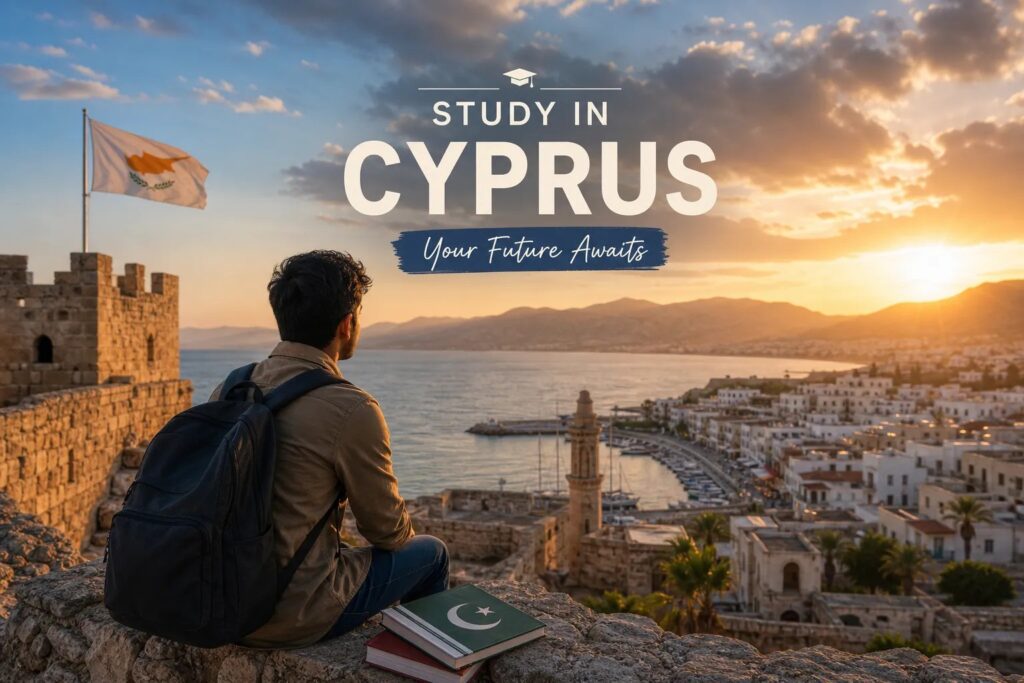
Cyprus rarely comes up when Pakistani families sit down to talk about studying abroad. The conversation usually lands on the UK, Germany, Turkey, or China. Cyprus gets skipped over. That is starting to change, and with good reason, and if you are researching how to study in Cyprus from Pakistan, this guide covers everything you need to make an informed decision.
The Republic of Cyprus is a full European Union member state. Degrees earned there are recognised under European qualification frameworks, tuition fees are generally lower than typical UK international tuition (often by a considerable margin), and the majority of private universities teach entirely in English. That combination is harder to find than it sounds. At MUSAFAT Student Consultants, our Gujranwala office has seen a measurable and consistent rise in Cyprus applications over the past several years, and this guide is built on that direct, first-hand experience. By the time you finish reading, you will know the universities to target, the real costs in PKR, how the student visa works, and what you need to do next.
Why Cyprus is gaining ground as a study destination for Pakistani students
Cyprus is not trying to compete with Turkey on price or China on volume. What it offers is something more specific: an EU-recognised degree in a country where English is the primary language of instruction at most private universities. For a Pakistani student who wants international credibility without the financial weight of studying in the UK or Germany, that is a real gap being filled.
Entry requirements are achievable. Most private universities accept an IELTS score between 5.5 and 6.0, and many will accept a Medium of Instruction (MOI) letter in place of IELTS altogether. That matters enormously for students who have completed their FSc or Intermediate and have not yet sat the exam. Undergraduate programmes are suited to students coming straight from matric or Intermediate; postgraduate programmes are designed for four-year bachelor’s degree holders.
Cyprus universities primarily operate two intakes: September (the main window with the broadest programme availability) and March (a secondary intake offered by most private institutions). For the September 2026 intake, some universities have already passed their standard deadlines, but some institutions do accept applications after their listed closing dates, always check directly with the admissions office before ruling out this window. European University Cyprus, for instance, runs a Fall intake starting in October with applications open until early September 2026. For students reading this in mid-2026, the March 2027 intake is a realistic and well-structured target.
Study in Cyprus from Pakistan, universities to target
Several universities consistently appear in the applications we process at MUSAFAT. Each has a distinct character worth understanding before you apply.
- University of Nicosia: One of the most prominent private universities in Cyprus, with strong programmes in medicine, business, technology, and health sciences. Widely recognised internationally.
- European University Cyprus: Research-oriented with a strong reputation in health sciences. Fall intake starts in October.
- Cyprus West University (CWU): Well-suited to business, engineering, and computer science applicants.
- UCLan Cyprus: The Cyprus campus of the University of Central Lancashire. UK-aligned degree programmes with strong brand recognition.
Universities in Northern Cyprus, including Eastern Mediterranean University, Near East University, and Cyprus International University, are popular for their affordability and generous scholarship waivers. However, Northern Cyprus degrees are accredited through Turkey’s YÖK system and are not recognised by the Republic of Cyprus or most EU countries. Before enrolling in any Northern Cyprus institution, verify degree recognition with the HEC and with the country where you intend to work after graduation. Republic of Cyprus degrees carry no such ambiguity.
On the academic side, undergraduate applicants need FSc or Intermediate with at least 50% marks; competitive programmes such as medicine or pharmacy require 60 to 70% or above. Postgraduate applicants need a four-year bachelor’s degree with a minimum CGPA of 2.5 out of 4.0. An SOP and attested academic transcripts are standard requirements across all institutions.
What studying in Cyprus actually costs in PKR
Using an approximate rate of €1 to PKR 317 (the mid-market rate as of mid-July 2026, sourced from XE.com), here is what the numbers look like. Check the State Bank of Pakistan or XE.com for the current EUR/PKR rate before finalising your financial plan, as exchange rates fluctuate.
Tuition fees by level
The ranges below reflect what Pakistani students typically encounter at Republic of Cyprus private universities:
- Undergraduate programmes: €3,000 to €8,000 per year (PKR 9.5 to 25.4 lakh)
- Postgraduate Master’s programmes: €4,000 to €12,000 per year (PKR 12.7 to 38 lakh)
- MBA programmes: €10,000 to €22,000 per year (PKR 31.7 to 69.7 lakh)
Most private universities, where Pakistani students typically enrol, charge between €7,000 and €12,500 for standard programmes.
Living costs
Living costs are the other half of the picture. Accommodation ranges from €250 to €800 per month depending on location and housing type. Nicosia and Limassol are pricier, with total monthly expenses running €700 to €1,100. Larnaca and Paphos are more manageable at €500 to €750 per month. Add food, utilities, and transport, and the total annual living cost lands at roughly PKR 19 to 42 lakh. Combined with tuition, a realistic annual budget for an undergraduate sits at PKR 28 to 67 lakh. These are honest figures, not optimistic ones.
Study in Cyprus from Pakistan: visa requirements and document checklist
The Cyprus student visa is a long-stay Type D entry permit. The process requires careful document preparation and correct sequencing. Getting either wrong is the most common reason applications stall.
Before you submit, you need:
- Valid passport with at least one year of validity from your intended arrival date
- University acceptance letter (some institutions require a partial tuition payment before issuing it)
- Bank statements for the last three to six months showing €7,000 to €12,000 in savings, along with a stamped bank letter issued within one month of application
- Attested academic certificates (processed through HEC first, then MOFA in Pakistan)
- Police Clearance Certificate issued within the last six months, apostilled or consularly attested
- Medical report covering HIV, Hepatitis B/C, Syphilis, and TB, valid within four months of your application date
- Health insurance covering Cyprus
- Proof of accommodation in Cyprus
- Tuition fee transfer receipt (no visa is issued without this)
- Four passport-size photographs with a white background
The timing requirements matter more than most students expect. The bank letter must be fresh, issued within one month of application. The medical report must be dated within four months. The attestation chain through HEC and MOFA takes time. Get these sequenced early or they will hold up the entire file.
For Republic of Cyprus universities, the submission process typically runs through your admitted university or the nearest Cyprus consulate, as the Republic of Cyprus does not maintain a visa-processing embassy in Islamabad. Confirm the submission channel directly with your university’s international admissions office once you receive your acceptance letter. After arrival in Cyprus, you must apply for a Temporary Residence Permit at the local Civil Registry and Migration Department within one month.
Scholarships and fee waivers: what is realistically available
Government-to-government scholarships for Cyprus are limited and run on annual cycles with mid-year deadlines and restricted seats. They are worth tracking but should not be the foundation of your financial plan. The more reliable route is university-based waivers, and these tend to be considerably more generous than most students realise.
University-based waivers
Cyprus International University (a Northern Cyprus institution, verify HEC recognition before applying) automatically offers international undergraduates a 50% tuition waiver, with merit awards up to 100% for strong academic profiles. Near East University (also Northern Cyprus) offers up to 100% for high-performing applicants. Cyprus Science University provides 70 to 80% waivers. These are not typically competitive grant processes; many are automatic upon admission or triggered by a straightforward form submitted alongside the application, though procedures vary by institution, so confirm directly with each university’s scholarship office.
Government and external funding
On the government side, the CyprusAid programme provides full tuition plus a stipend for students from developing countries including Pakistan, operating on an annual cycle with deadlines typically falling in June or July. The Cyprus State Scholarship Foundation offers €3,000 to €4,000 per year based on academic merit and financial need. Erasmus+ mobility grants are available if your home university in Pakistan holds a partnership with a Cypriot institution; apply through your home university. The strongest financial strategy combines a university-based waiver with one of these supplementary grants, rather than relying on either alone.
Your timeline and next steps for 2026 and 2027
For the September/October 2026 intake, the window is narrow but not closed. European University Cyprus accepts applications until early September 2026 for its October start. If you are reading this in mid-July, you need to move immediately: shortlist your university, request an offer letter, begin HEC and MOFA attestation (this takes longer than most students anticipate), and confirm your bank position. Visa applications typically take four to six weeks to process.
For the March 2027 intake, the timeline is more comfortable. Begin university shortlisting and document preparation between October and November 2026. Submit university and scholarship applications by November to December 2026. Submit your visa application in January 2027, allowing four to six weeks for processing before your programme start date.
The most common reasons Cyprus applications from Pakistan are delayed or rejected are incomplete attestation, insufficient bank balance documentation, and expired medical or police clearance certificates. The paperwork sequencing is the hardest part, not the universities or the visa itself. At MUSAFAT Student Consultants, our team in Gujranwala has processed Cyprus applications first-hand and has direct experience of where documents get rejected and how to prepare a file that holds up under consular scrutiny. Whether you apply independently or come to us for guidance, the approach is the same: start six months ahead, get the documents right from the beginning, and do not treat the process as simpler than it is.
If you plan to study in Cyprus from Pakistan, you are looking at a legitimate, underrated pathway to an EU-recognised degree taught in English, without the financial pressure of the UK. The visa is achievable, the costs are real and plannable, and the universities are established institutions with track records for international students. University-level scholarship waivers, as outlined above, can substantially reduce your outlay. The students who succeed are the ones who plan ahead and manage their paperwork properly.
If September 2026 is your target, the time to act is now.