
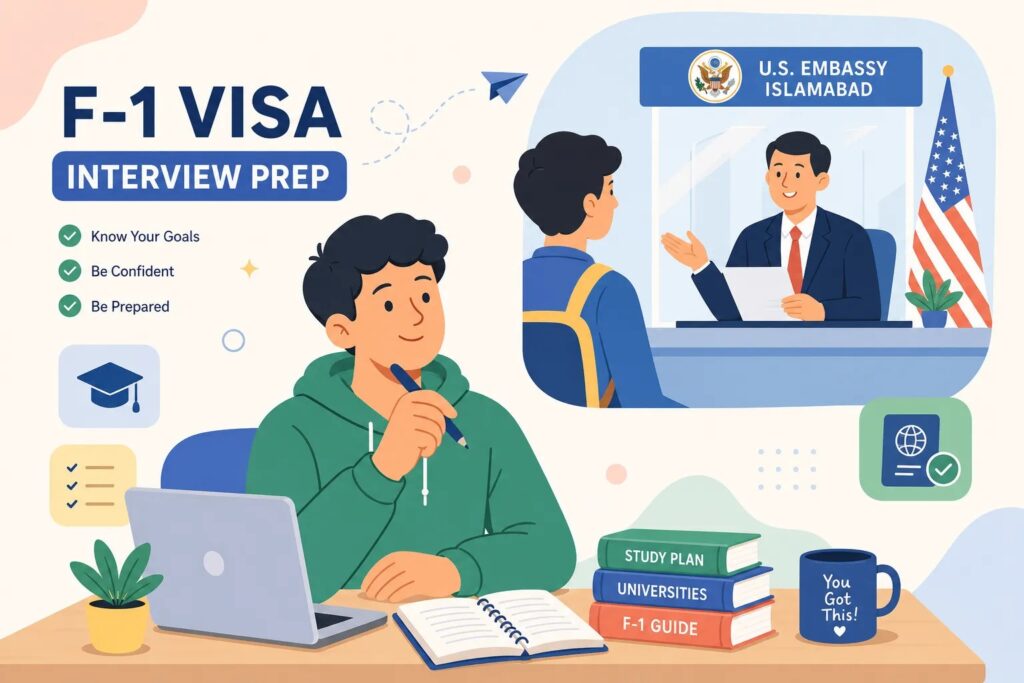
The F-1 visa interview lasts between 2 and 10 minutes. In that window, a consular officer decides whether years of planning move forward or stop completely. For Pakistani applicants, this is not a casual conversation, the interview outcome determines admission into a US programme, and consular officers assess intent and funding under Section 214(b) of the Immigration and Nationality Act.
Officers are assessing three specific things: whether you are a genuine student, whether you can afford US education, and whether you intend to return to Pakistan after graduation. MUSAFAT Student Consultants has been providing F-1 visa interview guidance to students in Pakistan for over two decades. This guide reflects the preparation framework used by our advisers when working with applicants ahead of their F-1 visa interview in Pakistan.
What actually happens on F-1 interview day in Pakistan
Two locations, two very different procedures. In Islamabad, you cannot drive to the embassy. You must take the mandatory diplomatic shuttle from the Diplomatic Shuttle Service building on Avenue 3, G-5, arriving there 30 minutes before your appointment. The embassy has a strict no-storage policy for electronics: your phone must be left at the shuttle building, not brought to the embassy gate. In Karachi, you enter the consulate directly at Mai Kolachi Road, arriving 15 minutes early. Knowing this difference helps you avoid common day-of issues such as arriving with prohibited electronics or at the wrong entry point.
Since September 2025, interview waivers (the Dropbox route) have been eliminated for all F-1 applicants in Pakistan, regardless of age. Every applicant attends in person. Only individuals named on the appointment confirmation letter are permitted entry; exceptions may apply for authorised companions such as helpers for minors or applicants with disabilities, but family members, friends, and attorneys are generally refused at the gate. Check the US Embassy or USTravelDocs portal for the current access policy before your appointment. Biometrics in Islamabad happen before the interview. In Karachi, fingerprints are taken after document review but before the Q&A portion begins.
Both locations prohibit mobile phones, bags, food, and sealed envelopes. In Islamabad, guards run a second security screening at the embassy hall entrance after the shuttle drop-off, so factor that into your timing. The interview itself typically lasts 2 to 10 minutes, keep your answers concise. Long explanations work against you, not for you.
As of July 2026, average wait times for a US Embassy Islamabad F-1 appointment are approximately 6 weeks, while visa appointment slots in Karachi run closer to 8 weeks. Book early, monitor the portal daily for cancellations, and reschedule strategically. The system permits up to five reschedules, and many applicants cut their wait from months to weeks simply by checking regularly.
F-1 visa interview Pakistan: Documents checklist
Start with the non-negotiables. The following documents are mandatory for your F-1 visa interview in Pakistan, and missing any one of them means the officer cannot proceed:
- Valid passport (valid for at least 6 months beyond your intended US stay)
- Original signed I-20
- DS-160 confirmation page with a clearly visible barcode
- SEVIS fee receipt (I-901, paid at least 3 days before the interview)
- MRV visa fee payment confirmation
- OFC-stamped appointment letter
- One recent 5 cm × 5 cm photograph with a white background (required if your DS-160 photo upload failed)
- All previous passports, if applicable
Consult the official US Embassy Pakistan website or USTravelDocs for the authoritative and up-to-date mandatory document list before your appointment.
Financial proof is where applications from Pakistan most often fall short. Officers are looking for demonstrated access to US$45,000 to US$60,000 per academic year. Bring 6 or more months of bank statements on bank letterhead, a sponsor’s affidavit, property ownership documents, and, where applicable, an education loan sanction letter or scholarship award letter. Proactively referencing your documents during the interview signals organisation and transparency, two qualities officers associate with credible applicants. Do not wait to be asked.
One requirement many students applying from Pakistan overlook: in 2026, every F-1 applicant must disclose all social media handles used in the past five years on the DS-160, including inactive, deleted, and alias accounts. Ensure all current profiles are set to public before your consular interview, in line with US State Department guidance on DS-160 social media disclosure. Officers actively review this information, and accounts left undisclosed or content flagged during background checks can trigger additional scrutiny or a denial outright. Complete this section honestly during DS-160 preparation, not as an afterthought.
The questions every Pakistani F-1 applicant faces
“Why did you choose this university?” and “Why this programme?” are the two questions that set the tone for everything that follows. Successful answers name specific curriculum elements, faculty, or research opportunities. “It’s a top-ranked university” is not an answer. “Its supply chain curriculum includes coursework on textile export logistics, which is directly relevant to my family’s business sector” is. Connect the programme to a professional need within Pakistan, and your answer becomes difficult to challenge.
When the officer asks why you chose the US over Pakistan, the question is testing one specific concern: are you here to study, or to emigrate? Never criticise Pakistan’s education system. Frame your answer around specific advantages that US institutions offer, research infrastructure, industry exposure, or a niche specialisation not currently available at this level in Pakistan. Then connect the US qualification back to a concrete professional opportunity at home.
“How many universities did you apply to?” is not a casual question. Officers ask this to verify that you made an informed, deliberate academic decision. Answer honestly, and explain your evaluation criteria briefly: programme structure, faculty expertise, scholarship availability, or research fit. Applicants who applied to only one university without a strong rationale, or who cannot explain why they declined other offers, raise flags with officers.
The two questions that determine most outcomes
The sponsorship question is where Pakistani F-1 applications most frequently fall apart. The officer wants three things: who is paying, what is their exact income source, and is the money genuinely available. Name your sponsor, state their occupation, and identify the income source precisely: salary, rental income, agricultural holdings, or business profit. Then reference your documents directly: “As shown in my bank statements and property deeds, we have sufficient funds to cover the I-20 cost.” Vague answers like “my parents are supporting me” without specifics invite follow-up questions and create doubt.
Proving you will return to Pakistan after graduation is not simply a matter of producing the right documents; it is an argument you must build clearly. Family ties, property ownership, a credible professional plan that requires a US qualification but leads back to Pakistan, and, where applicable, a conditional job offer or a defined role in a family business. Your post-graduation answer must name the sector, the employer type, or the specific role, and explain directly why the US degree enables it. Avoid saying you plan to “explore opportunities” after graduation. That phrasing signals an open-ended intention to remain in the US, which is precisely what the officer is watching for.
Three realistic scenarios students in Pakistan face
The family business sponsor. A student applying for an MS in Supply Chain Management, sponsored by a father who owns a garment export business in Faisalabad. The sponsorship answer names the father, identifies the income source precisely (business profit and salary), and references the bank statements and property deeds immediately. The return intent answer names the family business, describes the export operations, and explains how the US degree directly enables a specific role in scaling those operations. The university choice answer names the specific logistics modules in the curriculum. Every answer runs 20 to 30 seconds. Clear, concise, confident.
The scholarship recipient. A student who has received a partial merit scholarship from a US university should lead with the scholarship letter as the primary credibility anchor, not bury it. The officer will probe whether the remaining funds are genuinely available, so explain the supplementary family contribution with specific figures and demonstrate that the combined total meets or exceeds the I-20 cost of attendance. Beyond the money, the scholarship signals that the institution itself has validated your academic profile, and officers take note of that.
The reapplicant after a prior refusal. This scenario is common across Pakistan. A reapplicant must address a previous refusal directly if asked, explain concretely what has changed since the first application, and not appear defensive or evasive about the prior denial. Stronger financial documentation, a clearer career plan, improved programme fit: these are the changes that matter. Reapplicants who pretend the refusal did not happen, or who arrive with the same answers as before, are almost always refused again.
What to do if the officer says no
The most common denial triggers for students who attend the F-1 visa interview in Pakistan are well-documented: funds visible in the account for fewer than 6 months or a sudden large deposit with no explanation, a weak home ties argument with no property or dependents and vague post-graduation plans, inconsistent answers about the programme or university, undisclosed social media content, and academic records that do not match the stated study plan. Each of these is fixable with proper preparation. Most are not document problems, they are communication problems.
Refusal under Section 214(b), the most common ground for F-1 denials in Pakistan, is not permanent. You can reapply after demonstrating that your circumstances have materially changed. This is where professional support goes from useful to necessary. MUSAFAT Student Consultants offers structured F-1 visa interview coaching for students applying from Pakistan, reviewing each applicant’s specific profile, identifying the weak points that likely contributed to a refusal, and running mock interview sessions focused on the procedures consular officers follow at both the Islamabad embassy and Karachi consulate. If you have been refused once, or want to make certain you do not face a refusal at all, this is the step worth taking seriously.
Prepare now, not the night before
The F-1 visa interview in Pakistan is a short conversation with a very long-term outcome. Officers are not trying to catch you out. They are trying to confirm that you are a genuine student, that your finances are real, and that you plan to come home. Most refusals happen because applicants could not communicate those three things clearly in the 2 to 10 minutes they had.
Prepare your documents thoroughly. Know your answers before you walk in. If you are applying from Pakistan and want an experienced immigration law team reviewing your case before you sit down with a consular officer, speak to MUSAFAT Student Consultants. The interview is short. Your preparation should not be.