
The F1 visa Pakistan application process is one of the most document-intensive undertakings a Pakistani student will face. Most rejections have nothing to do with weak academics. They happen because of a single inconsistency between the DS-160 and the I-20, a bank statement that shows a sudden large deposit, or an interview answer that sounds rehearsed rather than genuine. The margin for error is thin, and consular officers are trained to spot these gaps quickly.
At MUSAFAT Student Consultants, our team has been guiding Pakistani students through every stage of the F-1 process, from securing the I-20 to walking out of the US Embassy in Islamabad with a visa stamp. What follows is the exact step-by-step walkthrough we give our students: specific portals, current fees, real timelines, and the documents that actually matter at the interview window.
Do you qualify for the F-1? What you must check first
Many students waste weeks filling in forms before confirming they actually meet the baseline requirements. The core non-negotiables are straightforward: you must have an offer of admission from a SEVP-approved US institution, you must be enrolled full-time, your Pakistani passport must be valid for at least six months beyond your intended stay, and you must demonstrate English proficiency through IELTS (typically 6.5 or above) or TOEFL (80 or above). The SEVP-approved requirement is critical. If the university is not on the Student and Exchange Visitor Programme list, no amount of documentation will result in a visa.
The requirement that catches the most Pakistani applicants off guard is non-immigrant intent. Consular officers at the Islamabad Embassy apply section 214(b) of the US Immigration and Nationality Act, which presumes that every applicant intends to immigrate permanently. It is your job to prove otherwise. Strong ties to Pakistan include property ownership, a family business, dependants, or a confirmed job offer after graduation. Verbal assurances carry no weight; documented evidence does.
On finances, consular officers expect proof of access to US$45,000 to $60,000 (approximately PKR 13 to 17 million at mid-2026 rates) to cover one academic year. The exact figure depends on the cost of attendance stated on your I-20, which is the definitive reference. This is not a frozen deposit; it is a demonstration of financial access, which means consistent bank statements over six months matter far more than a single large balance.
F1 visa Pakistan: your I-20 and SEVIS fee explained
Before you complete the DS-160 or book an appointment, you need two things in place: your Form I-20 and your SEVIS I-901 fee payment. Many online guides do not clearly explain the SEVIS timing sequence, which is why applicants often arrive at the appointment booking stage confused about why the portal is asking for a SEVIS ID.
The I-20, formally called the Certificate of Eligibility, is issued by your Designated School Official (DSO) at the US university after you accept your admission offer and submit proof of financial support. It contains your SEVIS ID number, your programme start date, and the estimated annual cost of attendance. Every detail on the I-20 must match what you later enter into the DS-160 exactly, including name spelling and dates. Even a minor mismatch gives the officer grounds to question the authenticity of your application.
Once you have the I-20, pay the SEVIS I-901 fee at fmjfee.com using the SEVIS ID printed on the form. The current fee is $350, raised from the previous $200. This is not the same as the visa application fee; these are separate payments made on different portals. Pay the SEVIS fee at least three business days before your interview to ensure the system registers the payment. Keep the receipt; it is a required document at the interview window.
Completing the DS-160 and paying your visa application fee
The DS-160 is the official online nonimmigrant visa application, completed at ceac.state.gov/genniv. The first thing you do after starting the form is save your Application ID and set a security question. Without these it is difficult to retrieve an in-progress application, so take a screenshot of the Application ID immediately and store it somewhere safe.
The sections that consistently trip up Pakistani applicants are social media accounts (you must list all active platforms), travel history, and the photo upload. The photo must be 5 x 5 cm with a white background and taken within the last six months.
Every personal detail, including your full name, date of birth, and passport number, must appear exactly as it does on your Pakistani passport. Once you submit the DS-160, it cannot be edited; a new application must be started if you spot an error after submission. Review everything carefully before clicking submit. Print only the barcode confirmation page, not the entire form, and keep it for the interview.
The visa application fee, known as the MRV fee, is $185 and is paid through the CGI Federal portal at cgifederal.secure.force.com. You can pay online or via a bank deposit slip at a designated bank in Pakistan. If you pay at a bank, do not lose the receipt. It contains the receipt number required to schedule your interview. It cannot be replaced. After payment, the scheduling system becomes active the following business day after 11:00 AM.
Booking your F1 visa Pakistan embassy interview
All interview scheduling for Pakistani applicants goes through ustraveldocs.com. After logging in with your MRV receipt number, the system shows two appointment types: the Visa Application Centre (VAC) for biometrics and the Consular Interview at the embassy. Both must be booked.
As of mid-2026, the US Consulate General in Karachi has suspended consular services indefinitely following a closure that began in March 2026. This means all F-1 applicants from Pakistan must book through the US Embassy in Islamabad. Current wait times for student visa categories in Islamabad sit at approximately six weeks, though this has spiked in the past, wait times reportedly crossed 300 days in early 2026 following a security review and a mass cancellation of appointments. Always verify current wait times at travel.state.gov before planning your application timeline.
Check the ustraveldocs.com portal daily. Cancellations release slots unpredictably, and regular checking is the only reliable way to find an earlier date. If your programme start date is within 90 days and you cannot secure a routine appointment in time, you may be eligible to request an emergency appointment through the portal. Avoid any agent claiming access to “early slots” through unofficial channels. These offers are fraudulent and can permanently damage your application record.
Documents and interview preparation: what actually determines the outcome
The interview stage is where applications are won or lost. Bring originals and photocopies of every document, grouped by category:
- Identity and application documents: passport, DS-160 barcode confirmation page, appointment letter, and compliant photos
- Fee receipts: SEVIS I-901 ($350) and MRV fee ($185)
- University documents: original signed I-20 and admission offer letter
- Academic proof: official transcripts from BISE or FBISE, IELTS or TOEFL score report, and GRE or GMAT scores if applicable
- Financial proof and ties-to-Pakistan evidence
Officers are not simply checking balances. They are checking consistency and source. Bank statements from the last six months must show regular activity, not a sudden large deposit that appeared just before the application. If a parent or family member is sponsoring the education, their income source must be fully documented: salary slips, tax returns, property deeds, or business registration certificates. Education loan sanction letters from Pakistani banks are also acceptable, provided the sanctioned amount covers at least one full academic year as stated on the I-20.
The five question categories that consistently appear at Islamabad interviews are: why the US, why this specific university, what you will study, who is sponsoring you, and what you will do after graduation. For each question, apply the 3C Rule: answers must be clear (no jargon), concise (20 to 30 seconds), and confident (maintain eye contact).
Tie your academic goals to Pakistan’s industries. Name specific courses or research facilities at the university. Link your post-graduation plans explicitly back to Pakistan and reference your documented financial sponsor accurately. Never criticise Pakistani education; instead, highlight specific US academic advantages relevant to your field.
For students from smaller cities or those reapplying after a prior refusal, professional interview preparation commonly helps applicants perform better at the consular window. MUSAFAT Student Consultants conducts mock interview sessions that mirror the actual consular environment and reviews every document for legal consistency before the student steps into the embassy, the same standard a consular officer applies at the window.
Fees, timelines, and what to do if your visa is refused
The total mandatory cost of an F1 visa Pakistan application is $535: $350 for the SEVIS I-901 fee and $185 for the MRV visa application fee. At mid-2026 exchange rates, this is approximately PKR 148,000 to 155,000, depending on the day you convert. These fees do not include university application costs, IELTS or TOEFL fees, or any courier charges for passport return after the visa is stamped.
After the interview, most Pakistani applicants receive a decision within one to three weeks. A significant proportion are placed in administrative processing, an additional security check that adds 30 to 90 days to the timeline. STEM applicants and those in fields on the Technology Alert List can face reviews extending to six months or longer. During administrative processing, there is nothing to do except wait and respond promptly if the embassy requests additional documents. The State Department advises waiting at least 180 days before formally enquiring about the status of a case in administrative processing.
A refusal under section 214(b) is the most common outcome for Pakistani applicants who do not prepare adequately. Pakistan’s F-1 denial rate sits at approximately 45 per cent, and the primary driver is failure to demonstrate non-immigrant intent rather than academic weakness. A refusal is not permanent. A new application requires a new DS-160 and a new MRV fee, though the SEVIS fee may not always be required again depending on the circumstances. Before reapplying, the exact grounds of the refusal must be identified and addressed with stronger documentation. MUSAFAT’s immigration legal team rebuilds the documentation file for post-refusal cases, targeting the specific deficiencies the consular officer flagged, rather than simply resubmitting the same file with a higher bank balance.
Start your F1 visa Pakistan preparation the right way
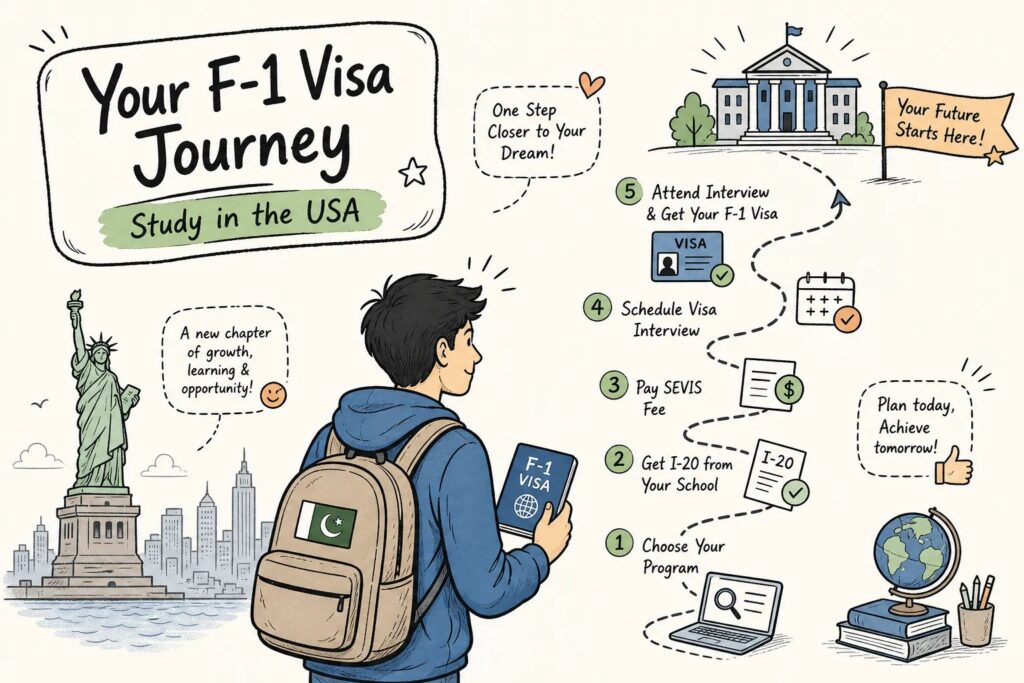
The F-1 process has six distinct stages: confirm eligibility and secure your I-20, pay the SEVIS fee, complete the DS-160 and pay the MRV fee, book the embassy interview through the official portal, prepare your document file and interview answers, then manage post-interview processing. Each stage has hard requirements, and a gap at any point can cause a delay or a refusal.
The application is achievable with thorough preparation, but the margin for error is genuinely thin. A single inconsistency between your financial documents and your I-20 figures, or one interview answer that contradicts your DS-160, can trigger a 214(b) refusal that resets your entire timeline.
If you want your F1 visa Pakistan documentation reviewed by immigration law professionals before you walk into the Islamabad Embassy, MUSAFAT Student Consultants offers exactly that service. Our team provides legal document review and mock interview preparation to give your application the strongest possible foundation, from the first form to the final interview. Contact us online or visit our Gujranwala office to book your initial assessment.