
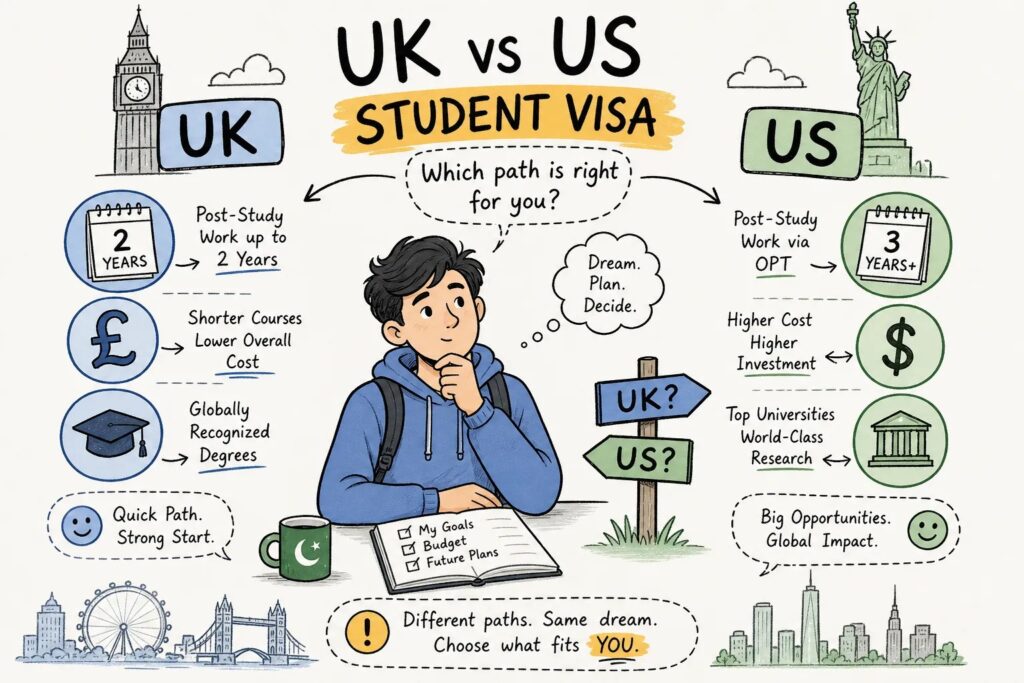
UK vs USA for Pakistani students is the single most common question families bring to us at MUSAFAT Student Consultants. And here is the honest answer: there is no universally correct choice. There is only the right choice for your budget, your programme, and your career plans. This guide breaks down the actual numbers, the visa reality, the scholarships available, and what happens after graduation, so you can stop guessing and start deciding.
What studying actually costs in the UK vs the USA
UK tuition and living costs
UK tuition for Pakistani undergraduates runs £11,000 to £18,000 per year. A master’s degree costs £12,000 to £22,000 per year, depending on the subject and institution. Monthly living costs outside London sit at £800 to £1,100; in London, budget £1,200 to £1,500. Add the Immigration Health Surcharge of roughly £776 per year, a cost that often catches students off guard during budgeting, and a realistic first-year total in the UK lands between £20,000 and £45,000. In Pakistani rupees, using exchange rates as of mid-2026, that translates to approximately PKR 7.5 million to PKR 17 million for year one.
US tuition and living costs
US costs are broadly comparable on a per-year basis, but the comparison breaks down quickly once programme length enters the picture. Public university tuition for out-of-state international students runs $20,000 to $35,000 per year; private universities charge $35,000 to $55,000 per year. A master’s programme ranges from $20,000 to $60,000 annually. These figures are based on typical ranges and may vary across institutions in 2026 due to annual fee increases. Monthly living costs sit at $1,200 to $2,000 depending on the city. You also pay $1,500 to $3,000 per year for mandatory university health insurance, amounts vary by institution and coverage level, a cost the UK’s NHS effectively absorbs through the health surcharge. A first-year total in the USA lands between $30,000 and $70,000, or roughly PKR 8.3 million to PKR 19.5 million at mid-2026 exchange rates.
On a per-year basis, the costs look similar. That impression disappears the moment you consider how long each programme actually takes.
How programme length quietly doubles your total spend
A UK master’s degree is completed in 12 months. The US equivalent takes two years. That extra year is not just tuition: it is another full year of rent, food, health insurance, and delayed earnings. A UK master’s at £15,000 tuition typically costs £30,000 to £45,000 in total spend across the programme. The same-prestige US programme runs $60,000 to $130,000. Even with 30 to 50 per cent merit aid from a US university, the UK route is typically 40 to 60 per cent cheaper in total spend for a master’s degree.
The same logic applies at undergraduate level. A UK bachelor’s degree takes three years; the US takes four. UK total undergraduate spend runs roughly £100,000 to £130,000 across the full degree. The US equivalent at a public university runs $120,000 to $140,000; a private university can reach $220,000. For Pakistani students without significant scholarship funding, the UK undergraduate route produces substantial savings before career plans are even part of the equation.
The US programme does offer more internship windows and a more spread-out academic pace, particularly useful in fields such as computer science, engineering, and business where co-operative education and summer placement cycles are deeply embedded. That is a genuine trade-off worth considering. But unless you have a Fulbright grant or a strong merit aid package, the financial gap is difficult to justify on programme length alone.
UK vs USA student visa: which country makes it harder for Pakistani applicants
The UK Student Route is procedurally straightforward. You need a Confirmation of Acceptance for Studies (CAS) from a UKVI-licensed university, proof of funds held for 28 consecutive days (£1,483 per month in London, £1,136 outside), an IELTS or PTE score, a TB test certificate (mandatory for Pakistani applicants), and the visa fee of £558 from April 2026. Processing typically takes three weeks. The key approval question is the Genuine Student Test: officials want clear evidence that you intend to study and return home after your course. Source-of-funds documentation must be thorough and traceable.
The US F-1 process adds layers of uncertainty. You need a Form I-20 from a SEVP-certified institution, SEVIS registration at $350, a DS-160 form, a visa application fee of $180, and an in-person interview at the US Embassy in Islamabad or the Consulate in Karachi. As of July 2026, interview wait times are approximately six weeks in Islamabad and eight weeks in Karachi, though these figures can spike significantly during peak demand periods. The critical challenge for Pakistani applicants is the Section 214(b) denial: you must demonstrate non-immigrant intent, meaning you must prove through family ties, property, and clear career plans that you will return to Pakistan after graduating. Financial credibility must come from liquid assets, not property valuations.
UK processing is predictable and takes about three weeks. US processing carries higher uncertainty, a longer wait, and a more subjective interview. For students with a strong file, both are achievable. For students with a prior visa refusal or complex financial documentation, the UK route is significantly more manageable.
Scholarships and funding available to Pakistani students
This is where the UK holds a clear structural advantage. Pakistan is a designated country for multiple government-backed awards. The Chevening Scholarship covers full tuition, travel, and living costs for a one-year master’s; the 2027, 28 cycle opens in August 2026. The Commonwealth Scholarship does the same for master’s and PhD applicants. The GREAT Scholarships, available through approximately 12 to 13 UK universities in partnership with the British Council (verify the current list at the official Study UK GREAT Scholarships page), provide £10,000 to £15,000 per award specifically for Pakistani postgraduate students.
University-specific awards add further depth: the University of Manchester’s Global Futures programme offers up to £30,000 for undergraduates; the University of Kent’s Bestway Foundation awards £26,000 each to STEM master’s students. Many of these deadlines fall between June and August 2026, so if you are planning for September 2026 or January 2027 intake, act now.
The US funding landscape looks different. There is no dedicated government scholarship programme exclusively for Pakistani students beyond the Fulbright Foreign Student Programme, which is fully funded but highly competitive. Most US funding comes from university merit aid, ranging from $5,000 to full tuition at a handful of institutions. Need-based aid for international students is limited to a small group of elite universities including Harvard, Yale, and Princeton. Private international loans through lenders such as Prodigy Finance and MPOWER are available, but these carry interest rates and repayment obligations that must be factored honestly into your total cost calculation.
Post-study work rights and long-term career paths
After completing a UK degree, Pakistani graduates qualify for the Graduate Route visa: two years of unrestricted work for bachelor’s and master’s graduates, three years for PhD holders. No job offer is required, no employer sponsorship, no salary threshold. You can work in any sector, freelance, or start a business. One policy note worth verifying directly with UKVI: at the time of writing, the UK government has proposed reducing the non-PhD Graduate Route from two years to 18 months for applications made on or after 1 January 2027. This proposal could be confirmed, amended, or withdrawn before you apply, so check the current rules before committing. The Graduate Route does not count toward Indefinite Leave to Remain directly; to build toward permanent residence, you must switch to the Skilled Worker visa and accumulate five qualifying years.
US graduates receive Optional Practical Training (OPT): one year of work authorisation in their field, extended to three years for STEM graduates. The complication begins when OPT ends. To remain in the USA long-term, you need an employer to sponsor an H-1B visa. H-1B visas are subject to an annual cap of roughly 85,000, with applicants entering a random lottery where selection rates have consistently been below 20 per cent. If you miss the lottery, you leave or find another status. The path to a green card then adds years of employer-sponsored backlog on top of that. For STEM graduates with strong employer connections, this path is viable. For everyone else, the uncertainty is significant.
UK vs USA for Pakistani students: how to pick the right country for your situation
The UK suits you best when your budget is tight, you are pursuing a one-year master’s, you want a predictable visa process, or you need post-study work flexibility without depending on employer sponsorship. Students in business, law, social sciences, and most STEM fields will find the UK’s cost-to-outcome ratio hard to beat, particularly once scholarship options specific to Pakistani students are factored in.
The USA makes more sense when you are targeting a STEM field with strong OPT extension prospects and have secured substantial merit aid or a Fulbright grant. It is also worth considering if long-term career settlement in North America is a firm and realistic goal backed by an honest plan for navigating the H-1B transition. The US job market in technology and research can justify the higher cost, but only with that plan in place from the start.
These two countries do not suit the same student. At MUSAFAT Student Consultants in Gujranwala, we help Pakistani students work through exactly this decision with an honest assessment of each student’s academic profile, financial position, and visa eligibility before any application is made.
The decision comes down to your numbers, not ours
There is no universally better country in the UK vs USA comparison for Pakistani students. The UK wins on cost, visa predictability, and post-study flexibility. The USA wins on STEM career depth, research access, and long-term earning potential in specific fields, but only if you have the funding and a realistic plan for the H-1B transition. Before you apply anywhere, clarify your total budget across the full programme, not just the first year’s tuition. Check scholarship deadlines now, as many UK awards close in mid-2026. Prepare your funds documentation early for either visa route. And sort your IELTS or TOEFL score before you start shortlisting universities, because your score affects which programmes you can realistically target.
If you are still weighing both options, a conversation with a consultant who understands both routes and your Pakistani profile specifically is worth having before you commit. Reach out to MUSAFAT Student Consultants in Gujranwala. We will tell you what the numbers actually look like for your situation, without the false promises that too many students in Pakistan have learned to distrust.