
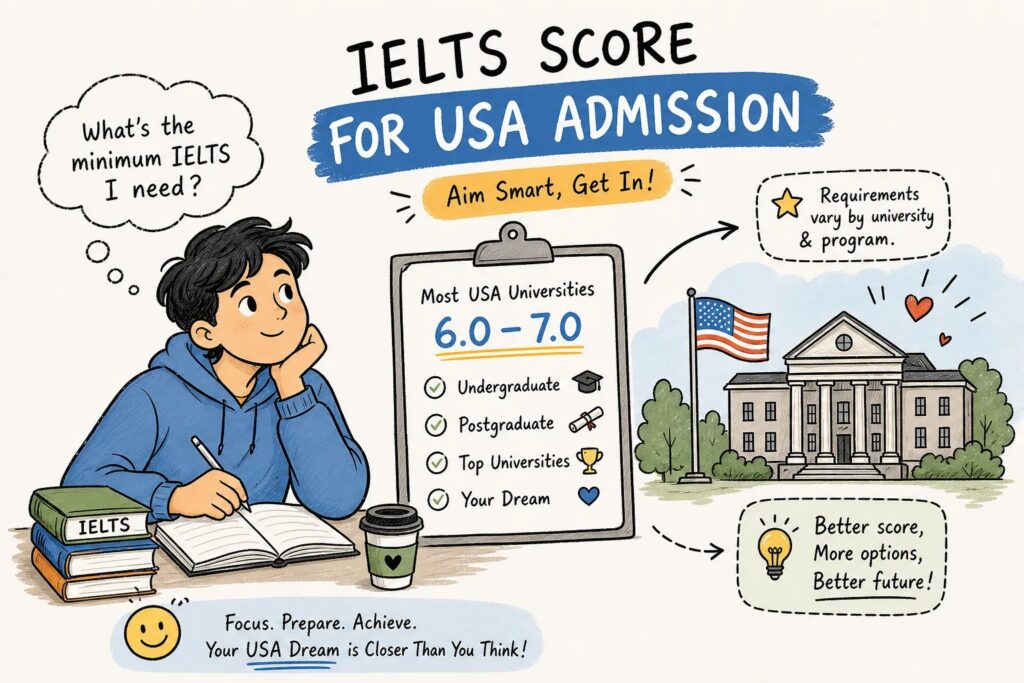
One website says 6.5. Another says 7.0. The official university portal says “competitive.” If you have been searching for the minimum IELTS for USA admission, you have probably closed more browser tabs in frustration than you have opened in hope. At MUSAFAT Student Consultants, this is one of the first questions students bring through our door, and the honest answer is: there is no single number that covers every university, every programme, and every level of study. But there is a framework that makes the answer clear for your specific situation.
By the time you finish reading, you will know the realistic IELTS band to target based on whether you are applying for undergraduate or postgraduate study, how section scores can trip you up even when your overall band looks sufficient, and what your options are if your current score falls short of the direct-entry minimum. This is practical, specific information, not the vague “it depends” answer you keep finding elsewhere.
What the standard minimum IELTS for USA admission actually looks like
Before moving into elite university territory, it helps to establish what the baseline looks like for the majority of US institutions. Many Pakistani students applying to US universities are targeting mid-tier state universities and four-year colleges where admission is genuinely within reach. At these institutions, the English proficiency benchmark is more accessible than many students expect.
Undergraduate entry: the 6.0 to 6.5 standard
The majority of US four-year colleges and state universities accept a minimum overall IELTS of 6.0 to 6.5 for undergraduate admission. The 6.0 threshold tends to appear at less selective institutions, while 6.5 is the practical benchmark to target if you want a reasonable range of credible options. Aiming below 6.5 significantly narrows your accessible university list: institutions at the 6.0 entry point tend to be smaller regional colleges with fewer programme choices, whereas 6.5 opens the door to a much wider tier of state universities and accredited four-year colleges. Treat 6.5 as the floor worth working towards rather than 6.0 as a comfortable ceiling.
Postgraduate programmes: why 6.5 is often the floor, not the target
Master’s and doctoral programmes set their own English proficiency requirements independently of the undergraduate admissions office. The floor for postgraduate programmes is typically 6.5, but research-intensive and communication-heavy disciplines (business, education, journalism, public policy) frequently require 7.0 or higher. Some US graduate programmes also impose explicit minimum section requirements on Writing and Speaking specifically, which means your overall band can meet the threshold while a weak section still disqualifies you from direct entry.
How elite and competitive universities raise the bar
If your target is a top-ranked US university, the picture changes considerably. Meeting the published minimum at these institutions is not the same as being a competitive applicant. Understanding the distinction saves you from preparing to a standard that places your application in the bottom tier of what the admissions committee receives.
Ivy League, MIT, and Stanford requirements
Most Ivy League programmes commonly require 7.0 overall with component minimums around 6.5, though requirements vary by school and programme, always check each programme’s admissions page directly. Brown University is the notable exception among the Ivies, requiring 8.0 overall for undergraduates, which is the highest published requirement of any Ivy League school. Cornell requires 7.5 for undergraduate programmes, while Columbia, Dartmouth, Yale, and the University of Pennsylvania set their baseline at 7.0.
MIT lists 7.0 as its minimum, but competitive applicants consistently present 7.5 or above. Stanford does not publish a fixed undergraduate minimum; the realistic benchmark for a competitive application is 7.5 or higher. At graduate level, Harvard’s Graduate School of Education expects 7.5 overall with no section falling below 7.0. Harvard’s Kenneth C. Griffin Graduate School of Arts and Sciences requires a minimum of 7.0 overall with 6.5 in Speaking, these are published programme-specific requirements, not suggested targets, and do not apply universally across all Harvard graduate programmes.
State universities and mid-tier schools: where many Pakistani students are applying
The UC system (Berkeley, UCLA) generally accepts 6.5 to 7.0 for direct entry, with an expected section minimum of around 6.0 per component for undergraduates. The University of Michigan requires 6.5 overall with 6.5 in each section for undergraduates, rising to 7.0 overall with 6.5 per section for postgraduate programmes. NYU commonly requires around 7.0 overall with component minimums near 6.5, check your specific NYU programme’s admissions page for confirmation. The University of Wisconsin sits at 6.0 overall with no sub-score permitted below 5.5. These institutions represent a realistic target tier for many Pakistani students, and 6.5 to 7.0 is the band range that opens doors across this group.
Section scores: minimum IELTS for USA admission goes beyond the overall band
Many students reach 6.5 overall and assume their English proficiency requirement is satisfied. Then they receive a conditional offer or an outright rejection because one section fell below the university’s component minimum. Section minimums are actively enforced, functioning as a secondary filter that your overall band cannot override.
What section minimums typically look like in practice
The most frequent pattern at undergraduate level is “6.5 overall with no band below 6.0.” At postgraduate level, this shifts to “7.0 overall with a minimum of 6.5 in Writing and Speaking.” The University of Wisconsin enforces no sub-score below 5.5. Harvard’s Graduate School of Education requires no section below 7.0 for its specific programmes. UC Berkeley expects around 6.0 per section for undergraduate direct entry. The practical consequence is straightforward: a student who achieves 6.5 overall cannot claim to meet the minimum if one of their four section scores is 5.5.
Why Writing and Speaking catch students out most
Many non-native English speakers find Writing and Speaking the most challenging sections, and these are precisely the two areas where universities impose the most specific sub-score requirements. A student who scores 7.5 in Listening and Reading but 5.5 in Writing will fail the section minimum at most universities that require 6.0 or above per component. Graduate programmes in business, education, law, and public policy are particularly strict on these two skills because they reflect the communicative demands of the programme itself. Factor section minimums into your preparation strategy from day one, not as an afterthought after your first test sitting.
What to do if your score falls below the minimum
A below-minimum IELTS score is not a rejection letter. It is a planning input. The US higher education system has built structured routes for students who are not yet at direct-entry standard, and some of these routes are genuinely accessible for Pakistani students whose overall band is as low as 4.5.
Pathway and bridge programmes: what they accept
Intensive English Programmes (IEPs) are designed for students who need foundational language support before entering degree-level study. Ball State University’s Intensive English Institute accepts IELTS as low as 4.5, making it one of the most accessible pathways available. Academic Bridge programmes, which allow students to take some degree classes while completing English modules, typically require 5.5 to 6.0. Illinois Institute of Technology accepts 5.5 overall (with 5.0 per section) for conditional admission into its bridge pathway. Ball State’s Academic Bridge programme accepts 6.0.
Several well-known state universities accept 5.5 for pathway or conditional entry, including Central Michigan University, California State University (Los Angeles and Fullerton), University of Mississippi, Ohio University, University of Oregon, and University of Kansas. Students complete the English programme first and then transition into their degree, this is a fully standard route at these institutions, not an exception.
Conditional admission and no-IELTS entry routes
A number of US universities grant conditional admission without any IELTS or TOEFL score at all, requiring the student to complete an on-campus English programme upon arrival. ELS Language Centers partners with over 50 US universities on exactly this basis, including institutions such as the University of Southern Indiana and the University of Delaware. If your current score is too low even for pathway entry, or if you have not yet sat IELTS, this conditional route is a legitimate option worth exploring. The important caveat is that sub-score requirements apply even within pathway programmes: Illinois Tech’s 5.5 pathway still requires a minimum of 5.0 in each individual section.
The F-1 visa and IELTS: clearing up the confusion
A large number of Pakistani students believe the US consulate sets a minimum IELTS band for the F-1 student visa. It does not. The US government has no official minimum IELTS requirement for an F-1 visa. The IELTS requirement is set entirely by the university and is satisfied the moment the university issues your I-20 form. The consular officer at the visa interview does not score-check your IELTS certificate.
What the US consulate actually checks at your visa interview
The I-20 form, issued by your admitting university, is the document that confirms your English proficiency has been accepted. Once the university is satisfied and has issued the I-20, the visa application proceeds on financial documentation and intent grounds. The confusion between university admission requirements and immigration requirements is understandable, but they are two completely separate processes. Your IELTS score is verified and accepted at the university stage; it plays no direct role in the consular officer’s decision at the visa window.
IELTS for US professional licensing in nursing and medicine
If you intend to practise as a nurse in the USA after graduating, CGFNS International requires IELTS Academic with an overall band of 6.5 and a minimum Speaking score of 7.0. The General Training test is not accepted; it must be IELTS Academic. For internationally trained medical graduates seeking ECFMG certification, IELTS Academic is required with a typical expectation of 7.0 or above overall with 6.5 in sub-scores. Both of these requirements are entirely separate from the F-1 visa and from university admission; they apply only when you seek to practise professionally after completing your degree.
Building a score strategy that actually works
The data above gives you a clear framework. Aim for 6.5 if you are targeting mid-tier state universities at undergraduate level. Aim for 7.0 if you are targeting competitive state universities or mid-rank private universities at postgraduate level. Aim for 7.5 or above if you are applying to Ivy League institutions or elite research universities. Each half-band increase opens more university options and strengthens your scholarship eligibility, many merit-based scholarships at competitive US institutions set their English proficiency benchmarks at 7.0 or above, so the investment in preparation is directly linked to the quality and range of your admissions outcomes.
Setting the right target for your profile and goals
The most important principle is to factor in section minimums from the beginning of your preparation, not just the overall band. A student who trains to achieve 6.5 overall without monitoring individual section scores may pass the overall threshold but still fail the component requirement at their target university. Identify the section minimum for your shortlisted universities first, then design your preparation around those specific targets rather than working backwards from an overall band.
Getting structured support to hit your target
Preparing without structured feedback leads to plateaus, particularly in Writing and Speaking, where self-assessment is unreliable and improvement requires targeted correction. In practice, students who work with experienced IELTS instructors and receive specific feedback on their weaker sections tend to improve more efficiently than those studying independently with generic materials, particularly when preparation is benchmarked against real programme requirements rather than abstract band targets. At MUSAFAT Student Consultants, our IELTS preparation is delivered by experienced English language instructors and tied directly to the student’s target university requirements. The preparation is goal-specific: if your target programme requires 6.5 per section at a state university, that is what the coaching is calibrated towards, not a generic band score in the abstract.
Know your number, then prepare for it
The minimum IELTS for USA admission is 6.5 for most undergraduate programmes at mid-tier and state universities, rising to 6.5 to 7.0 for postgraduate study and 7.0 to 7.5 or above for elite institutions. Section scores carry as much weight as the overall band, and a single weak component can disqualify an otherwise sufficient application. Students who fall below the direct-entry minimum have genuine, structured options through pathway programmes and conditional admission routes, with entry points as low as IELTS 4.5 at certain institutions.
The practical next step is straightforward: identify your target universities, check the specific IELTS requirement on each programme’s admissions page directly (not a third-party summary), note the section minimums, and set a preparation timeline based on your current score and the gap you need to close. If you are unsure where to start or which universities match your academic profile and IELTS target, the team at MUSAFAT Student Consultants can help you map out both your score strategy and your US admissions plan from a single, focused conversation.