
Many students preparing for US university applications focus on IELTS without knowing the actual IELTS score for US universities that their target institution expects. The result is predictable: either months of over-preparation that delays the application cycle, or a score that sits just below the admissions filter and gets the file rejected before anyone reads the personal statement. Both outcomes are avoidable with the right information upfront.
This guide gives you exact IELTS band thresholds, sub-score rules, and realistic targets across every tier of US university, from Ivy League research institutions to affordable state schools. The data here reflects 2026 admissions requirements. Whether you are applying to an undergraduate programme or a postgraduate degree in law, STEM, or business, the numbers below will help you set the right preparation goal before you sit the test.
At MUSAFAT Student Consultants in Gujranwala, we work with students at exactly this stage: connecting your IELTS preparation target to the specific universities on your shortlist, so your language goal and your admission goal are built around the same number from day one.
How US universities use IELTS scores in 2026
Virtually all accredited US institutions, including every Ivy League school, MIT, Stanford, and the entire University of California system, explicitly accept IELTS Academic in 2026. According to the British Council and IELTS official data, IELTS is accepted across 3,400-plus US institutions, and no major US university requires TOEFL exclusively over IELTS. If you see TOEFL listed as “preferred” on an older admissions page, treat it as a historical artefact. IELTS Academic is a fully valid option everywhere.
The distinction that actually matters is between a published minimum and a competitive score. A minimum score (say 6.5) is the eligibility threshold. It keeps your application in the pile. A competitive score, typically 0.5 to 1.0 bands higher, is what admitted students actually achieve. Universities like Harvard and MIT list 7.0 as a published floor; successful applicants at those institutions typically score 7.5 or above. Knowing this gap changes how you should set your preparation target before you register for the test.
IELTS score for US universities: thresholds by tier
Ivy League and top-50 universities
Many Ivy League graduate programmes publish a 7.0 minimum, but the picture varies by institution and level. Brown University requires 8.0 for undergraduate programmes. Harvard College does not formally require IELTS for undergraduates, making it optional at that level, while Harvard Law School expects 7.5 or above. Stanford typically expects 7.0 to 7.5, MIT recommends 7.0 for undergraduate applicants and requires 7.5 at postgraduate level, and Columbia sits in the 7.0 to 7.5 range depending on the programme.
For this tier, set your target at 7.5 overall with no individual section below 7.0. Meeting the published minimum of 7.0 does not make you competitive at these institutions. It just keeps you eligible.
Mid-tier state universities and large research schools
This is the tier where most Pakistani students applying to the US find their realistic admission zone. NYU, UCLA, UC Berkeley, and the University of Michigan all accept 6.5 to 7.0 depending on the programme. Many large state universities across this bracket accept 6.5 as the standard minimum for both undergraduate and postgraduate courses. UC Berkeley requires a strict 7.0 at postgraduate level, while its undergraduate floor sits at 6.5.
For this category, a 6.5 to 7.0 overall score with no band below 6.0 covers most programmes. If your target institution sits in this bracket, do not spend an extra six months preparing for a 7.5 when a 7.0 gives you everything you need to apply competitively.
Affordable and less selective institutions
Community colleges and less selective universities are a legitimate, cost-effective route to a US degree, particularly for students planning a transfer or working towards a postgraduate application later. These institutions often accept 5.5 to 6.0, sometimes through conditional admission routes that include additional English language coursework before full degree entry. Universities such as Central Michigan, Ohio University, California State campuses, North Dakota State, and Southern Arkansas University all fall in this range.
Undergraduate vs postgraduate IELTS requirements
Many students assume one score fits all academic levels, it does not. Postgraduate programmes almost always require 0.5 to 1.0 bands higher than undergraduate entry at the same institution, and the sub-score floors shift upward too.
Bachelor’s degree IELTS expectations
For undergraduate programmes, the typical overall range across US universities is 6.0 to 6.5 for general admission, rising to 7.0 or above for top-50 schools. Sub-band minimums at this level usually require no individual section to fall below 6.0. Foundation and pathway programmes may accept 4.5 to 5.5 for students who need bridging support before direct entry, a useful option for students who are strong academically but not yet at the required English proficiency level.
Master’s, MBA, and PhD programme requirements
At postgraduate level, the baseline shifts to 6.5 to 7.0 for general admission. Selective STEM, business, and humanities programmes at research universities typically expect 7.0 to 7.5. PhD programmes in particular set higher writing sub-score expectations because research output depends directly on academic writing ability. MBA programmes at top business schools typically expect 7.0 to 7.5 overall, with Writing and Speaking sub-scores at 7.0 or above as a firm floor. For top-50 STEM PhD programmes, aim for 7.0 overall with no section below 6.5, and 7.5 if your target institution sits in the top 10.
Sub-band minimums for high-demand disciplines
Several disciplines impose stricter sub-score requirements beyond the overall band, and these are the rules that most commonly catch applicants off-guard, a strong overall score will not offset a weak section score in any of them.
Law, medicine, and MBA: the highest language bar
At top-tier US law schools, both JD and LLM programmes typically require 7.5 overall with all four sections at 7.5 or above. The University of Chicago Law and Georgetown Law both enforce minimum sub-scores of 7.0 across all sections, with Writing often expected to reach 8.0 because legal analysis depends entirely on precise argumentation. Medical programmes have similarly high floors: 7.0 to 7.5 overall with no band below 7.0, and Speaking at 7.5 or above for clinical programmes at schools like Stanford.
MBA programmes at top-20 business schools generally require 7.5 overall with Writing and Speaking at 7.0 as a strict minimum. The “no band below” rule is firmly enforced in law, medicine, and MBA admissions. A weak Writing score of 6.5 will not be offset by a strong Listening score of 8.5. These fields treat sub-scores as independent requirements, not components to be averaged.
Engineering and STEM: flexible, but not without floors
Engineering graduate programmes are more flexible than law or medicine. Most US engineering schools require an overall 6.5 with sub-score minimums of 6.0 to 6.5 across all four bands. Top-tier STEM programmes, including the University of Illinois at Urbana-Champaign, require 7.0 in each individual section. Do not assume a technical programme has no language requirements because the subject matter is quantitative. Always check the specific department’s admissions page rather than relying on the university-wide policy, which is often less stringent than departmental rules.
How a strong IELTS band expands your scholarship options
A high IELTS score carries weight beyond the admissions filter, several institutions use English proficiency scores as part of their initial screening for funding consideration, meaning a 7.5 or above can move your application into scholarship review pools that a 6.5 would not reach.
The specifics are worth knowing. The University of Tulsa awards $9,000 per year for IELTS 7.0, rising to $12,000 per year at IELTS 7.5 with a 3.5 GPA. American University’s Emerging Global Leader Scholarship requires IELTS 7.0 as a minimum for full-tuition consideration. Centre College’s Lincoln Scholars Programme offers a full-ride covering tuition and living costs with IELTS 7.0 as the entry threshold.
At the fully funded level, the Fulbright Foreign Student Programme, the US-Pakistan Knowledge Corridor PhD Scholarship administered by HEC, and Yale University’s financial aid all expect a competitive IELTS score as a core eligibility criterion. Yale explicitly lists 7.0 as its floor for international scholarship applicants. For Pakistani students, this means building your IELTS score well above the admissions minimum is not wasted effort, it directly expands your funding options and, in some cases, is the single variable that moves your application from the admission pile into the scholarship consideration pool.
What IELTS score for US universities should you target in 2026?
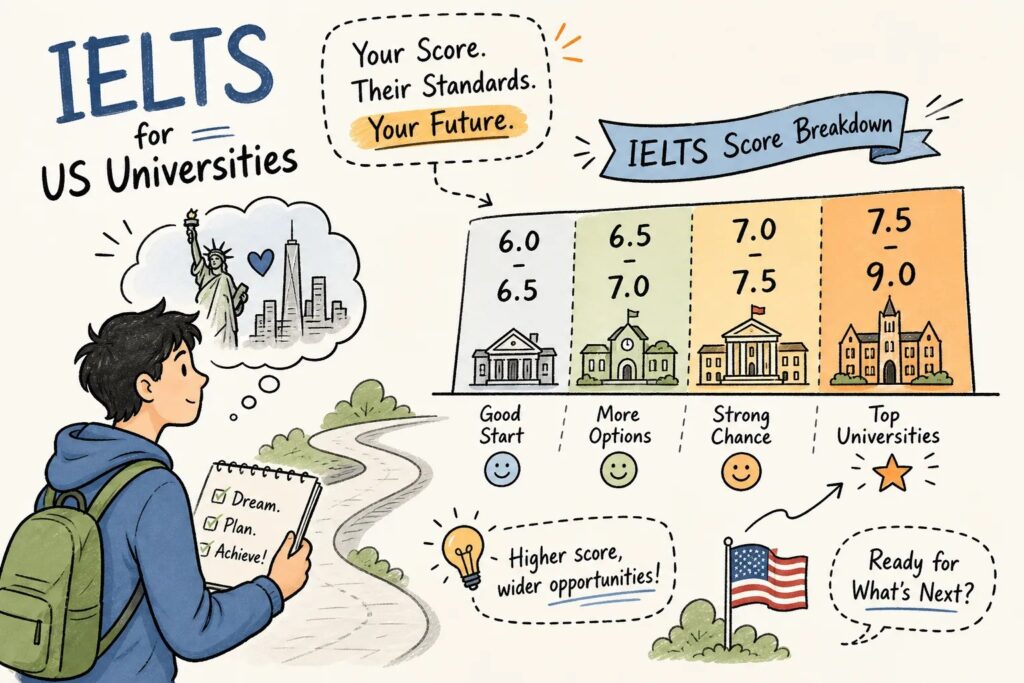
Stop preparing for a generic “good IELTS score” and start preparing for the number your specific target university requires. Here is the breakdown by tier:
- Ivy League and top-50 universities: aim for 7.5 overall with no individual section below 7.0. For law, medicine, or MBA at this tier, add 0.5 to that Writing target and treat 7.5 as the sub-score floor across all sections.
- Mid-tier state universities and large research schools: 6.5 to 7.0 overall, with no band below 6.0. This covers NYU, UCLA, UC Berkeley, the University of Michigan, and most mid-tier state universities without over-preparing.
- Affordable or less selective institutions: 6.0 is the practical floor, with conditional admission routes available from 5.5 at schools such as Ohio University, Central Michigan, and California State campuses.
- Postgraduate programmes in law, medicine, or MBA: take the undergraduate benchmark for your target tier and add 0.5 to 1.0 bands across all sections.
Meeting the published minimum is not the goal. The competitive score, what admitted students actually achieve, is what you should be preparing for. The gap between a minimum and a competitive score is usually 0.5 to 1.0 bands, and at selective institutions, that gap is the difference between getting a decision and getting an offer.
Knowing the right IELTS score for US universities before you sit the test is the smartest approach to 2026 admissions, and that target should come from your specific university shortlist, not a general idea of “good.” At MUSAFAT Student Consultants, this is the work we do with students from Gujranwala and across Punjab: building a shortlist that matches your academic profile, identifying the IELTS band each programme requires, and aligning your preparation accordingly so no time is wasted and no application is submitted with an under-target score. If you are planning a September 2026 or January 2027 intake, now is the right time to get that alignment right.