
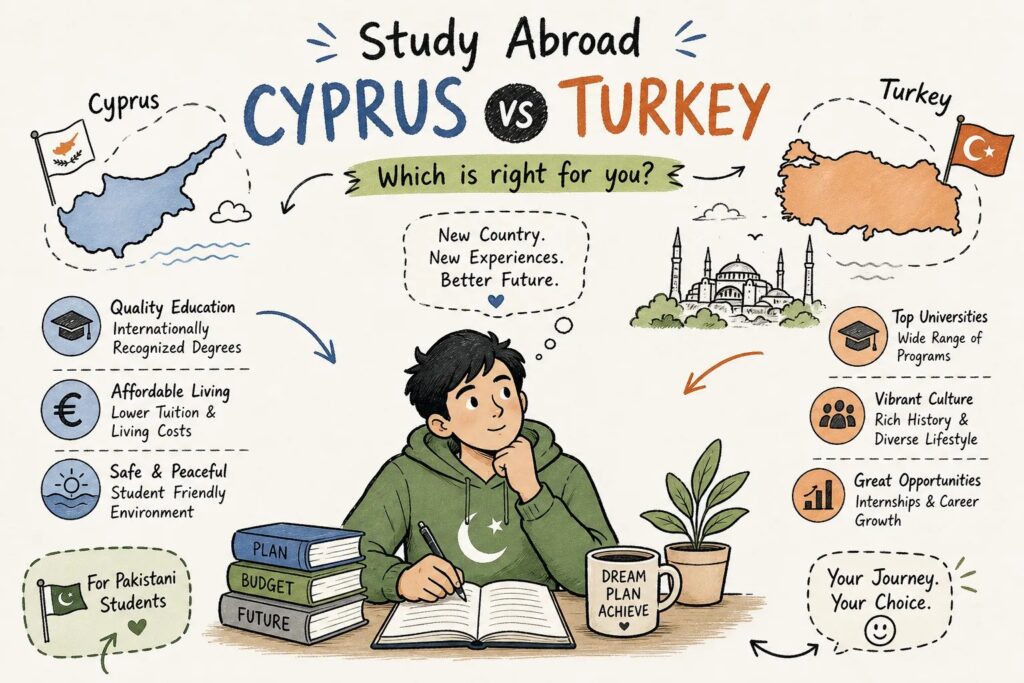
Every week, students in Gujranwala, Lahore, and Karachi open YouTube, watch a few videos, read some WhatsApp forwards, and walk away convinced they know which country is cheaper, easier to get into, and better for their future. Based on what we see at our consultancy, most of what they have heard is incomplete. Some of it is flat-out wrong.
When comparing Cyprus vs Turkey for Pakistani students, both destinations are legitimate choices. Both offer English-medium programmes, relatively accessible admissions, and a Muslim-majority or Muslim-friendly social environment. But the cost difference between the two, once you account for living expenses and scholarship realities, can reach $7,000 to $9,000 per year, roughly 19 to 25 lakh rupees at current exchange rates. That is not a rounding error. That is a family’s savings.
At MUSAFAT Student Consultants, we have been processing applications to both destinations for over two decades. We see the same confusion play out time and again: a student compares a TRNC university’s headline tuition with a Turkish public university without realising they are comparing completely different cost structures. By the end of this article, you will have actual numbers and a clear way to assess which destination makes sense for your academic profile, budget, and career plan.
Cyprus vs Turkey for Pakistani Students, Tuition Fees in 2026
What Turkish universities actually charge
Turkey has a wide fee range, and the gap between public and private universities is significant. Turkish public universities charge $240 to $1,500 per year for Turkish-medium programmes and $1,000 to $4,000 per year for English-medium undergraduate degrees. Private (foundation) universities are a different category entirely: expect $3,200 to $9,000 per year for non-medical programmes. Medical and dentistry degrees at private Turkish universities can reach $12,500 to $29,000 annually. Pakistani students frequently make the mistake of comparing a public university’s fee with a private one, then concluding “Turkey is cheap.” The range is too wide for that generalisation to mean anything useful.
What North Cyprus universities actually charge
North Cyprus universities advertise headline tuition of $1,400 to $6,500 for most undergraduate programmes. The important detail is that nearly all international students receive an automatic 30% to 50% discount, bringing the effective cost for non-medical degrees to roughly $1,800 to $3,500 per year. Medical programmes are the exception: even after scholarship discounts, expect $8,000 to $12,000 annually. Full scholarships of up to 100% do exist at TRNC universities, but they are highly competitive and not the figure a student should plan around from the start.
If tuition were the only factor, Turkish public English-medium programmes and TRNC post-scholarship fees are in a broadly similar range. The gap that actually changes the decision is in monthly living costs.
Living Cost Comparison, Nicosia vs Istanbul and Ankara
The real cost of living in North Cyprus
This is where the “North Cyprus is cheap” narrative breaks down. Northern Nicosia, which is where most TRNC university students are based, is part of the Turkish Republic of Northern Cyprus and operates primarily on the Turkish lira, though many landlords and universities quote prices in US dollars due to the island’s import-heavy economy. Prices reflect this: shared accommodation in Nicosia runs $400 to $600 per month, and a private one-bedroom apartment costs $700 to $1,000. Food, utilities, and transport push the monthly total to $1,200 to $1,800. That is the realistic monthly budget for a student living in Nicosia.
What students actually spend in Turkey
A student sharing accommodation in Istanbul spends $150 to $350 per month on rent, with a total monthly budget of $700 to $1,300 depending on lifestyle. Ankara is 20 to 30% cheaper across most categories: shared rooms at $120 to $250, total monthly spend around $550 to $1,000. Students in smaller Turkish cities spend less still. The living cost difference between Ankara and Nicosia alone can exceed $7,000 to $9,000 per year.
When you add tuition and living costs together, the full picture looks like this: a Turkish public English-medium programme in Ankara without a scholarship costs approximately $3,500 to $6,000 per year in total. For non-medical TRNC programmes, post-scholarship tuition combined with Nicosia living costs brings the annual total to roughly $5,000 to $7,300. For medical and dentistry programmes at TRNC universities, the same calculation produces $9,200 to $13,800 annually. That is not a marginal difference. Over a four-year degree, the gap runs into tens of thousands of dollars. Students and families who choose North Cyprus for cost reasons are often working from incomplete information.
Visa Process, Turkey vs North Cyprus for Pakistani Students
The Turkish student visa: what you need
The Turkish student visa process for Pakistani applicants is well-established. Based on Turkish embassy requirements and university international office guidance, you will need your university acceptance letter, MOFA-attested academic transcripts, financial proof, a police clearance certificate, a medical certificate, and a valid passport. Financial documentation is scrutinised closely, so bank statements need to reflect genuine funds over a sustained period, not a sudden deposit.
The TRNC student visa: the step most agents skip
The TRNC visa process carries a detail that many students only discover after accepting their offer. Because there are no direct flights from Pakistan to Ercan Airport in North Cyprus, every student must also obtain a Turkish double transit visa, since all routes pass through a Turkish airport. These are two separate legal documents, and both must be secured before purchasing flight tickets.
The TRNC student visa itself (Category F-1) requires attested academic records, a police clearance, a medical certificate that includes HIV, Hepatitis, and TB test results, and proof of financial support. Processing takes four to six weeks. The Turkish transit visa typically processes within three working days but should be applied for at least one month before travel.
Upon arrival in North Cyprus, the student visa is a short-stay entry permit only. It must be converted into a Student Residence Permit within one month of arrival, which requires university registration documents, a local medical check, and a permit fee of approximately $170. Students who do not begin this process immediately after landing create problems for themselves. Do not rely on verbal assurances from agents about timelines. Confirm every step in writing before booking flights.
Scholarships, Turkey’s Strongest Card and North Cyprus’s Reality
Türkiye Bursları: the most generous package in either destination
Turkey holds a significant advantage here, and it comes from one programme: Türkiye Bursları. This fully funded government scholarship covers tuition, university accommodation, comprehensive health insurance, a return air ticket from Pakistan, and a monthly stipend of 3,500 TL for undergraduates and 5,000 TL for Master’s students. It also includes a one-year Turkish language preparation course. For Pakistani students who qualify, this is the most generous funding package either destination offers.
The application window for 2026 ran from 10 January to 20 February. Eligibility requires Pakistani nationality, age below 21 for undergraduates, and a minimum academic score of 70% (90% for health sciences). The programme is extremely competitive globally, with an acceptance rate estimated at 3 to 4%. Pakistani bachelor’s applicants face particularly strong competition, with success rates estimated at 2 to 4%. Competitive applicants typically carry 80% or above in their academic records, not just the minimum threshold. Extracurricular profile and motivation essays matter as much as grades.
Scholarships for Pakistani students in North Cyprus
North Cyprus has no equivalent government scholarship for Pakistani students. Students rely on university-specific merit waivers from institutions like Near East University, Cyprus International University, and Eastern Mediterranean University. These typically cover 25% to 50% of tuition. Students should apply directly to the international admissions offices of TRNC universities between January and March for the autumn intake, since these waivers are not centrally advertised and availability is institution-specific.
Language of Instruction, Degree Recognition, and Post-Study Reality
TRNC universities deliver the majority of their programmes in English, which is a practical advantage for Pakistani students who want to begin their degree immediately without a language preparation year. Turkish public universities are a different story: many of the most competitive programmes are delivered in Turkish. Students who choose a Turkish-medium programme should factor in one full year of language preparation before the degree begins, which adds to both cost and time.
Post-study work is an important consideration that students rarely research before applying. Turkey does not offer a formal post-study work visa equivalent to the UK’s Graduate Route. International graduates can apply for an employer-sponsored work permit, but the employer must initiate the application and justify hiring a foreign national. There is a one-year job-seeker residence permit that allows graduates to remain in Turkey while searching for employment, but securing a work permit is employer-dependent and not guaranteed. For Pakistani graduates who plan to work in Europe after their degree, Turkey offers broader international degree recognition than North Cyprus.
TRNC is a self-declared republic recognised only by Turkey and not by the European Union. Degrees from TRNC universities are not automatically recognised across EU member states. Programme-specific accreditations such as ABET for engineering and WFME for medicine improve the situation for specific fields, and Near East University is listed on Germany’s anabin database through the Turkish higher education system. Students who plan to work or pursue postgraduate studies in Europe after graduating from a TRNC university must verify recognition directly with the relevant authority in their target country before they enrol, not after.
Which Destination Actually Fits Your Profile?
If you are applying for or genuinely competitive for the Türkiye Bursları scholarship, Turkey is the clear answer. No other funding package in either destination comes close. If you are comfortable with a Turkish-medium programme or a one-year language preparation course, Turkish public universities offer lower living costs, a well-established Pakistani student community of 5,000 to 6,000 students, and broader degree recognition. Pakistani student associations like PaksTurk and PSATurkiye are active in both Istanbul and Ankara, providing orientation support, housing guidance, and regular community events for new arrivals.
North Cyprus suits a narrower profile. It works well for students who want English-medium instruction from day one without a language year, who have a mid-range budget and are not counting on a fully funded scholarship, and who are applying to medical programmes where TRNC remains competitively priced even after the living cost difference is factored in. The campus environment in Nicosia is smaller and more internationally diverse, which some students prefer.
The wrong choice between these two destinations can cost a student’s family the equivalent of hundreds of thousands of rupees across a three or four-year degree. This is not a decision to make based on a YouTube video or a WhatsApp recommendation from someone who attended a university open day.
At MUSAFAT Student Consultants, we have guided Pakistani students through the Türkiye Bursları application process, the TRNC transit visa requirement, and the documentation standards that actually hold up under embassy scrutiny. Our founder holds qualifications as an Advocate High Court and a British Council Trained Agent. We offer an honest assessment of your profile, not a sales pitch for whichever destination pays us a commission.
Make the Call Based on Numbers, Not Brochures
In the Cyprus vs Turkey comparison for Pakistani students, Turkey wins on scholarship depth and lower living costs. North Cyprus wins on English-medium instruction and straightforward merit scholarships for students who do not meet the Türkiye Bursları eligibility criteria or missed the application window. Neither destination is universally better. The right answer depends on your academic marks, your family’s budget ceiling, your preferred language of instruction, and what you plan to do with the degree once you graduate.
If you are comparing Turkey and North Cyprus for a 2026 or 2027 intake, start with the total annual cost of attendance, not the headline tuition figure. Check the Türkiye Bursları eligibility criteria honestly against your academic profile. If you are considering TRNC, confirm the transit visa requirement and the degree recognition status in your intended post-graduation country before you sign anything. These steps take an hour. Skipping them can cost years.
If you want a straightforward assessment of which destination fits your specific profile and marks, reach out to MUSAFAT Student Consultants in Gujranwala. We will tell you what we actually think, not what you want to hear.