
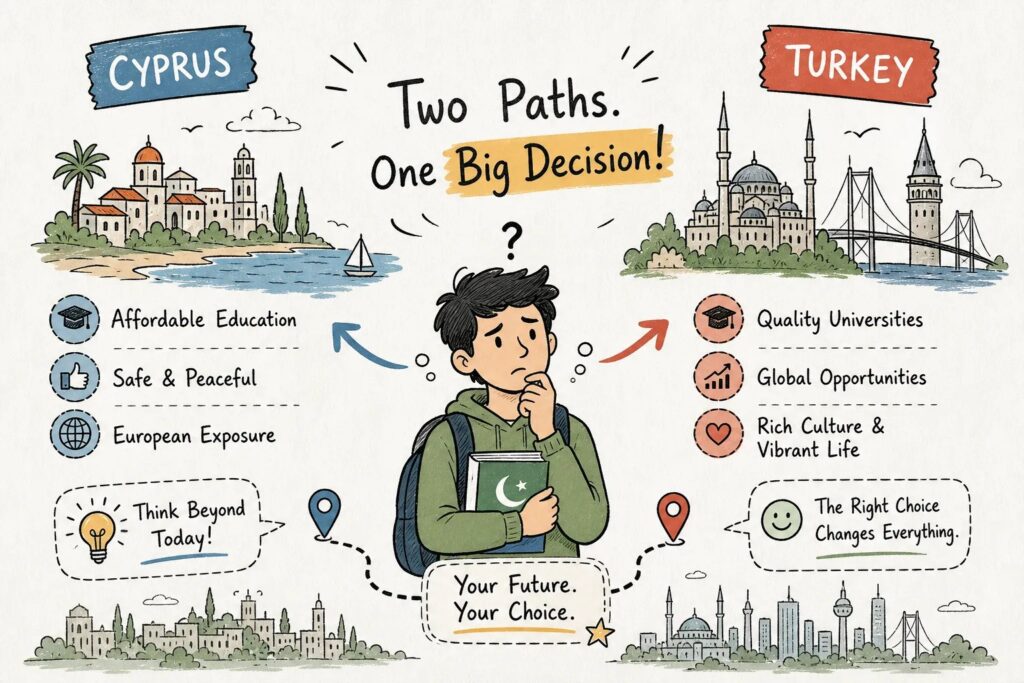
Both Turkey and Cyprus appear on every list of affordable study destinations for Pakistani students. Both offer English-medium programmes. On a comparison chart, they look almost identical. In practice, they are not, and the question of which is better for Pakistani students, Cyprus or Turkey, deserves a more honest answer than most consultancy websites will give you.
The honest answer is always the same. The right choice comes down to three things: your budget, your programme, and where you want your career to go after graduation. Pick the wrong country for the wrong reason and the regret shows up later, usually when the monthly expenses pile up or the degree does not carry the recognition you expected.
This article walks through each factor with real numbers. No sales pitch for either destination. Just the facts you need to make a clear decision.
Tuition fees: Turkey is cheaper, but the gap depends on your programme
Turkey’s public universities charge Pakistani students between $300 and $2,000 annually, depending on whether the programme is Turkish-medium or English-medium. Turkish-medium programmes at public universities sit as low as $300 to $800 per year, making them the most affordable degree option in either country by a significant margin. English-medium public programmes at institutions like METU or Boğaziçi run $1,000 to $2,000 annually, which translates to roughly ₨278,000 to ₨556,000 (approximate as of 2026).
Private universities in Turkey are a different story. General English-medium programmes cost $3,000 to $8,000 per year, and top-tier private institutions like Koç and Sabancı charge $8,000 to $15,000. Medical and dental programmes at private Turkish universities can reach $44,000 annually, placing them in a separate category altogether.
Public vs private: Cyprus tuition compared
Cyprus sits higher across the board. Public institutions in both the Republic of Cyprus and North Cyprus (TRNC) charge €1,500 to €4,000 annually, approximately ₨455,000 to ₨1,212,000. Private universities range from €2,500 to €8,000 per year, or roughly ₨758,000 to ₨2,424,000 (approximate as of 2026). North Cyprus is typically 15 to 20% cheaper than South Cyprus for private education, which partly explains the popularity of universities like Near East University and Cyprus International University among Pakistani students in the region.
If budget is the primary concern and a student is willing to study in Turkish or enter through a Turkish-medium public programme, Turkey wins decisively. If the student wants English-medium instruction at a recognised private university, the gap between the two countries narrows considerably.
The visa process: two different systems, one major surprise
Student visa from Pakistan to Turkey: steps and documents
Turkey requires a physical sticker visa applied for at the Turkish Embassy in Pakistan before departure. This is not an e-Visa; it must be obtained in person, and processing takes four to eight weeks. Core requirements include an admission letter from a YÖK-accredited institution, proof of funds showing at least PKR 1,000,000 (approximately $7,000 annually), IBCC, HEC, and MOFA-attested academic documents, health insurance with a minimum coverage of €30,000 per the Turkish Embassy’s student visa guidelines, and a police clearance certificate.
The most common refusal reasons are insufficient funds documentation, applying to a university that lacks YÖK accreditation, an expired passport, and unpaid tuition. The accreditation point matters more than most students realise: if the university does not appear on YÖK’s list, the visa application is essentially dead on arrival.
TRNC route vs Republic of Cyprus visa
North Cyprus presents a complication that catches many students off guard. The TRNC is not a UN-recognised state, and Pakistan does not issue a separate TRNC student visa, there is no TRNC embassy in Pakistan. Students must first obtain a valid Turkish sticker visa, travel to North Cyprus via Turkey, and then apply for a student residence permit through their university after arrival. That post-arrival residence permit process takes a further two to four weeks. It works, but it is a two-step process that must be planned accordingly.
The Republic of Cyprus operates differently. As an EU member state, South Cyprus has a more internationally standardised student visa process with stronger legal standing. Students who conflate “Cyprus” with “North Cyprus” often miss this distinction entirely, and it matters enormously for documentation, timelines, and post-graduation outcomes.
Monthly living costs: the number that changes the whole calculation
Cost of living: Istanbul vs Nicosia
This is where the two destinations genuinely diverge. A student in Istanbul manages comfortably on $400 to $700 per month, covering shared rent ($150 to $350), food ($100 to $200), a monthly transport pass (roughly $27), and utilities including internet ($50 to $80). Ankara and Izmir come in at roughly the same range or slightly lower, making any Turkish city a genuinely affordable base for a student on a Pakistani family budget.
Cyprus tells a different story. Nicosia, the capital of the Republic of Cyprus, runs approximately $1,200 to $1,600 per month for a student (based on available student budget estimates). Famagusta, which hosts most of the TRNC universities, is more manageable at $1,000 to $1,400 per month but still represents two to three times what a student would spend in a comparable Turkish city.
To put that in concrete terms: over a 36-month undergraduate programme, a $600 monthly gap between Famagusta and Istanbul adds up to roughly $21,600, and that is before accounting for the higher-cost Nicosia end of the range. For self-funded students, Turkey’s lower cost of living may matter more than any difference in tuition fees. A cheaper tuition in Cyprus does not help much if the monthly living costs erode the savings within the first semester.
English-taught programmes and what the language requirements actually mean
Both countries offer genuine English-medium options, but the depth differs. In Turkey, the best English-medium public universities, specifically METU, Boğaziçi, Koç, Sabancı, and Bilkent, are highly competitive and research-oriented, with strong programmes in engineering, business, and social sciences. Private universities offer a wider range of English-medium options with lower entry requirements.
Most Turkish universities accept IELTS 6.0 to 6.5, TOEFL iBT 80 or above, or an English Medium of Instruction certificate from a Pakistani school or college. That last option matters: students who completed their studies at an English-medium institution in Pakistan can often bypass IELTS entirely by submitting the certificate. Some private universities also use their own internal proficiency tests. For students enrolled in Turkish-medium public programmes, a one-year Turkish language preparation year is compulsory before the degree begins.
In Cyprus, English is the default medium at most private universities, and the IELTS requirements are broadly similar: 6.0 to 6.5, with comparable exemption pathways available. Near East University, University of Nicosia, and Cyprus International University are the most popular English-medium choices for Pakistani students in the region. The key difference is that Turkey’s top English-medium public universities carry stronger research credentials and are more selective, while Cyprus private universities have lower entry bars but charge more for the privilege.
Scholarships and financial aid: where Turkey pulls far ahead
This section has a clear answer: Turkey wins, and it is not close. The Türkiye Bursları scholarship is one of the most comprehensive government-funded scholarship programmes available to Pakistani students anywhere in the world. It covers 100% of tuition, provides monthly stipends (3,500 TL for undergraduates, 5,000 TL for Master’s students, and 6,500 TL for PhD students), free university housing, health insurance, and return flights.
Eligibility requires a minimum academic result of 70% for undergraduate applicants, 75% or CGPA 3.0 for postgraduate, and 90% for health sciences. Age limits apply: under 21 for undergraduate and under 30 for Master’s. Applications open in January and close in late February each year, so students need to plan well in advance. The application is entirely online through the official Türkiye Bursları portal and is free of charge.
Cyprus has no equivalent. Financial aid in Cyprus comes primarily through partial university merit scholarships, typically 25% to 50% tuition waivers, offered directly by institutions like Near East University and University of Nicosia to high-achieving applicants. Pakistani students can also explore HEC Overseas Scholarships for both destinations, provided the programme meets HEC’s accreditation standards. The contrast with Türkiye Bursları is significant: any student who meets the eligibility criteria should apply for the Turkish scholarship before considering a self-funded Cyprus route.
Post-study outcomes: matching the destination to your career plan
Degree recognition shapes how much your qualification is worth after graduation, and this is where the decision becomes genuinely consequential. Turkey’s YÖK-accredited degrees carry solid credibility in Pakistan, Gulf markets, and beyond. However, Turkey does not offer automatic post-study work rights. International graduates receive a six-month residence permit to search for employment, though some provisions may allow for variations depending on the graduate’s specific circumstances, after which an employer-sponsored work permit is required. It is a workable system, but it is employer-dependent rather than open, which limits flexibility for those who want to remain in Turkey after completing their degree.
The Republic of Cyprus presents a stronger post-graduation picture for students targeting Europe. As an EU member state, South Cyprus degrees carry full EU recognition under the Bologna Process, opening access to European employment and postgraduate study without additional verification. This is a material advantage for anyone with long-term plans in Europe, and no TRNC degree offers this.
TRNC degrees occupy a more complicated position. Established universities like Near East University hold programme-specific accreditations, such as WFME for medicine and ABET for engineering, that allow recognition in Pakistan through bodies like PMDC and PEC. However, TRNC degrees carry no EU status; in European public-sector contexts and regulated professions, they are treated as Turkish qualifications and often require additional validation.
Students targeting European careers should factor this in from the start, not after graduation. For those returning to Pakistan or working in Gulf markets, PMDC and PEC recognise accredited TRNC medical and engineering qualifications, which is sufficient for practice in Pakistan and broadly accepted in Gulf markets.
Cyprus or Turkey for Pakistani students: how to decide
If cost and scholarship potential are your priorities, Turkey is the stronger option. The living costs are significantly lower, public tuition for Turkish-medium programmes is the most affordable option in either country, and Türkiye Bursları is one of the best fully funded scholarships available to Pakistani students globally. For self-funded students on a tight budget, the monthly living cost difference alone makes Turkey the more sustainable choice over a three or four-year programme.
If EU degree recognition matters to your long-term plan, the Republic of Cyprus has a clear structural advantage over both Turkey and TRNC. TRNC universities offer an affordable middle ground with English instruction and established private institutions, but without the EU backing that a South Cyprus degree provides. That distinction needs to be decided upfront, not halfway through the programme.
When weighing up which is better for Pakistani students, Cyprus or Turkey, the answer depends entirely on your individual profile. There is no universal right answer, only the right answer for your grades, budget, field of study, and career goals.
At MUSAFAT Student Consultants in Gujranwala, we work through exactly these considerations with students every week. Our founder is an Advocate High Court and British Council Trained Agent with formal legal training in immigration law, which means we approach visa documentation and destination selection with a rigour that goes well beyond standard consultancy advice. If you are weighing up a degree in Turkey or Cyprus and want an honest assessment of which route makes sense for your profile, speak to our team before you decide.