
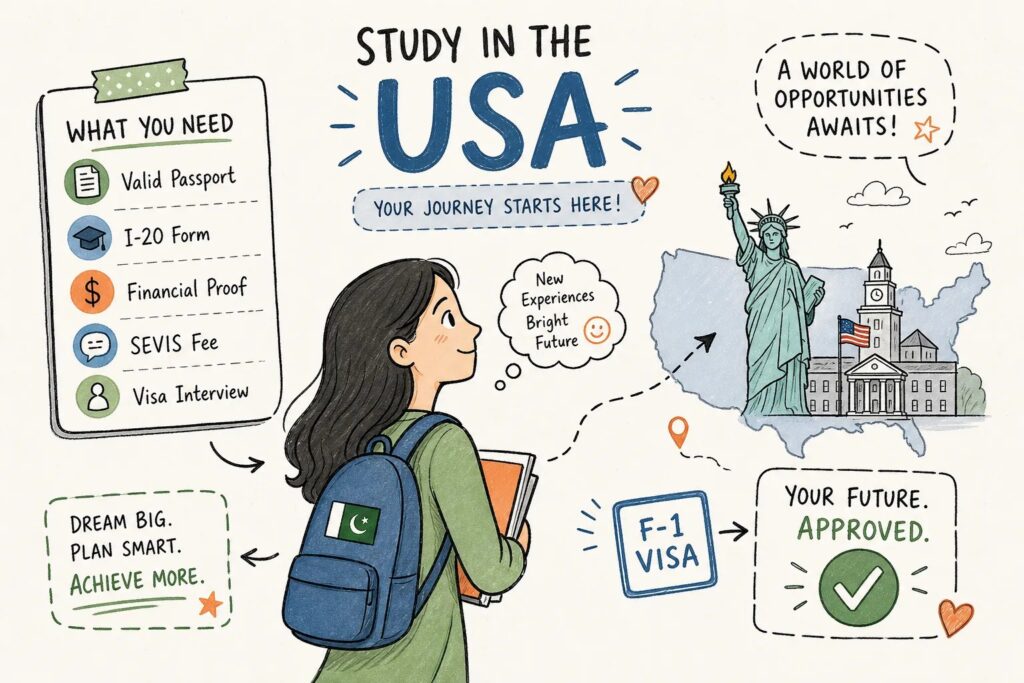
US Student Visa Requirements.Student visa USA requirements for Pakistani applicants are more involved than most expect. The F-1 visa is not one form and a bank statement, it is a sequence: SEVP-certified admission, a Form I-20, two separate fee payments, a completed DS-160, and a consular interview, all before you board a flight to the United States. Miss a step, get the order wrong, or submit financial documents that fall short of embassy standards, and your application stalls or is refused outright.
At MUSAFAT Student Consultants, we see a consistent pattern with students who come in for guidance. Many arrive already confused about the difference between the SEVIS I-901 fee and the MRV visa fee. Others bring bank statements full of sudden large deposits that raise immediate red flags at the US Embassy. These are not minor oversights; they are the kinds of issues that result in rejection letters. Every one of them is avoidable when you know exactly what you are dealing with.
This article is a complete, step-by-step checklist of every document, every fee, and every interview requirement for Pakistani students applying for an F-1 student visa in 2026. Work through it methodically and you will know precisely what you are walking into.
Who qualifies for an F-1 student visa from Pakistan
Core admission and academic requirements
Before worrying about paperwork, confirm you meet the baseline. You must be accepted by a SEVP-certified US university, the only type of institution authorised to issue a Form I-20. For bachelor’s programmes, a Matric or O-Level qualification is the minimum academic entry point; for master’s programmes, a bachelor’s degree is required. Most universities expect a minimum GPA of around 2.5, and you must be enrolled as a full-time student. The minimum age is 18, with no upper limit.
English proficiency and intent to return
Most US universities require a minimum IELTS 6.5 or TOEFL iBT 80 for undergraduate admission, and IELTS 6.5 to 7.0 or TOEFL 90 to 100 for postgraduate programmes. Top-50 universities typically expect IELTS 7.0 or TOEFL 100 and above. Beyond language scores, the consular officer must believe you intend to return to Pakistan after graduation. Strong ties, family commitments, property ownership, or documented employment prospects at home, serve as evidence of this. These ties need to be visible in your application, not just mentioned verbally during the interview.
Student visa USA requirements: complete document checklist
Passport, I-20, and visa application forms
Every F-1 application rests on the same core documents. Your passport must be valid for at least six months beyond your intended stay in the United States. The Form I-20, issued by your admitted university, is the document that makes the F-1 visa possible, without it, there is no visa category to apply under. The DS-160 form confirmation page, completed at ceac.state.gov and printed with its barcode, must be carried to your interview. All three are irreplaceable.
Academic records and English test scores
Bring originals and clean copies of every academic qualification: Matric or O-Level certificates, Intermediate or A-Level results, bachelor’s and master’s degrees where applicable, full transcripts, and individual mark sheets. Your IELTS or TOEFL score report also belongs in this folder. These documents collectively tell the consular officer a coherent academic story. Gaps, missing transcripts, or inconsistencies between what you claim and what your paperwork shows will prompt hard questions.
Supporting evidence: photos, fee receipts, and ties to Pakistan
You will need two passport-size photographs, 2×2 inches with a white background. On the fee side, carry the MRV fee receipt ($185) and the SEVIS I-901 fee receipt ($350), both are covered in detail in the next section. To support your intent-to-return argument, include documentation that demonstrates ties to Pakistan: an employment letter, family business records, or property documents. These are supporting materials rather than primary evidence, but they can be decisive when a consular officer is weighing a borderline case.
Financial proof that actually satisfies the US Embassy
What counts as acceptable proof of funds
Bank statements covering the last three to six months are the primary financial document. The balance must match or exceed the estimated annual cost stated on your I-20, which typically ranges from $22,000 to $105,000 depending on the university and programme. Critically, the embassy is looking for consistent liquid balances over time, not a large deposit made the week before you applied. Consular officers routinely treat sudden large deposits as a solvency concern and scrutinise them accordingly. Fixed deposit certificates, official loan approval letters from reputable banks, and scholarship award letters from the university are also accepted as evidence of funds.
Sponsorship documents and the affidavit of support
If a parent or third party is funding your studies, the sponsor must submit a notarised affidavit of support alongside their own bank statements, income tax returns for the last three years, and a current employment letter. The consular officer will scrutinise the sponsor’s financial health with the same rigour applied to your own documents. One point worth remembering: property documents alone are not accepted as primary financial proof. Liquid assets, cash, and readily accessible investments carry far more weight. Property can strengthen a case when it appears alongside solid bank statements, but it cannot substitute for them.
Fees, timelines, and the step-by-step application process
SEVIS I-901 fee and US student visa requirements: what you must pay
Pakistani F-1 applicants in 2026 face the following fees. The MRV fee is $185, paid before scheduling your interview via the US Embassy Pakistan portal, typically through an authorised bank using a deposit slip. The SEVIS I-901 fee is $350, paid online at fmjfee.com using your SEVIS ID from the I-20; Pakistani students can pay with a Visa, MasterCard, or American Express card enabled for international transactions. A third charge, a new $250 Visa Integrity Fee approved in July 2025, had not yet been collected as of mid-2026 but is expected to come into effect before 30 September 2026. All fees are non-refundable. Print every receipt and carry them on interview day.
Step-by-step: from I-20 to your interview appointment
The sequence matters. Follow it in order:
- Receive your Form I-20 from your admitted SEVP-certified university.
- Complete the DS-160 form at ceac.state.gov and print the barcode confirmation page.
- Pay the MRV fee and then the SEVIS I-901 fee; print both receipts.
- Schedule your interview at ustraveldocs.com/pk. Only Islamabad and Karachi conduct F-1 interviews; there is no consular section in Lahore.
- Attend your interview. Biometrics (fingerprints and photograph) are collected at the embassy on the day, not at a separate pre-scheduled appointment.
As of mid-2026, routine appointment wait times are approximately 45 days at the US Embassy in Islamabad and around two months at the Consulate in Karachi. During peak season, particularly the summer intake rush, Islamabad wait times can stretch to 20 or more weeks. Book your interview appointment as soon as your I-20 arrives. Do not wait until the offer feels sufficiently confirmed.
How to prepare for your F-1 visa interview in Pakistan
What to bring on the day and what to expect
Arrive 30 minutes early at the US Embassy in Islamabad or the Consulate in Karachi. Bring every document from the checklist above, originals and clean copies, organised in a folder. The consular officer will ask questions, take your biometrics, and issue a decision. Routine approvals are processed within a few business days. If your case is flagged for administrative processing under Section 221(g), expect a wait of 60 days or more before receiving a final outcome.
Answering questions about your study plans and finances
A consular officer probes several key areas: why you chose this university, how you will fund your studies, and why you will return to Pakistan after graduating. Your answers must be specific and consistent with what is written in your I-20 and DS-160 form. Common questions include:
- Why did you choose the United States over studying in Pakistan?
- Who is sponsoring your education and what is their income source?
- What does your chosen major involve?
- What is your post-graduation plan in Pakistan?
Vague answers and scripted responses are both common reasons for refusal. Understand the logic behind each question and answer it in plain language. The interview is too short and the officer too experienced for a rehearsed script to work in your favour.
Why a trained immigration professional gives your application an edge
The difference between a consultancy and an immigration law firm
Most education consultants help students fill in forms. What they cannot do is review an application with the legal eye of someone trained in US immigration law: identifying weaknesses in a financial proof narrative, spotting inconsistencies between a DS-160 and an I-20, or recognising the specific red flags a consular officer is trained to catch. That is a different skill set entirely, and for Pakistani applicants, who face a high standard of scrutiny at both Islamabad and Karachi, the distinction matters when meeting US student visa requirements.
How MUSAFAT’s legal background supports F-1 applicants
At MUSAFAT Student Consultants, we have been working with Pakistani students since 2004, over 22 years of experience across visa applications, refusals, reapplications, and successful approvals. Our practice is founded by an Advocate High Court and British Council trained agent whose US immigration law training comes from the University of Pennsylvania. That legal background directly shapes how F-1 applications are compiled, reviewed, and submitted. If you have a previous refusal on record, a complicated sponsorship structure, or simply want your application reviewed with genuine legal rigour before submission, we can help. Get in touch with our team in Gujranwala or reach out online well ahead of your September 2026 or January 2027 intake deadline.
Putting it all together
Satisfying student visa USA requirements comes down to methodical preparation across three stages: getting your documents in order (I-20, DS-160 form, academic records, and financial proof), paying your fees in the correct sequence, and preparing thoroughly for the consular interview. None of these stages is inherently difficult, but each has specific requirements that, if ignored or rushed, create problems that can take months to resolve.
Know which bank statements to submit and why. Know the fees before you log into the payment portal. Know what the consular officer is looking for before you sit down across from them. Approach it that way and the process becomes manageable rather than intimidating.
Professional support from someone with immigration law expertise is not a luxury reserved for complicated cases, it is an investment in avoiding a reapplication. With September 2026 and January 2027 intake deadlines on the horizon, the earlier you begin working through your F-1 checklist, the more time you have to address any issues before they reach the embassy counter.