
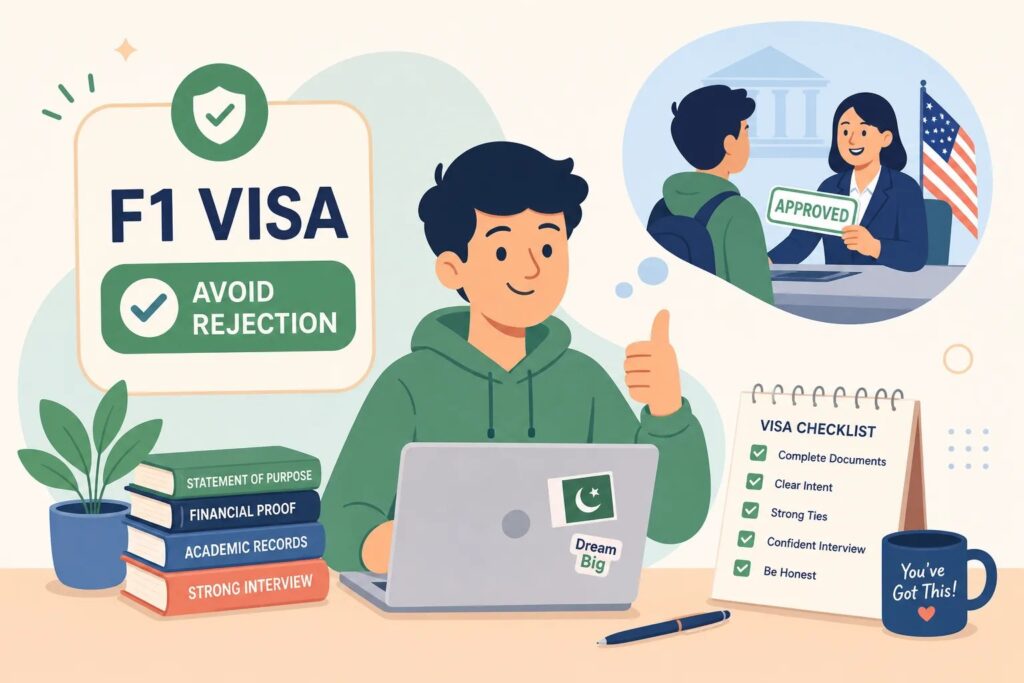
How to avoid F1 visa rejection starts with understanding exactly why Pakistani applications fail, and then fixing those weaknesses before your appointment. Pakistan holds the highest F-1 visa refusal rate in the world at 71%, nearly double the global average of 41%. With a 71% refusal rate, roughly 29% of applicants are approved, fewer than one in three. The odds are not random, and they are not about luck. The same three or four weaknesses show up in most denied cases, and every one of them is correctable before you sit down across from a consular officer in Islamabad.
At MUSAFAT Student Consultants, the same patterns have emerged repeatedly across two decades of working with Pakistani students through US visa applications: incomplete financial documentation, a generic Statement of Purpose that reads like a template, and little to no evidence of genuine ties to Pakistan. This article breaks down each of those failure points and tells you exactly what to fix. By the end, you will know how to build a case strong enough to satisfy a sceptical consular officer, and what to do if a denial has already landed in your hands.
Why F-1 applications from Pakistan fail at such a high rate
What Section 214(b) actually means for your application
US immigration law operates on a presumption that every applicant intends to stay permanently unless proven otherwise. This is the core of Section 214(b) of the Immigration and Nationality Act, and the burden of proof sits entirely on you, not the consular officer. The officer is not required to doubt you; you are required to convince them. That distinction changes how you should approach every single document in your file and every answer you give in the interview room.
This presumption makes financial evidence, academic alignment, and personal ties to Pakistan the three pillars of a successful application. Weakness in any one of them is often enough to trigger a refusal. Publicly available refusal-rate data for high-scrutiny countries, including Pakistan, reflects a consistent tightening of nonimmigrant intent assessments that has accelerated through 2025 and into 2026.
Why Pakistan’s refusal rate tells a bigger story
The 71% figure is not a character judgement on Pakistani students. It reflects a documentation and preparation gap that is entirely addressable. To put it in context, India’s refusal rate climbed from 36% in 2023 to 61% in 2025, driven by the same structural issues. African applicants face a rate of roughly 64%. The common thread across all high-refusal regions is that consular officers are not being given the specific, well-organised, and legally credible evidence they need to approve an application under the 214(b) standard. Fix the documentation, and the statistics stop being your problem.
How to avoid F-1 visa rejection: fixing financial proof
What consulates actually want to see in your bank documents
Bank statements must be originals on official letterhead, dated within three to six months of your interview, and showing a clear liquid balance. The common mistake Pakistani applicants make is submitting a thick stack of transaction history pages when what the consular officer needs is a single-page summary showing a stable, accessible balance. Long transaction histories can actually work against you if they reveal inconsistent patterns or raise questions about the source of funds.
Six to twelve months of consistent balance history is far more persuasive than a last-minute top-up. A large deposit that appeared in your account two weeks before the interview is one of the most reliable ways to trigger suspicion. The balance should match or exceed the Cost of Attendance figure on your I-20, which for most one-year US programmes falls between USD 30,000 and USD 75,000, with USD 45,000 to 70,000 being the realistic target for Pakistani applicants.
Sponsor letters and financial affidavits that hold up under scrutiny
If a parent or family member is funding your education, a signed sponsor letter is required alongside their bank statements, pay slips, tax returns, and employment letter. The sponsor letter must state clearly that they are committing to cover your tuition and living costs for the duration of the programme. If your sponsor is a US citizen, the Form I-134 (Affidavit of Support) is the specific document required, not a generic letter.
Education loan sanction letters from recognised Pakistani banks such as HBL or MCB are accepted as supporting evidence when personal funds are limited. These letters must show the approved loan amount and disbursement timeline, and they work best when paired with consistent bank statements rather than presented as the sole source of funding. A combined case, stable family savings, a sponsor letter with employment proof, and a sanctioned loan, is structurally stronger than any single document on its own.
How to avoid F-1 visa rejection: SOP and academic alignment
What makes an SOP convincing rather than generic
Officers review large volumes of Statements of Purpose and quickly identify generic or templated language. Phrases like “I want to advance my career in a globally recognised institution” tell the officer nothing specific and raise the question of why this particular university, in this particular country, was chosen above all others. Be specific from the very opening lines, it is the only thing that signals genuine academic intent.
A strong SOP names a specific professor whose research aligns with your academic interests, references a programme module or research project that does not exist in Pakistan, and connects the degree directly to a named career outcome back in Pakistan. The logic chain must be clear: you have a specific academic goal, this programme is the best path to it, and the resulting qualification leads directly to a role or opportunity in Pakistan. Without that chain, the SOP reads as immigration intent dressed up as academic interest. Specificity is what separates a credible SOP from one that raises more questions than it answers.
Aligning your degree choice with your prior academic background
A mismatch between your previous qualification and your chosen US programme is a recognised red flag. An FSc student applying for an MBA without a bridging explanation, or a commerce graduate applying for a Master’s in Biomedical Engineering, will face immediate questions about academic coherence. Consular officers are looking for a logical educational trajectory, and any gap in that trajectory needs to be addressed directly in the SOP rather than left for the officer to interpret.
Be honest about the gap and explain it in terms of professional experience or self-directed learning that bridges the two qualifications. Ignoring a mismatch never helps; addressing it with a clear, confident explanation almost always will. The core logic consular officers are looking for is straightforward: did you choose this programme because it is the right next step in your education and career, or because you wanted to get to the US?
Proving genuine ties to Pakistan before the interview
The documents that carry the most weight with consular officers
This is the area where most Pakistani applicants are weakest, and it is also where a strong portfolio can shift an application from marginal to credible. Four categories of evidence carry the most weight:
- Property deeds or land title documents. Property is viewed as a non-abandonable financial commitment, and its existence matters more than its value.
- The NADRA Family Registration Certificate (FRC). This is the gold standard for proving family structure and legal responsibilities within Pakistan. It is obtainable online through the Pak-ID portal within 24 to 48 hours at a fee of Rs. 1,000, so there is no excuse for leaving it out of your file.
- An employer letter or No Objection Certificate (NOC). This must confirm a named position waiting for you upon return, including your job title, length of service, and expected return date.
- Business registration documents. For self-employed applicants or family business heirs, these establish your ownership stake and ongoing operational responsibilities.
Each of these documents represents a tangible reason to return, and together they form the factual foundation of your nonimmigrant intent case.
How to frame your ties as a coherent case, not a random pile of documents
Submitting individual ties documents in isolation is less effective than presenting them as a connected narrative. The documents should tell one consistent story: you have a family business to return to, a property you own, and family obligations that make remaining in the US not just unlikely but logistically and financially irrational. The narrative must make returning home the logical outcome of completing your degree, not a reluctant concession.
When you present your ties evidence in the interview, connect each document to a specific consequence of your return. The property means ongoing rental income or family housing. The family business means a pre-agreed operational role. The NADRA FRC means parents and siblings who depend on your presence. Every document should answer the consular officer’s unspoken question: what is pulling you back?
Interview preparation and DS-160 mistakes to avoid before your appointment
High-impact answers to the questions consular officers always ask
Officers conducting F-1 interviews recognise scripted answers immediately, and a scripted non-answer is worse than a hesitant but genuine one. The four questions that appear in almost every F-1 interview are: why this university, who is funding you, what will you do after graduation, and what ties do you have to Pakistan. Each answer must be specific, quantified where possible, and connected to a named outcome in Pakistan.
For example, on funding: “My father, who holds a senior position at a logistics firm in Gujranwala, is sponsoring me. His annual income is PKR 8 million, and I also have a PKR 4 million education loan sanctioned from HBL.” On ties: “I will return to manage our family’s logistics operations, where I have a pre-agreed role as Head of Operations. We also own a residential property in Gujranwala valued at PKR 15 million.” Quantification tells the officer that your answers are grounded in verifiable reality, not vague assurances.
The DS-160 and document checklist to review before your appointment
The DS-160 is where technical errors cause avoidable damage. The programme dates on the DS-160 must match the I-20 exactly. Prior refusals must be disclosed honestly; any inconsistency between the DS-160 and your interview answers on this point is treated as misrepresentation. Social media accounts must all be listed, even ones you rarely use. Every field must be accurate because consular officers cross-check DS-160 answers against other documentation.
The documents to review before your appointment include: the I-20 with matching dates in the DS-160, bank statements covering three to six months at minimum (ideally six to twelve months of consistent history), the financial affidavit paired with sponsor employment proof, proof of SEVIS fee payment of USD 350 via FMJfee.com (pay at least three business days before the interview), IELTS or TOEFL results, academic transcripts from all previous institutions, your NADRA FRC, property documents, and any employer letter or NOC. Missing one of these does not guarantee a denial, but it hands the officer a reason to doubt the completeness of your case.
After a denial: how to reapply strategically
Practical steps and the right timing for a stronger reapplication
There is no mandatory waiting period after an F-1 denial, but reapplying within days with the same documents almost guarantees the same result. A realistic minimum of two to three months gives you time to gather new evidence that represents a material change in your circumstances. Cosmetic updates, such as reformatting the same bank statements or adding a new photograph, will not change the outcome. The new application must demonstrate that something substantive has changed.
Complete a new DS-160 for every reapplication and disclose the prior denial honestly. Pay the MRV fee again. If the programme start date on your original I-20 has passed, contact your Designated School Official for an updated I-20 before scheduling a new interview. Aim for twelve months of bank statements, a reconstructed SOP, fresh ties documentation, and a clear explanation of what has changed since the previous application. Note also that because Lahore is closed for nonimmigrant visa interviews as of 2026, most applicants from Lahore should expect to schedule in Islamabad or Karachi (where the category is accepted). Check travel.state.gov for post-specific status and current wait times, which have been running at approximately six to twelve weeks at the Islamabad post.
When immigration law expertise gives your case a structural advantage
Professional documentation review, SOP reconstruction, and structured mock interview preparation under expert guidance produces a structurally different case the second time around. That difference is what separates another refusal from an approval. Consultancies with formal immigration law training approach reapplications with the legal rigour that the 214(b) standard demands, reviewing not just what documents are present but whether they collectively satisfy the statutory burden of proof.
MUSAFAT Student Consultants combines formal immigration law expertise with direct experience preparing Pakistani students for the specific evidentiary standards applied at the Islamabad post. If you have already received a denial or want a professional review before your appointment, that preparation is available to you before you sit down in the interview room, not after.
The five fixable failure points, summed up
Every F-1 denial from Pakistan traces back to one or more of five addressable gaps: nonimmigrant intent not clearly established, financial documentation that is incomplete or recent rather than consistent, a generic SOP that does not demonstrate genuine academic purpose, an absence of tangible ties evidence, and interview answers that are vague when specificity is what the officer needs. None of these failures require a stronger academic profile or more money in the bank. They require more thorough preparation and a clearer understanding of what the consular officer is actually evaluating.
This is how to avoid F1 visa rejection as a Pakistani student: present a truthful, complete, and well-organised case that answers the consular officer’s core question before they ask it. Every gap described in this article is fixable. Fix them before your appointment, and if you want that preparation backed by immigration law expertise and direct experience with Pakistani applications, MUSAFAT Student Consultants is where that process starts.