
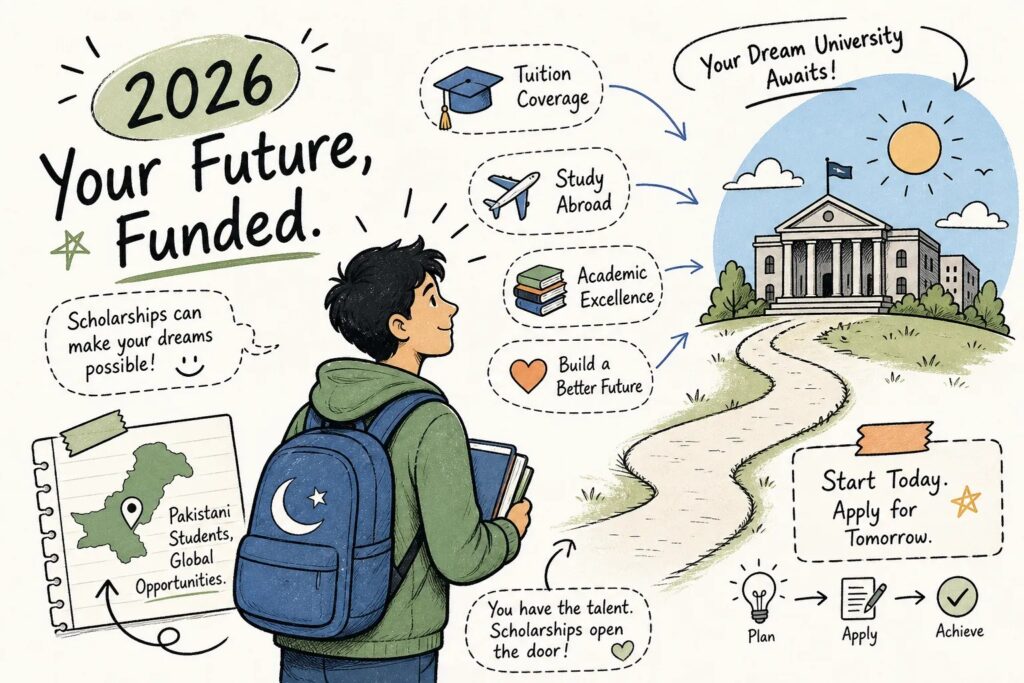
Pakistan produces a large number of postgraduate applicants every year, yet many eligible students never apply for the fully funded international scholarships that could cover every rupee of their education. This complete 2026 guide to scholarships for Pakistani students explains who qualifies, what each programme pays for, and how to prepare a competitive application. The gap between eligible and applying is often driven by preparation, timing, and awareness of where to look before deadlines arrive.
One essential step before any application: securing a competitive IELTS score. Nearly every programme on this list requires it, with most setting a minimum of 6.5 overall, though individual programmes and universities may accept TOEFL or other qualifications, so check official requirements carefully. Students across Punjab increasingly work with local consultants who pair IELTS preparation with scholarship counselling and study abroad guidance, making quality advice more accessible outside the major cities. MUSAFAT Student Consultants offers exactly this kind of combined support for students in Gujranwala and surrounding areas.
HEC scholarships for Pakistani students: preparing for the next cycle
Most HEC scholarship windows for the 2026 session have now closed, but the programme structures and eligibility rules remain consistent year to year. Students who understand the frameworks now will be significantly better placed when the 2027 cycle announcements open.
The Stipendium Hungaricum Programme is the most prominent HEC-administered option, offering fully funded Bachelor’s, Master’s, and PhD places at Hungarian universities. Eligibility requires Pakistani or AJ&K citizenship, no second or third divisions across the entire academic record, and a minimum 50% score in the HAT or USAT test. The 2026 application deadline was 15 January 2026. The 2027 cycle is expected to open in October or November 2026, following the same annual pattern. Students should monitor scholarship.hec.gov.pk now and begin preparing their academic records and test scores before the portal goes live.
The Chinese Government Scholarship (HEC Type-A) offers 75 fully funded seats annually across Bachelor’s (35), Master’s (25), and PhD (15) programmes at Chinese universities. Undergraduate applicants must complete the China Scholastic Competency Assessment (CSCA). The January 2026 portal deadline has passed, but the programme runs every year. Students should get their academic documents in order and prepare for the CSCA test now, ahead of the next announcement.
The US-Pakistan Knowledge Corridor PhD Scholarship places Pakistani students at top-50 QS-ranked universities, including Harvard and MIT, on a fully funded basis. Applicants need a 16-year BS degree or an 18-year MS/MPhil, no third divisions, and a GRE score of 300 or above. Age limits apply: 35 for general applicants and 40 for government employees. Both the Spring/Summer and Fall 2026 cycles are now closed. Students targeting Fall 2027 should begin GRE preparation immediately.
International scholarships for Pakistani students open or opening imminently in 2026
This section focuses on programmes with windows that are currently open or about to open, giving you actionable steps rather than historical context.
Chevening opens on 4 August 2026 and closes on 6 October 2026 at 11:00 UTC. This is the most time-sensitive deadline in this entire guide. Chevening funds one-year Master’s degrees at UK universities and covers full tuition, a monthly living stipend, return airfare, visa fees, and an arrival allowance. To be eligible, you need Pakistani citizenship, a completed undergraduate degree, at least 2,800 hours of work experience (roughly one and a half years), and a commitment to return to Pakistan for two years after the scholarship period ends. There are four essays to write, and they take time to do properly. Start drafting them now, before the portal opens on 4 August.
The DAAD development-related postgraduate courses (EPOS programme) for the 2027 intake typically accept applications between August and October 2026, with the primary deadline falling around 15 October 2026. Most DAAD tracks require two or more years of professional work experience and are field-specific, meaning you need to match your application to the right programme from the outset. For research-based grants, securing contact with a German university supervisor early in the process is essential. Applications go directly to the specific course or university, not to DAAD Pakistan.
The Fulbright Foreign Student Programme remains open for Pakistani applicants until approximately October 2026, covering Master’s and PhD programmes at US universities with full tuition, a monthly stipend, health insurance, airfare, and a book allowance. The US Embassy Pakistan administers the process locally. Australia Awards provide comparable full coverage for Master’s and PhD study, including OSHC health insurance; the 2027 intake announcement is expected in late 2026.
What “fully funded” actually means across different programmes
Many students chase the fully funded label without understanding how coverage differs between programmes, and end up financially stretched mid-degree. The breakdown matters.
Chevening covers full tuition at a UK university, a monthly living stipend roughly equivalent to PKR 200,000 to 350,000, return airfare, visa fees, and an arrival allowance for a one-year Master’s. Fulbright adds health insurance and a book allowance on top of a similar structure. DAAD offers a monthly stipend in the PKR 150,000 to 250,000 range; most German universities charge no tuition at all, making the net value comparable to Chevening in purchasing power terms.
Commonwealth Scholarships follow a structure similar to Chevening, covering tuition, flights, and a living allowance. Chinese Government Scholarships cover tuition, on-campus accommodation, and a monthly stipend; living costs in China are considerably lower than in the UK or Germany, so the real-world value holds up well. Among university-specific awards, the Bestway Foundation Scholarship at the University of Bradford stands out as one of the few awards explicitly targeting Pakistani Master’s students. It covers full tuition, accommodation at The Green, and £6,665 per year in living costs paid in three instalments, with five scholarships available annually for STEM fields. Applicants need a minimum 60% average in a four-year Bachelor’s degree and must be self-funded with demonstrated financial need. The 2026 application window ran from 1 April to 1 May, but the 2027 cycle will follow the same structure. The Stanford Knight-Hennessy Scholars programme is another university-specific option worth noting for graduate-level applicants with strong research profiles.
Realistic timelines and how competitive these awards actually are
Students who begin preparing three to four months before an application opens have a structural advantage over those who start the week the portal goes live. The numbers below are not meant to discourage; they are meant to show that preparation is the actual differentiator.
The Chevening timeline runs approximately ten months from application to first lecture: application opens early August, closes early October, shortlisting happens in December to January, interviews take place between February and April (held in Islamabad, Karachi, or Lahore), results are announced in mid-June, unconditional university offers are due by mid-July, and study begins in September. The global acceptance rate is approximately 2%. Pakistan receives roughly 20 to 40 scholarships per year from a pool of thousands of applicants, depending on the cycle. That is highly selective, but many applicants are screened out during the written stages. A well-crafted application gets further than most people expect.
DAAD’s development-related tracks accept approximately 10 to 15% of applicants globally, based on historical programme-level data, though figures vary by field and year. Commonwealth scholarships sit around 2 to 3%. Turkish Government scholarships and Chinese Government scholarships are more accessible, at estimated rates of 15 to 25% and 20 to 30% respectively, these are rough historical estimates and may vary by cohort. They remain strong options for students building their first international application. Fulbright acceptance rates for Pakistani applicants are estimated at 5 to 10%. Strategic targeting, matching your academic profile and work experience to the right programme, is what separates successful applicants from the rest.
What every strong scholarship application must include
Across all major programmes, certain documents are non-negotiable. Official academic transcripts must be stamped and in English; if originally in Urdu, certified translations are required. Check the passport validity requirement for each scholarship and associated visa process, many require at least six months of remaining validity, though some may require more, and renew your passport well in advance if needed. IELTS scores must meet the stated threshold: 6.5 overall with no band below 5.5 for Chevening; 6.5 or above for DAAD and most Commonwealth awards, though requirements vary by university and award. Competitive applicants in Pakistan typically present 7.0 or higher to improve shortlisting chances.
Beyond documents, the quality of three components determines most outcomes:
- Personal statement or essays: Chevening rewards demonstrated leadership and a clear plan to return and contribute to Pakistan. DAAD rewards research relevance and development contribution. Submitting the same statement across multiple scholarships is one of the most common and costly mistakes applicants make. Each essay must be written specifically for the programme.
- Letters of recommendation: Choose referees who know your work specifically, not those with the most impressive titles. A generic letter from a senior professor who barely remembers your name will lose to a specific, detailed letter from a supervisor who can speak to real contributions.
- CV: Tailor it to each scholarship’s stated values, highlighting research experience, leadership roles, and community impact. A generic résumé submitted unchanged across applications signals that the applicant has not engaged seriously with the programme.
Building a scholarship-ready profile before the next deadline opens
The Chevening window opens on 4 August 2026. For every other major programme, the next cycle is three to six months away. That gap is preparation time, and it matters for Pakistani graduates and postgraduate applicants alike.
Four things need to be locked in before any application portal opens:
- IELTS score: Take and retake the IELTS until you reach your target band. This is non-negotiable for Chevening, Fulbright, DAAD, and Commonwealth applications. No amount of strong essays will compensate for a score that falls below the threshold.
- CV: Update and tailor your CV to the specific scholarship’s values before you open the application form.
- Personal statement or essays: Draft these in advance and revise over several weeks rather than several days. Rushed essays are the single most visible sign of an under-prepared application.
- Referees: Brief your referees early and give them at least four weeks to write letters that are specific and compelling.
Students in Gujranwala, Hafizabad, and Wazirabad often assume they need to travel to Lahore or Islamabad to access quality scholarship guidance. That is not the case. MUSAFAT Student Consultants in Gujranwala offers IELTS preparation through experienced English language instructors alongside full study abroad counselling, covering university shortlisting, scholarship identification, SOP writing, and visa documentation, all under one roof. For students preparing for Chevening, DAAD, or other fully funded scholarships, having IELTS coaching and scholarship strategy available locally removes a real preparation burden.
The bottom line
Scholarship opportunities for Pakistani students are more accessible than most applicants realise, but they are not accessible to the unprepared. The programmes covered in this guide collectively fund hundreds of Pakistani students every year at universities in the UK, USA, Germany, Australia, China, and Hungary. The students who win these awards are not necessarily the ones with the highest grades. They are the ones who started early, matched their profile to the right programme, submitted clean and compelling applications, and walked into interviews ready.
If you are targeting Chevening or other fully funded scholarships for Pakistani students, preparation starts today. The window opens on 4 August 2026. If you are building towards the 2027 cycles for HEC programmes, the DAAD EPOS track, or Fulbright, you have time to bring your IELTS to where it needs to be, strengthen your profile, and enter the process with a genuine shot at a funded degree. The work you put in over the next three months will determine which side of the acceptance rate you land on.