
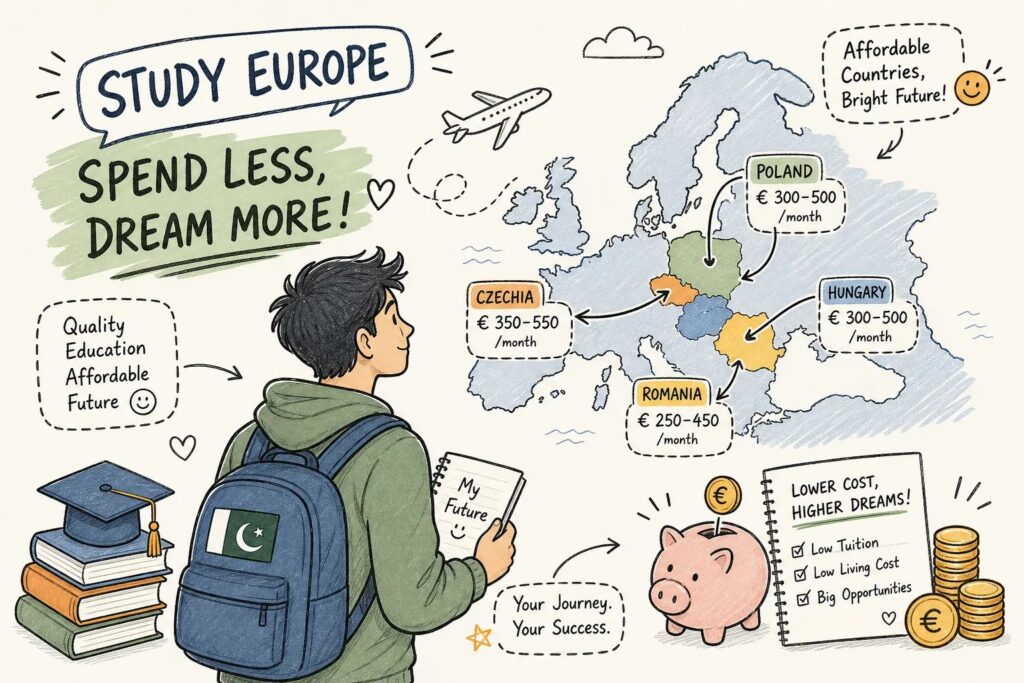
Most Pakistani families write off European universities the moment they hear the word “abroad.” The assumption is that it means UK-level fees, Western European living costs, and a budget that simply does not exist. That assumption is wrong for a significant number of countries, and the gap between perception and reality is costing students very real opportunities.
At MUSAFAT Student Consultants, the single most repeated question we hear from families is: what are the most affordable countries for Pakistani students to study in Europe? After more than 22 years of placing Pakistani students in universities across Turkey, Cyprus, Georgia, Hungary, and beyond, the answer is clear: affordable European study is entirely possible, but only if you look at the full annual cost, not just the headline tuition figure on a brochure.
This article breaks down the four strongest low-cost European destinations for Pakistani students in 2026, what they actually cost per year, what scholarships are available, and what the visa process looks like. By the end, you will have enough to shortlist two or three realistic options before making a single phone call.
What “affordable” actually means when comparing European destinations
Comparing countries on tuition fees alone is one of the most common planning mistakes Pakistani students make. A country with zero tuition but €900 per month in living costs will cost more annually than one charging €2,500 in tuition with €400 per month in expenses. The number that actually matters is your total annual outlay: tuition plus twelve months of living costs plus visa and administrative fees.
The four figures every family should calculate before shortlisting any destination are: annual tuition, monthly rent in shared accommodation, combined food and transport, and the minimum bank balance required for the student visa. Add those up, convert to PKR, and you have an honest annual budget number. That figure tells you far more than any country comparison chart.
One legitimate offset worth factoring in: many European countries permit international students to work part-time during term time, commonly around 20 hours per week, though the rules vary by country. In practice, 20 hours per week at local minimum wage can offset roughly €300 to €500 in monthly costs, depending on the destination. Always verify the host country’s specific regulations before building this into your budget, as some destinations require a separate work permit rather than granting rights automatically with the student visa.
What are the most affordable countries for Pakistani students to study in Europe?
Turkey and Cyprus: the established, budget-friendly choices
Turkey remains the most established low-cost destination for Pakistani students in Europe, and the numbers explain why. Annual tuition at English-taught programmes in Turkish universities typically runs between $2,500 and $5,000 (approximately PKR 7 lakh to PKR 14 lakh), covering disciplines such as engineering, business, and health sciences. The standard English proficiency benchmark is IELTS 6.0 or equivalent, and Pakistani students with HSSC above 65% are generally competitive for admission. One practical note: Ankara and Istanbul have noticeably different cost profiles. Ankara is the more budget-friendly option, with monthly student costs averaging $450 to $600, while Istanbul runs $550 to $700 per month including rent, food, and transport.
Cyprus occupies a different position on the affordability scale, but it offers something Turkey does not: EU-recognised degrees. Private universities in Nicosia and Limassol have historically charged in the region of €3,000 to €8,000 per year in tuition, figures that vary by institution and programme, so confirming current fees directly with the university is advisable. Monthly student budgets are broadly estimated at €600 to €800 all-in, though inflation and exchange-rate shifts mean families should treat this as a planning estimate rather than a fixed figure. For students targeting careers in Europe or seeking postgraduate study in an EU country later, that EU recognition carries real long-term value.
For scholarships, the Türkiye Bursları programme is the standout option for Turkey. It covers full tuition, government dormitory accommodation, a monthly stipend, health insurance, and return flights from Pakistan. The eligibility bar is 70% marks for bachelor’s applicants and 75% for master’s level, with medical programmes requiring 90%. In 2026, the application window ran from January to late February. Exact dates for future cycles are published on the official Türkiye Bursları website, and applicants should monitor it closely as the window is narrow. For Cyprus, university-specific merit discounts of 25 to 50% are available to international applicants but are not heavily advertised. Applying early and contacting the international admissions office directly is the most reliable way to access those reductions.
Georgia and Hungary: affordable options gaining serious traction
Georgia is, without question, the most underrated destination on this list. Annual tuition for English-taught medical and business programmes at Georgian universities has typically fallen in the range of $3,000 to $6,000, these are approximate figures based on historical data, and families should confirm current fees with individual universities. Tbilisi’s monthly student living costs are among the lowest of any capital in the region, typically running $400 to $600 for accommodation and food combined. Georgian universities are listed in the WHO directory and recognised within European higher education frameworks, which matters significantly for students pursuing medicine or health sciences who plan to practise professionally after graduation; note, however, that recognition status can vary by institution, so verifying your specific university’s listing before applying is essential.
The visa process for Pakistani applicants to Georgia carries one important logistical consideration: there is no Georgian Embassy in Islamabad. Applications must be submitted through the Georgian Embassy in Tehran, the UAE, or Turkey. Processing typically takes two to four weeks once documents are submitted. The financial requirement is relatively accessible, a bank statement showing approximately PKR 8.5 lakh ($3,000) is the standard benchmark, which is considerably lower than the blocked account requirement for Germany.
Hungary enters the picture primarily because of the Stipendium Hungaricum scholarship, one of the most generous bilateral education programmes available to Pakistani students. Stipendium Hungaricum covers full tuition and university accommodation at Hungarian public universities at no tuition cost to the student. The University of Debrecen and the University of Pécs are the two most popular destinations, particularly for medicine and health sciences programmes. Medical programmes require an entrance examination, so students need to factor in preparation time. For those applying without the scholarship, tuition at Hungarian public universities runs approximately €3,000 to €5,000 per year for most programmes.
Germany and a few other European destinations worth knowing
Germany’s tuition structure is genuinely unusual and worth understanding clearly. Most German federal states charge zero tuition to international students at public universities, with only a semester contribution of €300 to €700 per year covering administration and public transport. The exception is Baden-Württemberg, where non-EU international students pay €3,000 per year. The real cost in Germany is living: Berlin averages €1,200 to €1,400 per month, making it one of the more expensive options on this list despite the zero tuition.
Pakistani applicants face two additional requirements that other nationalities do not. The first is the APS certificate, an academic verification document required before a German university application can proceed. The second is the blocked account, which requires Pakistani students to deposit €11,904 (as of April 2026) into a restricted account as proof of financial means before a visa is issued. These requirements are manageable but add preparation time and upfront capital that families need to plan for well in advance.
Poland and Czechia offer English-taught programmes at public universities, with fees that have historically ranged from approximately €1,000 to €3,000 per year, though families should verify current figures directly with institutions, as fee structures are subject to change. Both countries are less established among Pakistani students but worth considering for specific programmes. France’s public universities charge only €170 to €243 per year in tuition, one of the lowest in Europe, though Paris living costs of €850 to €1,500 per month offset that advantage significantly.
Annual cost comparison: most affordable countries for Pakistani students to study in Europe
To give you a clearer picture, here is a rough annual cost guide covering tuition plus twelve months of living costs at typical student budgets (PKR conversions are approximate at current rates and should be recalculated at time of application):
- Turkey (Ankara): Tuition $2,500, $5,000 + living ~$5,400, $7,200 = roughly $8,000, $12,000 per year (approx. PKR 22, 33 lakh)
- Georgia (Tbilisi): Tuition $3,000, $6,000 + living ~$4,800, $7,200 = roughly $8,000, $13,000 per year (approx. PKR 22, 36 lakh)
- Hungary (without scholarship): Tuition €3,000, €5,000 + living ~€4,800, €7,200 = roughly €8,000, €12,000 per year (approx. PKR 27, 41 lakh)
- Cyprus: Tuition €3,000, €8,000 + living ~€7,200, €9,600 = roughly €10,000, €17,000 per year (approx. PKR 34, 58 lakh)
- Germany (excl. Baden-Württemberg): Tuition €300, €700 + living ~€14,400, €16,800 = roughly €15,000, €17,000 per year (approx. PKR 51, 58 lakh)
These figures illustrate why Turkey and Georgia consistently rank as the most accessible entry points, and why Germany, despite its zero-tuition model, sits at the higher end of the actual annual spend.
Scholarships that can bring the total cost down significantly
Three scholarship programmes are the most directly relevant for Pakistani students targeting affordable European universities. Türkiye Bursları (Turkey) and Stipendium Hungaricum (Hungary) have both been covered above. The third is the Higher Education Commission of Pakistan’s overseas scholarship programme, which funds postgraduate study in Europe for eligible Pakistani graduates. HEC scholarships target master’s and PhD applicants with strong academic records and typically require a minimum GPA of 3.0 or equivalent. Application cycles open annually and the specific programme list changes each year, so checking the HEC website during the active window is essential.
Beyond government programmes, some universities offer merit-based fee waivers for international students, in certain cases covering a significant portion of tuition, though availability and size vary considerably by institution. The approach is to apply early, submit a strong academic profile, and contact the international admissions office directly asking about available funding for international students. Universities that offer such waivers rarely advertise them prominently, which means students who proactively enquire are at a genuine advantage over those who do not.
How to match the right country to your budget and academic profile
The shortlisting process works best when approached in stages. Start by establishing an honest annual budget that includes any family contribution and a realistic estimate of part-time income where applicable. From there, check whether your academic profile actually meets the entry requirements for your preferred country, there is no value in targeting a destination you cannot qualify for. Finally, verify that the degree you plan to pursue is recognised in the career market you are targeting, whether that is Pakistan itself or the destination country.
This is precisely where MUSAFAT Student Consultants’ 22 years of experience becomes genuinely useful rather than just a marketing claim. Our team knows which universities in Turkey, Cyprus, Georgia, and Hungary are realistic for students with different academic profiles, and which ones carry complications that a brochure will never mention. Students who have previously faced visa rejections benefit additionally from MUSAFAT’s immigration law background. The firm’s founder holds qualifications as an Advocate High Court and as a British Council Trained Agent, with immigration law training from the University of Pennsylvania, a background in documentation law that is uncommon among consultancies and directly reduces the risk of avoidable rejections.
On timing: for the January 2027 intake, the final country decision should ideally be made no later than September 2026, with document preparation beginning around two months before the application deadline. As a rule of thumb, visa submission should allow at least eight weeks before the intended start date, though specific embassy processing times vary, Germany, for instance, can take four to ten weeks. Scholarship programmes like Stipendium Hungaricum and Türkiye Bursları operate on their own earlier calendars and cannot be approached last minute. If you are targeting either of those programmes for 2027, the preparation window is effectively open right now.
The bottom line for Pakistani families weighing their options
Affordable European study is not a myth. It requires choosing the right destination for the right reasons, not simply picking the country with the lowest headline tuition. Turkey, Cyprus, Georgia, and Hungary are the strongest starting points for Pakistani students working within a real budget, with Germany as a compelling option for those prepared to handle the additional documentation requirements and higher monthly living costs.
The students who navigate this successfully are not necessarily the ones with the highest grades or the largest budgets. They are the ones who research early, calculate total annual costs honestly, and seek guidance matched to their actual academic profile and visa history, rather than relying on generic country lists pulled from a search result.
If you are still asking what are the most affordable countries for Pakistani students to study in Europe, the answer depends on your specific budget, academic profile, and intended field of study, and that is precisely the conversation MUSAFAT Student Consultants is built to have. Turkey, Georgia, and Hungary are consistently the strongest entry points; Cyprus and Germany offer compelling advantages for the right candidate. Reach out for an honest, profile-specific assessment of where you actually stand and which destination makes the most sense for your situation.