
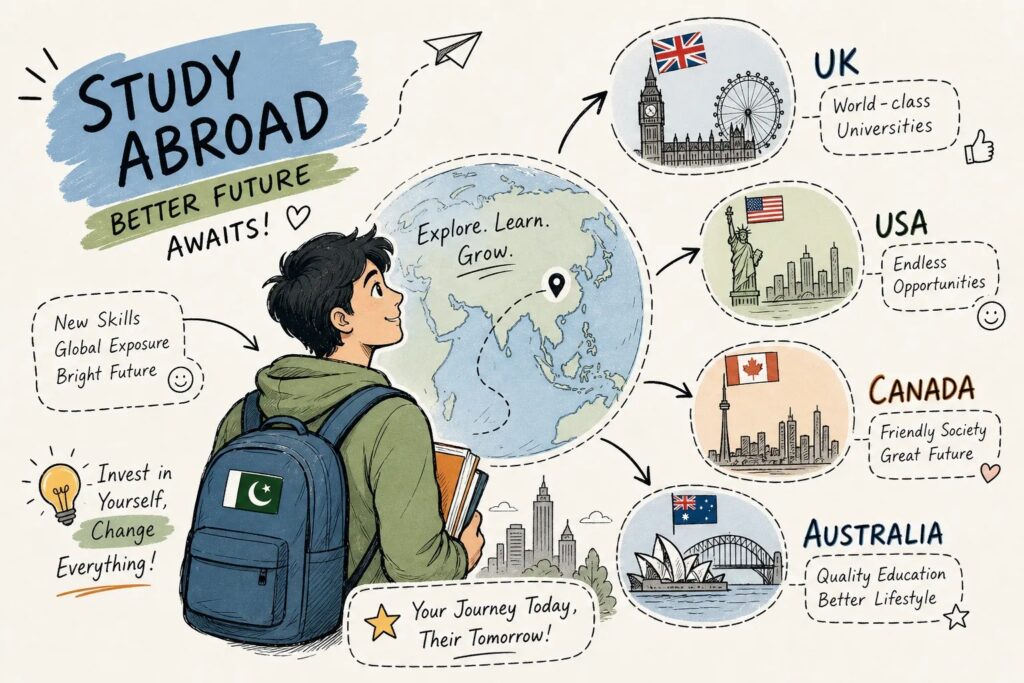
The UK turned down 41% of Pakistani student visa applications in Q1 2026, up from just 6% in the same quarter of 2025. That single figure should change how every Pakistani student approaches the destination selection process. If the most popular country on your shortlist is also the one rejecting nearly half of applicants from Pakistan, then popularity is a terrible selection criterion.
Choosing the best country to study abroad for Pakistani students comes down to three things: your budget, your career trajectory, and your actual visa eligibility as a Pakistani passport holder. There is no universal answer. At MUSAFAT Student Consultants, two decades of working through these decisions with students from Gujranwala and across Punjab has produced a clear picture of which destinations deliver and which ones disappoint. The patterns below let you shortlist intelligently.
By the end of this article, you will have a shortlist of three to four countries matched to your profile, realistic cost figures, a clear view of scholarship access, and the post-study work rules that determine whether your degree pays off in the long run.
The four variables that should drive every shortlisting decision
Most guides tell you to “consider your goals.” That is not actionable. There are four specific variables that actually determine which country makes sense for Pakistani students, and none of them is vague goal-setting.
Total cost of attendance, not just tuition. Tuition is one line item. Add accommodation, food, transport, health insurance, and visa fees, and the picture changes entirely. A country with zero tuition but high living costs can easily exceed the total expenditure of a country with moderate tuition and affordable living. Set your annual budget ceiling before you look at a single university website.
Post-study work rights and PR pathways. A degree is an investment, and the return depends on how long you can legally work after graduating. Canada’s Post-Graduation Work Permit gives Master’s graduates three full years of open work authorisation. The UK’s Graduate Route provides two years for Bachelor’s and Master’s holders, dropping to 18 months from January 2027. These rules change, and they matter more than rankings.
Visa success rates for Pakistani applicants. Pakistani applicants have faced heightened scrutiny at several major destination countries. Germany’s approval rate for Pakistani student visas sat around 70% based on 2024 to 2025 data. Canada’s IRCC showed 70 to 75% approval in recent cycles. The UK stands at 59% acceptance in Q1 2026. These numbers belong on your shortlist alongside tuition figures.
Scholarship access matched to your academic profile. Strong grades are necessary but not sufficient. Chevening requires two years of work experience. Australia Awards assesses development impact. DAAD places weight on research potential. Knowing which programmes fit your specific profile, not just your grades, saves months of wasted effort.
Best countries to study abroad for Pakistani students, affordable destinations that deliver
These are not compromise options. For a large proportion of Pakistani student profiles, Germany and Turkey represent the strategically superior choices in 2026, based on cost, visa odds, and scholarship availability.
Germany: near-zero tuition, strong labour market, credible visa odds
Public universities across most German states charge no tuition fees for undergraduate and postgraduate programmes, regardless of nationality. Students pay a semester contribution of roughly €150 to €400, which typically includes a public transport pass. Living costs average €850 to €1,100 per month, placing total annual expenses at approximately €11,000 to €13,000. That figure is lower than UK accommodation costs alone in London.
Germany’s 18-month job-seeker visa after graduation gives graduates time to find employment without racing against a deadline, and the EU Blue Card opens a PR pathway within 21 months for those with B1 German proficiency. The DAAD scholarship and the Friedrich Ebert Stiftung both offer funding routes for postgraduate applicants with strong academic records. For an English-taught programme, the IELTS requirement typically sits at 6.5 for postgraduate study, which is achievable for most well-prepared Pakistani applicants.
Turkey: government-funded, accessible, and genuinely international
The Turkiye Burslari scholarship covers full tuition, student accommodation, a monthly stipend, Turkish language training, and return flights. There is no IELTS requirement for the scholarship track at the application stage, note that individual universities may later request English proficiency evidence for specific programmes. For self-funded students, tuition fees at Turkish state universities vary by programme; costs are generally low relative to Western markets, though applicants should verify current fee schedules directly with their chosen institution. Istanbul and Ankara are major economic centres, and Turkey’s bilateral relationship with Pakistan supports a relatively straightforward student visa process for Pakistani applicants.
China and Cyprus: strong scholarship supply, lower entry barriers
China’s CSC scholarship is one of the most accessible fully-funded routes for Pakistani students at undergraduate, Master’s, and PhD level. The Belt and Road track is specifically designed for Pakistani applicants and covers tuition, accommodation, a monthly stipend, and health insurance. Eligibility requires a minimum GPA of around 3.0, an IELTS of 6.0 for English-taught programmes, and age limits of 25 for Bachelor’s, 35 for Master’s, and 40 for PhD applicants. Cyprus offers EU-accredited degrees, with tuition rates and visa processing timelines varying by institution, applicants should consult individual university fee schedules and official immigration guidance for current figures.
Premium destinations: where higher costs can still make sense
Higher tuition and living costs are justifiable when post-study work rights and global degree recognition are strong enough to produce a measurable long-term return.
Canada: the clearest path from degree to permanent residency
Canada remains the most credible long-term destination for Pakistani students pursuing PR in 2026. The PGWP gives Master’s graduates three years of open work authorisation, irrespective of programme length, provided the programme was at least eight months and completed at a PGWP-eligible institution. After 12 months of skilled work in Canada, Express Entry eligibility opens up, with an average PR processing time of six months. Total annual costs vary considerably by province and institution, prospective applicants should check current figures through IRCC and individual university websites, but the PR pipeline makes this a measurably better long-term investment than most alternatives for students whose goals extend beyond the degree itself.
Australia: the strongest post-study work duration for PhD graduates
Australia’s Subclass 485 visa gives Bachelor’s and Master’s graduates two years of post-study work rights, rising to four years for metropolitan PhD graduates and six years for regional PhD graduates. PR approval rates exceed 90% for eligible applicants once the skilled work threshold is met. The Australia Awards Scholarship covers full tuition plus a living allowance for students from developing countries, including Pakistan. The constraint is cost: total annual expenses in Australia typically run AUD $35,000 to $55,000, making it one of the higher-cost study abroad options for Pakistanis on this list.
UK: strong brand, real visa hurdles
The UK still carries strong degree recognition globally and provides access to one of the world’s largest economies. Pakistani applicants, however, need accurate information before they apply. The 41% rejection rate in Q1 2026 is the highest recorded for Pakistani applicants in recent years, driven by additional security checks and tighter documentation scrutiny, a trend corroborated by UKVI data from the same quarter. Students who do secure admission and clear the visa hurdle have access to the Graduate Route, which currently provides two years of post-study work, dropping to 18 months for Bachelor’s and Master’s holders from January 2027. Chevening and the Commonwealth Scholarship remain two of the most prestigious fully-funded routes for Pakistani postgraduate applicants, and both are highly competitive. Given the current documentation requirements, ensuring your application file is complete and correctly structured before submission is essential.
Scholarships for Pakistani students abroad in 2026
The scholarship landscape is wider than most students realise, but eligibility criteria are specific. Applying without reading the full requirements is the single most common, and most avoidable, mistake Pakistani applicants make.
- Chevening (UK): One-year Master’s, requires two years of work experience and demonstrated leadership, administered through the British High Commission.
- Commonwealth Scholarship (UK): Nominated through HEC Pakistan; postgraduate and doctoral level, full funding.
- DAAD (Germany): Undergraduate and postgraduate tracks; German language not mandatory for English-taught programmes; weight placed on academic and research merit.
- Turkiye Burslari (Turkey): All academic levels; no IELTS required initially; deadline typically falls in February.
- CSC and Belt and Road (China): Undergraduate through PhD; the Belt and Road track is explicitly designed for Pakistani nationals.
- Australia Awards: Full funding for students from developing countries, with a leadership and development focus in the selection criteria.
Chevening and Commonwealth require work experience that undergraduate applicants simply do not have. DAAD assesses research potential, not just grades. Australia Awards evaluates the development impact of your proposed field of study. Matching your profile to the right programme, not just the most prestigious name on the list, is how Pakistani students win these awards.
Matching your profile to the right shortlist
Here are three common profiles and where the data points for each.
Budget-constrained undergraduate applicants. Germany and Turkey are the rational first choices: near-zero tuition, scholarship access, and manageable visa odds make them the leading affordable countries to study abroad for Pakistanis in 2026.
Postgraduate applicants with PR intent. If you have a clear career path and a longer-term settlement goal, Canada’s PGWP-to-Express Entry pipeline is the most direct student visa pathway for Pakistani applicants available anywhere.
Applicants with short timelines or tighter budgets. China offers strong scholarship supply through the CSC and Belt and Road programmes, with accessible admission criteria. Cyprus may also be worth considering for EU-accredited study, though applicants should verify current scholarship availability and processing times directly.
If you have faced a prior visa refusal, some destination countries may be more challenging to re-enter than others in the current environment. In that situation, specialist country-specific guidance is particularly important before you commit to any application.
This decision becomes significantly easier with guidance that accounts for your academic profile, your financial documents, and your visa history before you submit a single application. MUSAFAT Student Consultants has been navigating exactly this shortlisting process for Pakistani students since 2004. With in-house immigration law expertise and experienced counsellors, the team evaluates each profile against real admission data and current visa conditions, not generic advice. If you are preparing for the September 2026 or January 2027 intake, a direct consultation is the most efficient way to confirm your shortlist.
Make the decision on data, not peer pressure
The right answer to which is the best country to study abroad for Pakistani students is the one that aligns your budget with a credible visa pathway and delivers a measurable return after graduation. Germany and Turkey lead on cost and accessibility. Canada leads for long-term career and PR planning. The UK remains a viable option, though recent Q1 2026 data confirms a significant tightening in documentation scrutiny and refusal rates compared to previous years.
Do not let this decision be driven by what is most popular in your peer group or what a relative applied to ten years ago. Run it through the four variables outlined here: total cost, post-study work rights, visa success rates, and scholarship access. Your shortlist will emerge clearly. When it does, confirm it against your actual profile before committing to any application. That step is what separates students who get through from those who spend another year trying again.