
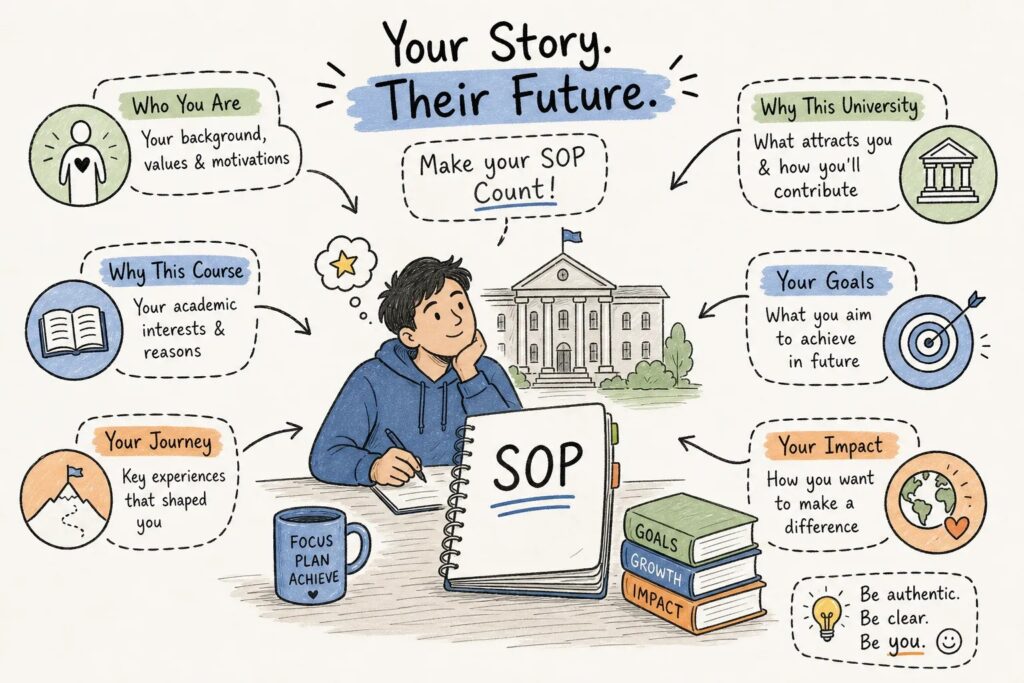
If you’re asking what should I include in my SOP for a US university application, you’re already ahead of the applicants who treat the document as a formatted transcript. Many SOPs from Pakistani applicants fall short not because the student lacks qualifications, but because the document fails to tell a coherent story. It lists. It summarises. It doesn’t persuade. Admissions readers are time-pressured and prefer concise, targeted narratives, they’re looking for a person with a clear direction and the preparation to back it up.
At MUSAFAT Student Consultants, we’ve reviewed a large volume of SOPs from Pakistani students applying to US programmes over many years. The same weaknesses appear repeatedly: a generic opening that says nothing, goals so vague they could apply to any programme at any university, no mention of faculty or research fit. These structural problems frequently reduce applicants’ competitiveness, and they’re entirely avoidable.
This guide covers the commonly recommended sections your SOP should include, the right length for master’s and PhD applications, sample opening lines that work, and how to handle anything awkward in your background. By the end, you’ll have a clear picture of what to write and in what order.
How long your SOP should actually be
Word count isn’t arbitrary. Admissions readers work through hundreds of files. A bloated SOP signals poor judgement, not thoroughness. For taught master’s programmes, 500 to 1,000 words is the right range. Research master’s programmes sit between 750 and 1,200 words. PhD applications warrant the most depth, landing between 1,000 and 1,500 words.
These ranges exist because the depth required at each level is genuinely different. A taught master’s SOP is a career document. A PhD SOP is closer to a research proposal. Treating them the same length is one of the first mistakes applicants make.
When the university sets its own limit, that overrides everything else. If a programme says 750 words, that is the ceiling, not a suggestion. Many top US institutions, including MIT and Stanford, cap their SOPs tightly, often between 500 and 1,000 words, depending on the programme. Before writing a single sentence, check the programme’s official graduate admissions page. Starting within the constraint produces a stronger document than cutting a 1,400-word draft down to 750 words at the last minute.
What should I include in my SOP for a US university application, the six essential sections
A strong SOP for US universities has a predictable structure, and that’s a good thing. Admissions committees aren’t looking for creative formatting. They’re looking for specific information in a logical order. Here’s what every section must do.
The opening hook and purpose statement. The first 100 to 150 words carry the most weight. Your opening must be concrete: a specific moment, a driving research question, or a challenge you encountered, not a broad statement about passion, not a quote from a famous scientist. Immediately after the hook, tell the reader what you’re applying for and why. Don’t make them hunt for it.
Academic background and relevant experience. This combined section runs roughly 350 to 450 words in a 1,000-word SOP. For academic background, focus on relevant coursework and achievements, not a transcript summary. For experience, prioritise research projects, internships, or professional roles that connect directly to the programme you’re applying to. If a project you completed during your BSc or MS used the same methodology you plan to pursue in the US, say so explicitly.
Why this specific programme and faculty fit. Vague praise for a university wastes space. Name two to three faculty members, reference their recent published work, and explain how your interests intersect with theirs. For PhD applicants, this section is non-negotiable. For master’s applicants where faculty fit is less central, focus instead on specific courses, labs, or industry partnerships the programme offers. Either way, the reader should finish this section understanding why your application landed in their inbox specifically.
Your goals and a confident conclusion. Short-term and long-term goals should be distinct and specific. “I want to work in data science” is not a goal. “I aim to join a public health analytics team addressing disease surveillance in South Asia” is. The conclusion, roughly 50 to 100 words, restates your fit with the programme and ends forward-looking. It should not restate your introduction.
Sample SOP paragraph: faculty fit section
Professor Ayesha Khan’s recent work on federated learning architectures for low-resource environments aligns directly with my MS thesis on distributed sensor networks in rural agricultural settings. Her 2024 paper on privacy-preserving data aggregation addresses the precise constraint I encountered when attempting to scale my project’s data pipeline. I am applying to this programme specifically to continue that line of inquiry under her supervision, with access to the lab’s embedded systems testbed.
SOP checklist for admissions
- Opening hook: specific moment, research question, or current position (100, 150 words)
- Academic background and relevant experience: coursework and projects tied to the programme (350, 450 words in a 1,000-word SOP)
- Programme and faculty fit: two to three named faculty with referenced recent work
- Short-term and long-term goals: distinct, specific, and grounded in the programme’s offerings
- Gaps or weaknesses addressed: factual, brief (80, 120 words), placed after strengths
- Forward-looking conclusion: tied to a specific programme resource, not a restatement of the intro
How to open strong and close with purpose
Three opening formulas consistently produce strong SOPs for US universities. The first is the catalyst moment: a specific, recent experience that crystallised your research interest. “While working as lead engineer of the AGV team at a vertical farming start-up, I developed three versions of an environmental sensing system for scale.” That sentence tells the reader who you are, what you’ve built, and what kind of thinker you are, before the second sentence arrives.
The second is the research question: open with the intellectual problem driving you to graduate study. “Computational methods alone could not solve the real problem: how to validate these predictions in biological systems.” The reader immediately understands your field, your gap, and your direction. The third formula, the current position, establishes who you are now and what gap graduate study fills. “Three months into my role at a consulting firm, I realised I was solving problems for clients while remaining ignorant of the deeper business strategy driving them.”
What to avoid is equally straightforward: “I have always been passionate about…” tells the committee nothing, and philosophical quotes from Einstein or Iqbal signal that you didn’t know how to begin. Both waste your most valuable real estate in the statement of purpose.
For the conclusion, connect your goals directly to a specific programme resource: a lab, a professor’s methodology, or an interdisciplinary approach the programme is known for. It should not mirror the opening. Frame it around the impact you intend to make. “The programme’s emphasis on industry collaboration will provide the foundation I need to lead applied research in renewable energy systems within the South Asian context” is a closing line. “I hope to contribute to your esteemed institution” is not.
Addressing gaps, weak grades, or a non-linear background
Keep explanations of gaps or low grades to 80 to 120 words, roughly 10 to 15% of the total SOP. Place this section after establishing your motivation and academic background, but before discussing programme fit. This sequence means the reader already sees your strengths before encountering the weakness. That order matters.
Factual language works. Emotional language backfires. “I used this period to complete a professional certification in data analysis and fulfil a family obligation” is a complete explanation. “I was going through an incredibly difficult time” invites the reader to worry rather than move on. Connect the gap or weakness directly to what you gained and how it prepared you for graduate study.
One point that Pakistani applicants often overlook: all dates and explanations in your SOP must align exactly with your visa application documents. If your SOP states you were working during a gap year and your visa paperwork shows no employment record, that discrepancy will be noticed. Trained admissions readers and consular officers both look for consistency across your application file. An inconsistency here doesn’t just weaken your SOP, it creates problems at the visa stage that are far harder to fix after submission.
How an MS SOP differs from a PhD SOP
A PhD SOP is a research document. It needs a specific research question or cluster of related questions, a sense of your methodological orientation, quantitative, qualitative, computational, and explicit faculty alignment. Passion is not enough. You need to demonstrate that you understand current questions in the field and can contribute original thinking. Name specific professors, explain their recent work, and state what you bring to their research environment. If you haven’t read at least one recent paper from each professor you name, don’t name them.
A taught master’s SOP centres on professional goals, not scholarly contribution. The emphasis shifts to career progression, relevant work experience, and the specific skills or specialisations the programme will provide. Faculty naming is optional; programme resources, co-op opportunities, and industry ties matter more. For a research master’s or thesis-based MS, the structure moves closer to the PhD model, with greater weight on prior research and methodology. Applying the wrong template to the wrong programme type is one of the most common structural mistakes we see at MUSAFAT, and it’s one of the clearest signals in a statement of purpose USA admissions readers flag immediately.
Why a professional SOP review strengthens your application
After writing your own SOP, you read what you meant to write, not what’s actually on the page. This is a well-documented drafting challenge: self-editing struggles to catch structural problems, vague goals, weak faculty fit paragraphs, and tonal inconsistencies. A reviewer with admissions experience reads it the way an admissions committee does, quickly, critically, and comparatively. That shift in perspective catches the problems that self-editing misses.
At MUSAFAT Student Consultants, SOP review goes beyond editing for grammar or flow. Our team brings together education counselling and immigration law expertise, which means we read your SOP through both an admissions lens and a visa compliance lens. Your SOP is not just a university document. For US student visa (F-1) purposes, it also shapes how your case is perceived by consular officers. An SOP that conflicts with your visa documentation, or frames your goals ambiguously, creates downstream problems that are far harder to fix after submission than before.
We ensure your SOP is strong on both fronts. If you’re preparing for the September 2026 or January 2027 intake, getting your SOP reviewed early gives you time to revise before deadlines close. We frequently see applicants who sought review too late, after a rejection had already come in. Give yourself time to fix it before the deadline closes.
The bottom line: what should I include in my SOP for a US university application
A strong SOP is not about writing eloquently. It’s about being specific, coherent, and honest. Use the SOP checklist for admissions above as your starting point: cover the six sections, match your length to the programme type, open with a concrete moment, name real faculty and reference their actual work, explain any weaknesses briefly and factually, and close with a forward-looking statement tied to the specific programme. The structure is straightforward. The execution takes deliberate effort.
If you’d like a second opinion from consultants who combine admissions guidance with immigration law expertise and have supported Pakistani students through US applications for many years, MUSAFAT Student Consultants offers personalised SOP writing and review services. Reach out before your intake deadline, and give yourself a real chance to get this right.