
US student visa from Pakistan.The F-1 visa is the single most consequential document between a Pakistani student and a US degree. Yet the process involves more steps, more receipts, and more sequencing decisions than most applicants realise until they are already behind. At MUSAFAT Student Consultants, where we have guided Pakistani families through this exact process since 2004, the questions we hear most often are not about eligibility. They are about sequencing: what comes first, what triggers what, and why getting the order wrong wastes months. This guide resolves all of that for anyone applying for a US student visa in Pakistan in 2026. By the end, you will have a reliable, chronological checklist from I-20 to visa grant, built around the specific realities Pakistani applicants face this year.
Who qualifies for a US student visa: the eligibility basics
Three pillars determine whether you are eligible for a US student visa in Pakistan. First, you must hold acceptance from a US institution certified by the Student and Exchange Visitor Programme (SEVP). Second, you must enrol as a full-time student: 12 credit hours per semester for undergraduates, 9 for postgraduates. Third, you must demonstrate nonimmigrant intent, meaning the consular officer needs to be satisfied that you plan to return to Pakistan after your studies conclude.
One misconception circulates widely among Pakistani applicants, and it is worth addressing directly: IELTS or TOEFL scores are a university requirement, not a US Embassy requirement. The consulate does not verify your test band. What the visa officer is doing during the interview is listening to how you communicate, not reading a score sheet. This distinction matters enormously for how you prepare.
The I-20 and what your university must do first
The I-20 (Certificate of Eligibility for Nonimmigrant Student Status) is issued by your university after acceptance. You do not apply for it; the institution generates it automatically once you are admitted. The document contains your SEVIS ID number, your programme start date, and the university’s estimated annual cost of attendance. Every subsequent step in your F-1 student visa Pakistan application depends on the I-20 being in your hands, so chase your admissions office for it the moment your acceptance arrives.
Accuracy on the I-20 is non-negotiable. Any discrepancy between the information on your I-20 and your DS-160 or financial documents is treated as a red flag at the embassy. If your name spelling, programme dates, or funding figures differ across documents, have the university correct the I-20 before you proceed.
English test scores: university rule, not embassy rule
Most US universities require IELTS 6.5 or above, or a TOEFL iBT score of 80 or higher, for Pakistani applicants. These thresholds are set by the institution, not the consulate. The visa officer’s concern is whether you can hold a coherent conversation in English, explain your academic goals, and answer questions about your finances clearly. Interview preparation therefore matters far more than the score on your certificate.
US student visa Pakistan: document checklist
Organise your documents into two groups before you open the DS-160 portal. Gathering everything first prevents mid-application errors and ensures you are not searching for a salary slip on the morning of your interview. The consular officer expects a coherent, complete package, not a single bank certificate.
Core identity and academic documents
Before your student visa Pakistan interview, confirm you have each of the following:
- Passport valid for at least six months beyond your programme completion date
- Original I-20
- Printed DS-160 confirmation page
- SEVIS I-901 payment receipt
- MRV fee receipt
- 2×2 inch photograph with a white background
- CNIC
- Full academic transcripts from Matric or O-levels through your most recent qualification
- Official IELTS or TOEFL score report (if required by your university)
Financial proof: what Pakistani applicants actually need to show
The financial package that satisfies a consular officer is a combination, never a single document. You need three to six months of bank statements from the applicant’s or sponsor’s account, a signed sponsorship letter (notarised as an affidavit of support if the sponsor is not an immediate parent or guardian), two to three months of the sponsor’s salary slips, the sponsor’s income tax returns, and an employment verification letter. If fixed deposits are being used, include a bank encashment confirmation letter showing the funds are liquid before your enrolment date. A loan sanction letter from a recognised Pakistani bank is also accepted if the loan is already approved.
Two critical clarifications for Pakistani applicants: first, funds should ideally be visible in statements for six to nine months prior to your interview to demonstrate they are not temporarily borrowed. Second, Form I-864 (Affidavit of Support) is for immigrant visas only. Do not submit it for a US student visa Pakistan application. All documents must be in English or carry a certified translation.
Completing the DS-160 and paying your fees correctly
The DS-160 is completed on the Consular Electronic Application Center (CEAC) portal. You will need your SEVIS ID from the I-20 to fill in the student section accurately. The single most common error is submitting the form with inconsistencies. Once submitted, the form cannot be edited, so review every field twice before you click submit.
Filling the DS-160 step by step
Access CEAC and select Pakistan as your application location. Upload a compliant photograph: JPEG format, under 240KB, neutral expression, no glasses, white background. Enter all personal details exactly as they appear on your passport, including your name spelling. Declare your social media handles accurately; this is a required field and omissions are flagged. Review the completed form thoroughly, submit, and print the confirmation page with its barcode immediately. Without that confirmation page, you cannot enter the embassy on interview day.
SEVIS fee vs. MRV fee: what each one is and how to pay it
These are two entirely separate payments with two separate receipts, and both are mandatory. The SEVIS I-901 fee is $350 for F-1 students, increased from the previous $200, and is paid to the US Department of Homeland Security via fmjfee.com. You cannot pay this fee without your SEVIS ID, which means the I-20 must be in your hands first. The MRV fee (the visa application fee) is $185 and is paid through the US Embassy Pakistan’s designated portal, typically via bank transfer at an authorised bank such as HBL, UBL, MCB, or Standard Chartered. The total minimum official cost for an F-1 student visa in Pakistan for 2026 is therefore $535 ($350 + $185), excluding any travel or accommodation for your Islamabad appointment.
Booking your US Embassy appointment in Islamabad
As of mid-2026, only the US Embassy in Islamabad is operational for student visa interviews. The US Consulate General in Karachi and the Lahore consular services have both been suspended indefinitely since March 2026 due to security reviews. Every Pakistani applicant, regardless of their city of residence, must schedule their F-1 interview in Islamabad. Factor in travel and accommodation costs when planning your timeline.
Why Islamabad is the only option right now
The Karachi suspension is indefinite, with no confirmed restart date as of the time this article was written. Students from Karachi, Lahore, Multan, and all other cities must travel to Islamabad for their interview. Build at least two to three additional days into your schedule to account for travel, rest, and any document-related queries on the day.
Sequencing your application timeline correctly
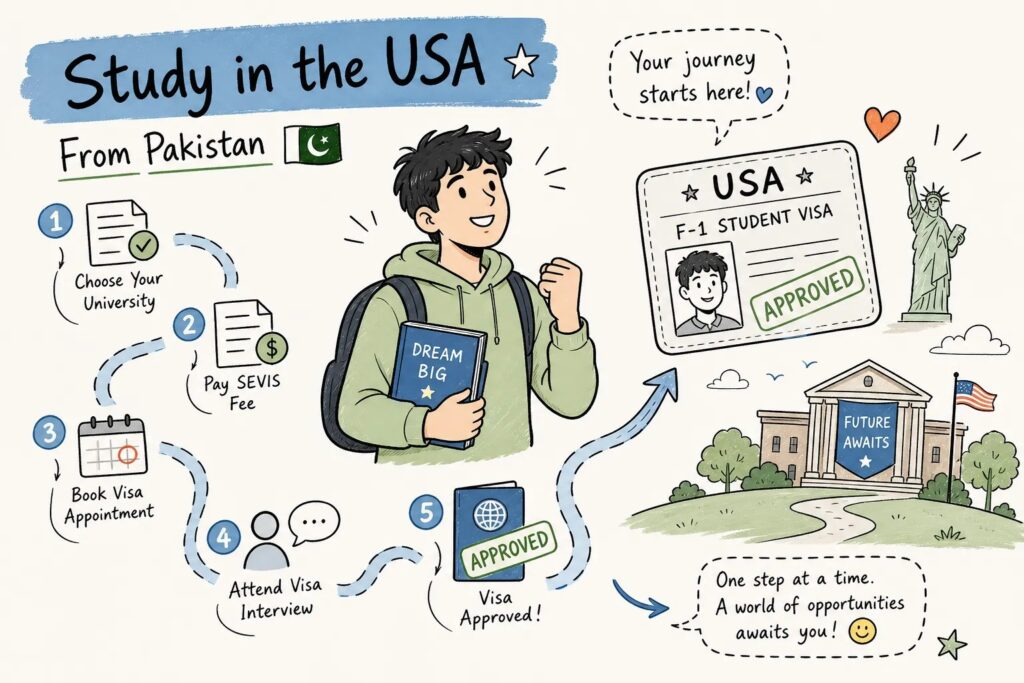
The correct order is non-negotiable, because each step unlocks the next. Follow this sequence precisely:
- Receive your university acceptance letter.
- Receive your I-20 from the university.
- Pay the SEVIS I-901 fee ($350) at fmjfee.com using your SEVIS ID.
- Complete and submit your DS-160 on CEAC.
- Pay the MRV fee ($185) through the Embassy’s designated portal.
- Book your embassy appointment in Islamabad.
Current F/M/J student visa wait times at Islamabad are approximately 45 days, significantly shorter than the six-month wait for B1/B2 visitor visas. Even so, begin your US student visa Pakistan application at least three months before your programme start date. If your case triggers Section 221(g) administrative processing, resolution can take 60 to 90 days, and some cases run up to 180 days. Starting early is not optional.
US student visa Pakistan interview: what to expect and how to prepare
The interview typically lasts two to five minutes. The officer is not testing your knowledge of US immigration law. They are assessing three things: whether your academic intent is genuine, whether your financial situation is clear and credible, and whether you have strong enough ties to Pakistan to return after graduation. Calm, concise, direct answers serve you far better than memorised scripts.
The questions you should prepare for
The most common questions Pakistani applicants face at the US Embassy Islamabad cover four areas. Prepare specific, one-to-two sentence answers for each:
- University and programme: “Why this university?” and “Why study in the US rather than Pakistan?” Name the programme, the specific faculty or research strength that attracted you, and the career outcome you are targeting.
- Finances: “Who is sponsoring your education?” and “What is your sponsor’s occupation and income?” Know the exact figures: your sponsor’s monthly salary, the university’s annual cost of attendance as shown on the I-20, and how long the funds will sustain your studies.
- Return intent: “What are your plans after graduation?” Be specific and grounded in Pakistan’s job market. Mentioning a family business, a specific employer, or a sector with genuine demand in Pakistan is far stronger than a vague reference to “using the degree back home.”
- Background: “Have you travelled abroad before?” and “Have you ever been refused a US visa?” Answer honestly. Attempting to conceal a prior refusal is grounds for permanent inadmissibility.
How MUSAFAT’s interview coaching gives applicants an edge
MUSAFAT Student Consultants offers structured interview preparation backed by immigration law expertise. The founder, an Advocate High Court with US immigration law training from the University of Pennsylvania and over 22 years of consultancy experience, understands precisely what consular officers in Islamabad probe for with Pakistani applicants. The coaching addresses the specific pressure points: how to prove home ties convincingly, how to explain a sponsor’s income clearly, and how to frame post-graduation plans in Pakistan’s actual job market. This is not generic mock interview practice. It is preparation built on knowing what causes refusals and eliminating those gaps before interview day.
Why Pakistani applicants get rejected and how to reduce the risk
The majority of F-1 denials in the US student visa Pakistan process come down to a handful of recurring triggers. None of them are random, and all of them are addressable with the right preparation. The most dangerous assumption is that the interview is a formality after securing admission.
The 214(b) problem and how to show genuine return intent
Section 214(b) places the burden of proof on the applicant. The officer must be convinced that you have strong enough ties to Pakistan to return after your studies. Concrete evidence is what moves the needle: a property deed in your name or a parent’s name, a letter of future employment from a family business, or a signed commitment letter from a Pakistani employer stating they will hire you upon return. Never volunteer information about Optional Practical Training (OPT), H-1B sponsorship, or permanent residency aspirations unless you are directly asked. Framing your entire future around Pakistan is not a weakness in the interview; it is the correct strategy.
Documentation gaps and DS-160 inconsistencies that trigger denials
Several additional denial triggers are entirely preventable. First, mismatched or insufficient financial documents: if your DS-160 states one funding source but your bank statements suggest another, the officer notices immediately. The fix is to reconcile every figure across every document before submission. Second, a vague academic purpose with no connection to Pakistan’s job market: generic statements like “I want to pursue higher education” carry no weight. Connect your degree to a specific industry or role in Pakistan. Third, DS-160 date or funding inconsistencies: gaps in education history or changing funding declarations within the form are red flags. Fill the form carefully and review it as a whole before submitting. Fourth, poor English communication during the interview: hesitant, one-word answers undermine credibility regardless of your actual qualifications. Practise speaking your answers aloud until they feel natural, not rehearsed.
A professional documentation review before submission catches most of these issues before they reach the consular officer’s desk. At MUSAFAT, our documentation review process draws on 22 years of experience and the legal rigour of an immigration law practice. We review financial documents, cross-check them against the DS-160, and identify inconsistencies that would otherwise surface as denial triggers. For students who have faced a previous refusal, this review is not a box-ticking exercise; it is the foundation of a successful reapplication.
Get this right from the start
The checklist, in brief: receive your I-20, pay your SEVIS fee at fmjfee.com, complete your DS-160 carefully on CEAC, pay your MRV fee, book your Islamabad appointment as early as possible, assemble a thorough and consistent financial package, and practise your interview answers until confidence replaces anxiety. Every step follows from the one before it, and a mistake at any stage delays the entire chain.
The US student visa Pakistan process rewards preparation and penalises shortcuts. Applicants who arrive at the embassy with clean documents, a coherent financial story, and a clear answer to every question about their future in Pakistan are the ones who walk out with their visa. Those who treat the interview as an afterthought often find themselves exploring reapplication options shortly afterwards.
If you are planning to study in the US for the September 2026 or January 2027 intake, contact MUSAFAT Student Consultants before you begin your application, not after a rejection. Our team in Gujranwala handles everything from university shortlisting and SOP writing through to documentation review and interview coaching, backed by two decades of immigration law expertise. Reach out now and start your application on solid ground.