
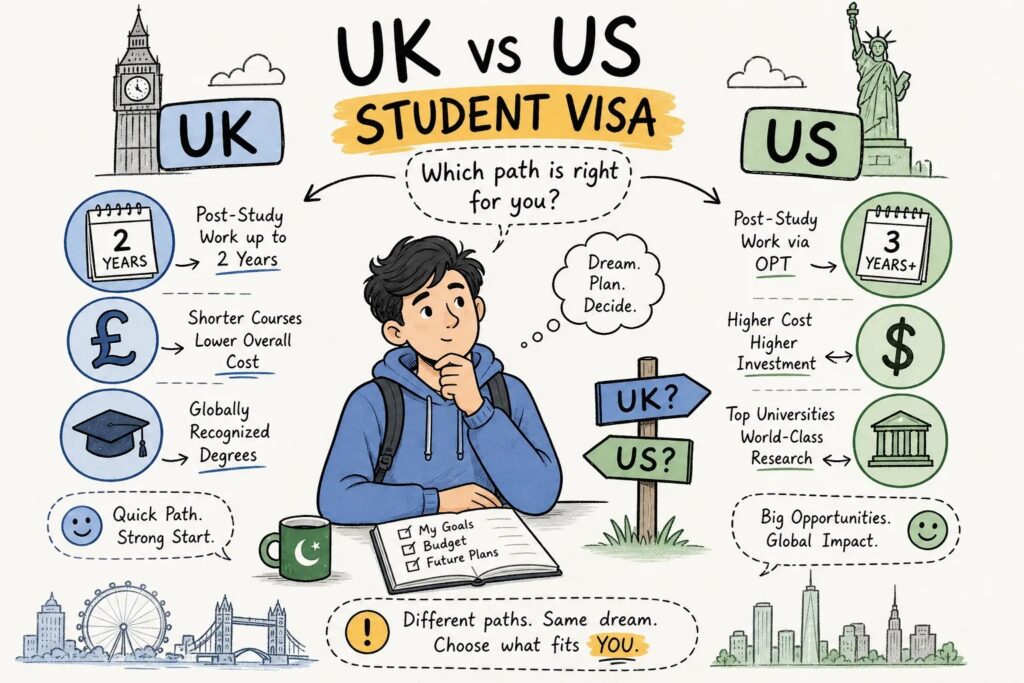
You have received two university offers, one from a UK institution, the other from a university in the United States. Both are strong options academically, but choosing between a UK student visa vs US student visa means navigating two completely different processes in terms of cost, timelines, and what happens after you graduate. Choosing the wrong pathway does not just cost you time; it can substantially increase costs for your family and, in the worst case, end in a visa refusal that sets your plans back by a year.
This is one of the most common situations students bring to MUSAFAT Student Consultants. Our counsellors have extensive experience helping Pakistani applicants navigate exactly this decision, and the answer is never the same for every student. What follows is a straight, numbers-driven comparison of the UK Student Route visa and the US F-1 visa across the factors that matter most: eligibility, fees, processing time, total programme cost, and post-study work rights. No generic rankings, just the information you need to make a confident decision in 2026.
Eligibility and documents: what each visa actually requires
Before comparing costs or outcomes, you need to know whether your current academic profile qualifies you for each pathway. The requirements differ considerably, and gaps in documentation are the most common reason Pakistani applications fail at both routes.
What the UK Student Route demands from Pakistani applicants
To apply for the UK Student Route visa, you need a Confirmation of Acceptance for Studies (CAS) from a licensed sponsor, along with proof of English proficiency at CEFR B2 or above, typically IELTS UKVI. You must also provide a 28-day bank statement showing maintenance funds of £1,023 per month outside London, or £1,334 per month in London (verify the exact current figures on GOV.UK before applying, as thresholds can change). A TB test certificate is required since Pakistan remains on the UKVI affected-countries list, and if your intended course involves certain STEM subjects, an ATAS certificate is required as well.
One practical advantage that Pakistani applicants often overlook: the UK process has no routine interview. Your application is assessed on documents alone, which removes a significant source of anxiety and unpredictability from the process.
What the US F-1 visa demands from Pakistani applicants
The F-1 process is more demanding upfront. You need an I-20 from a SEVP-certified institution, a completed DS-160 form, and financial documentation showing you can cover $25,000 to $70,000 annually depending on the school and location. Every F-1 applicant must attend a mandatory consular interview, and the single most critical factor assessed is nonimmigrant intent: you must convincingly demonstrate that you plan to return to Pakistan after your studies.
This is where many Pakistani students encounter difficulty. The consular officer is looking for concrete ties to your home country, a clear study plan, and no ambiguity about your intentions. Without thorough preparation, the interview alone can end your application before it begins.
UK student visa vs US student visa: fees and processing times
Most students calculate tuition and living expenses carefully but underestimate what it actually costs to secure the visa before departure.
Government fees compared: UK vs US in 2026
For the UK Student Route visa applied from outside the UK, the government application fee is £558 (effective 8 April 2026, per GOV.UK). On top of that, you pay the Immigration Health Surcharge at £776 per year of study, paid upfront for the full visa duration. A three-year undergraduate degree therefore adds roughly £2,328 in IHS charges to your initial costs, in addition to the application fee.
The US fee structure in 2026 comprises a $185 MRV application fee, a $350 SEVIS I-901 fee, and a $250 Visa Integrity Fee introduced this year, bringing total US government fees to approximately $775. Before any flights are booked or university deposits are paid, that represents a higher upfront government-fee spend than the UK application fee alone. Note, however, that the UK’s IHS surcharge increases the total UK upfront cost considerably when compared on a like-for-like basis across the full visa duration.
Processing times and refusal risk for Pakistanis
The UK standard processing time is three weeks after biometrics, with priority (five working days) and super-priority (next working day) options available. Because there is no interview, the process is comparatively predictable. According to Home Office data, UK student visa refusal rates for Pakistani applicants sit at approximately 12 to 18%.
The US process takes three to six weeks including interview scheduling, and the interview itself introduces an element of unpredictability that preparation can reduce but not fully eliminate. F-1 refusal rates for Pakistani applicants reached approximately 71% in 2025; early 2026 data suggests the rate remains around 65%, driven primarily by weak financial documentation and insufficient proof of nonimmigrant intent. These figures are drawn from US Department of State visa statistics and sector reporting; consulate-level breakdowns are not publicly disaggregated, so national averages are the best available indicator. This is a risk factor that Pakistani families must weigh seriously before committing to the US pathway.
Tuition and living costs: what a degree actually costs in each country
This is often where the choice becomes clearest for cost-conscious Pakistani families, and the numbers are more decisive than most students expect.
Undergraduate programmes: a three-year vs four-year reality
International students at UK universities pay between £15,000 and £40,000 per year in tuition, with living costs outside London averaging £11,000 to £13,700 per year. Crucially, a UK undergraduate degree takes three years, not four. That single structural difference gives the UK a built-in cost advantage that compounds significantly across the total programme.
A four-year US undergraduate degree at a public in-state university carries a typical total cost of $146,000 to $180,000; however, these figures are broadly representative of in-state student profiles. International fee-payers at private or out-of-state institutions frequently face costs well above $250,000 for the same degree. For most Pakistani families, the UK’s shorter degree duration translates directly into a lower total spend, even when both sets of fees are calculated at international rates.
Master’s programmes: where the gap is even clearer
The UK’s one-year master’s is the sharpest comparison point in this analysis. Total costs for a typical UK master’s, including tuition and living, sit at £20,000 to £25,000. The equivalent US master’s, which typically runs one to two years, costs $45,000 to $65,000 in total. For postgraduate students especially, the UK delivers a globally recognised qualification in less time and at roughly half the cost of a comparable US programme.
Work rights during studies and post-graduation options
For most Pakistani students, part-time work during studies and the quality of post-graduation options are as important as the degree itself. The two pathways differ substantially on both counts.
Part-time work during your studies
UK Student Route visa holders studying at degree level can work up to 20 hours per week during term time and full-time during official university vacations. This is a meaningful income source that genuinely helps offset living costs over a three or four-year programme. US F-1 students, by contrast, are limited to on-campus employment in their first year, and off-campus work requires either Curricular Practical Training (CPT) or Optional Practical Training (OPT) authorisation, both of which are tied to specific academic programme structures.
Post-study work: UK student visa vs US student visa comparison
The UK Graduate Route currently grants two years of open work rights after a bachelor’s or master’s degree, with no job offer required and no restriction on sector, employer, or employment type. Self-employment and freelancing are both permitted. One critical deadline applies: students who apply for the Graduate Route before 1 January 2027 receive the full two years; applications submitted after that date will be reduced to 18 months for non-PhD graduates. If you are targeting the September 2026 intake, this is directly relevant to your planning.
The US offers two distinct post-study work streams. Standard OPT provides 12 months of authorised work after graduation; it does not require a job offer at the point of application (though employment must be secured within regulatory limits), and there is no E-Verify requirement for the employer under standard OPT. STEM graduates can apply for a 24-month STEM OPT extension, bringing total post-study work entitlement to 36 months, but the STEM OPT extension does require your employer to be enrolled in the E-Verify programme and meet additional USCIS conditions. This is a significant advantage for engineering, computing, data science, and business analytics graduates, but your flexibility is directly tied to finding and retaining a qualifying employer. Neither the Graduate Route nor OPT counts towards permanent residence in either country, so neither pathway constitutes a direct settlement route.
Choosing the visa pathway that fits your profile
There is no universally correct answer. The right pathway depends on your field, your budget, your financial documentation, and what you want your career to look like in five years.
Profiles where the UK pathway makes more sense
For students in non-STEM fields, those with a moderate budget, and those who want the freedom to explore the job market without being tied to a single employer from graduation day, the UK Student Route is the more practical choice in 2026. The lower total cost, shorter degree duration, no-interview visa process, and the open Graduate Route collectively make this a lower-friction pathway for most Pakistani undergraduates and master’s applicants. The refusal rate is also substantially lower than the US, which matters enormously when your intake window is fixed.
Profiles where the US pathway is worth the additional investment
For students targeting STEM fields at globally ranked research universities, the F-1 combined with STEM OPT offers up to 36 months of post-graduation work experience, three times the current UK Graduate Route window and nearly double what it will be after January 2027. The US is the right choice if you have strong financial documentation, clear and demonstrable ties to Pakistan, a specific academic plan at a named institution, and the profile to withstand a rigorous consular interview. The investment is higher and the process is more demanding, but for the right STEM applicant at the right institution, the long-term career outcome can justify the difference.
Getting a decision that is right for your specific situation
At MUSAFAT Student Consultants, this comparison is never treated as a generic checklist. Every student’s academic background, financial profile, and post-graduation goals are different, and the right visa pathway follows from those specifics rather than from a blanket ranking. Our team brings hands-on experience guiding Pakistani students through both UK and US visa applications, and can map your profile against the actual eligibility requirements to help you build the strongest possible application for whichever route fits your goals.
The bottom line
When weighing up the UK student visa vs US student visa, the picture for most Pakistani applicants is fairly clear. The UK Student Route is typically faster to obtain, cheaper overall, carries a substantially lower refusal risk, and offers greater flexibility on the post-study work side for non-STEM graduates. The US F-1 is the stronger pathway for STEM students willing to navigate a more demanding process at considerably higher cost, primarily because of the 36-month STEM OPT window. Neither visa is inherently superior; the right answer is the one that matches where you are academically and financially today, and where you want to be professionally in three to five years.
If you are targeting the September 2026 or January 2027 intake, now is the time to get your profile assessed and your documentation in order. Book a consultation with MUSAFAT Student Consultants in Gujranwala for a personalised recommendation on which pathway to pursue, what your application needs to include, and how to avoid the documentation gaps that lead to refusal. The decision is consequential, make it with accurate information and professional guidance behind you.