
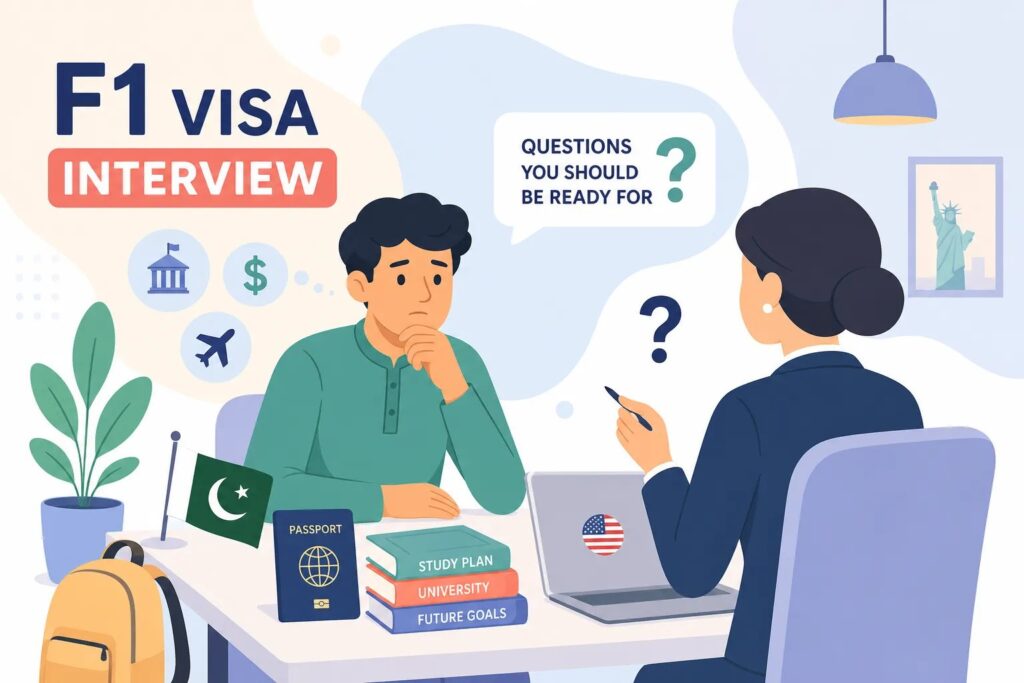
Meta description: Learn what questions are asked in a US student visa interview, sample answers, a document checklist, and expert tips for Pakistani applicants, start preparing now.
Five minutes. That is roughly how long your F1 visa interview will last at the US Embassy in Islamabad, Karachi, or Lahore. Five minutes to undo or validate months of application work, IELTS preparation, university shortlisting, and document gathering. Many applicants underestimate just how much those five minutes matter. The numbers are sobering: according to industry analyses by organisations such as ICEF Monitor and BrainGain, Pakistan’s country-level F1 refusal rate reached approximately 71% in 2025 and sits near 65% in early 2026, among the highest nationally recorded figures in the world, though embassy-specific rates for Islamabad, Karachi, and Lahore are not published separately. This guide explains what questions are asked in a US student visa interview and how to answer them convincingly, so you walk into the embassy with a prepared, coherent case, not a rehearsed script.
The problem is rarely that students don’t know what questions are asked at a US student visa interview. Most have read a list somewhere. The real problem is that they don’t understand why each question exists, and so their answers hit the wrong note entirely. This guide, drawn from extensive experience of F1 interview preparation at MUSAFAT Student Consultants, breaks down every major question category, the logic behind it, and what a credible answer actually sounds like.
What consular officers are actually evaluating
Before you memorise a single answer, you need to understand the legal framework governing your interview. Section 214(b) of the US Immigration and Nationality Act presumes that every visa applicant intends to immigrate permanently until proven otherwise. You walk into that embassy already at a disadvantage. The officer’s job is not to help you; it is to assess, in a very short window, whether you have shifted that presumption.
Officers evaluate three things in rapid sequence: genuine academic intent, financial ability to sustain your studies without resorting to unauthorised work, and demonstrable ties to Pakistan that make returning home the obvious and logical outcome. Every single question in an F1 interview maps onto one or more of these three pillars. Once you understand that framework, preparing becomes far more focused. You are not memorising a script; you are building a coherent case across three dimensions.
What questions are asked in a US student visa interview, and what officers evaluate first
The interview almost always opens with motivation and academics. Officers ask: Why the US rather than Pakistan? Why this specific university? Why this course? How many universities admitted you? These questions test academic intent, the first pillar. Generic answers collapse here. “It’s a well-reputed university” or “the US has better education” are denial triggers, not answers.
Sample answers for “why the US” and “why this university”
Compare two approaches for “Why this university?” The vague version: “University of X has a great engineering programme and is well known internationally.” The specific version: “I chose the University of X because Professor Sarah Ahmed’s research in renewable energy systems directly aligns with my thesis focus. The programme’s partnership with three Pakistani energy firms also means my dissertation could have direct application at home.” The second answer takes fifteen more seconds to deliver and is far more persuasive to the officer. Reference a faculty member’s research, a specific course, or an industry partnership. It signals that you actually investigated the programme rather than paying an agent to select it for you.
Handling questions about your academic background
When officers ask about your GPA, subjects you’ll be studying, or how this programme connects to your previous degree, they are checking for course alignment. A mismatch between your undergraduate subject and the graduate programme you are applying for is a known denial trigger. If there is a perceived gap, address it proactively: explain what bridged the two fields, such as a certification, work experience, or a specific project. Don’t wait for the officer to question it. Your DS-160 and I-20 must be fully consistent with everything you say here.
How to answer questions about money and your plans after graduation
Financial questions are where Pakistani applicants face the sharpest scrutiny. The annual cost on your I-20 is usually between USD 45,000 and USD 60,000. Officers will ask who is sponsoring your education, what that person does for a living, what they earn, and whether you’ve applied for any scholarships. They are not simply confirming that money exists. They are checking whether your explanation is coherent, consistent with your documents, and plausible given Pakistan’s economic context.
Explaining your financial sponsor in one clear answer
A clean answer to “How will you fund your education?” follows a simple structure: sponsor name, occupation, income source, and how that income covers the annual figure on your I-20. For example: “My father is a textile exporter in Faisalabad. His annual income is sufficient to cover the USD 48,000 listed on my I-20, and he has maintained consistent savings over the past three years. The bank statements I’ve brought reflect that history.” No vagueness, no “we’ll manage.” Large recent deposits in a bank statement signal funds that were artificially placed there for the interview; officers see this regularly and it raises immediate red flags.
Proving you’ll come back without sounding rehearsed
Ties-to-Pakistan questions often appear in the same cluster: Do you have relatives in the US? What will you do after graduation? Do you have property or family responsibilities at home? The key is specificity without recitation. “I plan to return because my father’s business needs someone with a supply chain management degree” is more credible than “I will definitely return to serve my country.” Document what you say. If you mention a family business, bring the registration certificate. If you mention a job prospect, bring an employer letter. Officers are trained to distinguish a genuine answer from a rehearsed one; the former has texture and detail, the latter sounds polished and hollow.
The student visa interview document checklist
The US Embassy states there is no fixed list of required supporting documents. What that actually means in practice is that officers have full discretion, which makes organisation critical. Your most important documents should be at the top of your folder, immediately accessible, not buried under photocopies and printouts.
Documents you must have without exception
The mandatory items are: your original Form I-20 (signed by both you and your designated school official), your DS-160 confirmation page, a valid passport with at least six months’ validity, your SEVIS fee payment receipt, and your visa application fee receipt. These are processed before you reach the counter and are cross-referenced against your verbal answers in real time. Any inconsistency between your DS-160 and what you say at the window is a serious problem.
Supporting evidence that strengthens your case
Beyond the mandatory documents, the most commonly examined supporting items are six to twelve months of bank statements for your sponsor, a formal sponsor letter with evidence of income (salary slips or business revenue), and original academic transcripts. For ties to Pakistan, bring property title deeds in your family’s name, a business registration document if applicable, or an employer letter confirming a position awaiting your return. Scholarship award letters, if applicable, should also be immediately accessible. CVs, English proficiency score sheets, and recommendation letters are rarely requested; don’t lead with them.
The answers and mistakes that lead to F1 denials
The refusal rate data is stark, and the reasons behind it are consistent. Weak ties to Pakistan, inconsistent financial documentation, a generic or poorly written statement of purpose, course mismatch, DS-160 discrepancies, unexplained gaps in education, and unclear communication under interview pressure account for the vast majority of rejections. None of these are random. They are all things that preparation can directly address.
The questions where vague answers get applications denied
“What are your plans after graduation?” is the single most consequential question in a Pakistani F1 interview, and the most frequently answered poorly. Saying “I’ll see what opportunities come up” or “I might explore options in the US first” is an effective way to end your interview early. The answer must be specific, concrete, and Pakistan-facing: “I’ll return to join my uncle’s pharmaceutical company in Lahore as their supply chain analyst, applying what I’ve learnt in operations management.” Similarly, “How will you pay?” answered with “My family will support me” is not an answer; it is a prompt for the officer to conclude that no real financial plan exists.
DS-160 inconsistencies and what officers catch immediately
Officers cross-reference your DS-160, your I-20, and your verbal answers in real time. A different funding source mentioned verbally from what appears on the DS-160 will end the interview. A date inconsistency, an unexplained gap between your last qualification and your application, or an undisclosed relative in the US, treated as misrepresentation, all carry serious consequences. Social media vetting is also real; official consular guidance and immigration industry commentary confirm that public posts suggesting permanent immigration intent can be flagged during the vetting process. If you have relatives in the US, disclose them honestly and explain your ties to Pakistan clearly. Concealment is riskier than disclosure.
Why mock interview coaching changes your outcome
Reading about F1 interview questions and actually practising them out loud with an experienced immigration professional are entirely different things. Students who have worked through their answers in a structured mock session give more natural, credible responses because the difficult questions are no longer new to them. They’ve already been challenged, corrected, and had their phrasing refined before they face a consular officer.
What questions are asked in a US student visa interview: what a proper mock session covers
At MUSAFAT Student Consultants, F1 interview coaching sessions are led by immigration lawyers, not general counsellors. The session begins with a full document review for consistency across the DS-160, I-20, bank statements, and supporting evidence. This is followed by question drilling across all three pillars: academic intent, financial credibility, and ties to Pakistan. Risky phrasing is corrected, inconsistencies are identified, and students receive guidance on pacing and demeanour. That legal grounding means document and answer review is conducted at a standard few consultancies can match.
Book your session before your interview, not after a refusal
Students from across Punjab, including Gujranwala, Sialkot, and Hafizabad, have used MUSAFAT’s F1 interview preparation service ahead of embassy appointments in Islamabad and Karachi. The process works because it treats the interview as a legal proceeding, which, under Section 214(b), it effectively is. Applicants often find that reapplication after a refusal demands considerably more time, additional documentation, and deeper preparation than getting it right the first time. Contact MUSAFAT Student Consultants before your interview date is confirmed.
The honest summary
Every question in your F1 interview connects to one of three things: your academic intent, your financial credibility, or your reasons to return to Pakistan. The interview is short, but it is not simple. Officers are experienced, the refusal rate is high, and inconsistent or vague answers end interviews quickly.
The document checklist matters. The denial triggers in this guide are real and avoidable. But the most important thing you can do is practise your answers out loud, under real questioning, with someone qualified to identify the problems before you walk into the embassy. Understanding what questions are asked in a US student visa interview is the starting point. Answering them well, with consistency and credibility, is what actually determines the outcome.
Preparation does not guarantee approval, no consultant can promise that. But walking into your F1 interview uncoached, with untested answers and unchecked documents, is the one thing that consistently raises the risk of rejection. If you’re serious about your US student visa application, speak to MUSAFAT Student Consultants before your interview date arrives.