
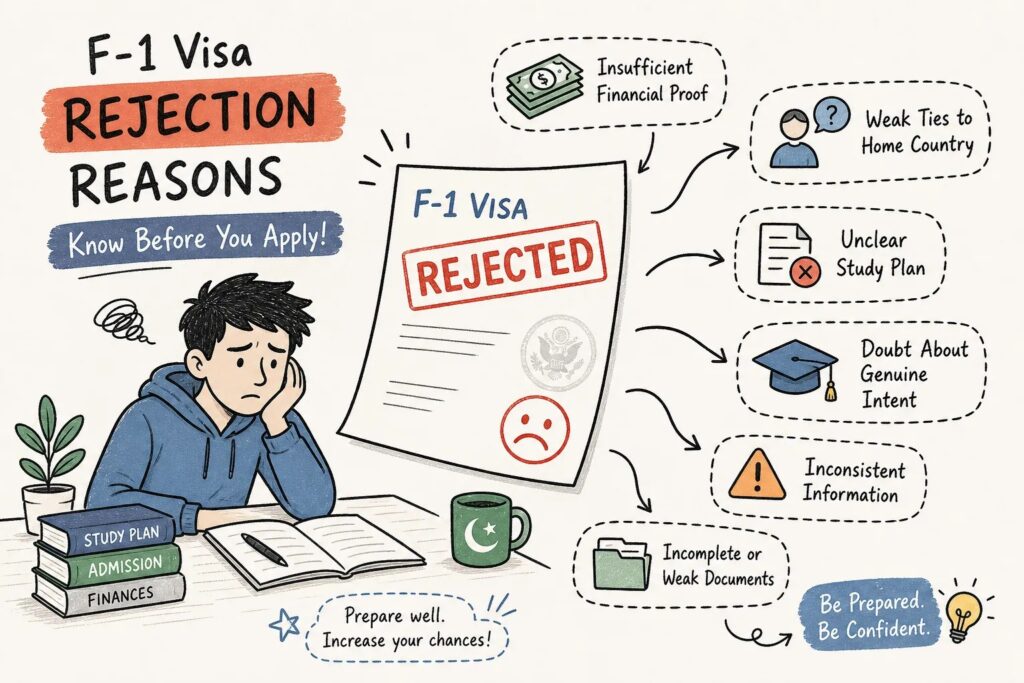
Most Pakistani students who receive an F-1 refusal assume they were denied for one reason. They weren’t. Understanding the real F1 visa rejection reasons in Pakistan starts with a single question the consular officer needed to answer with confidence: “Will this person leave the United States after graduation?” Everything else (the paperwork, the bank statements, the university letters) is merely evidence for or against that single conclusion. This article breaks down each failure point clearly, explains what your refusal code actually means, and gives you a concrete plan to address what went wrong before your next attempt.
At MUSAFAT Student Consultants, we review refusal cases regularly. After working with Pakistani students on reapplications for many years, the same failure patterns appear across nearly every denied file. The causes are documented, understandable, and in most cases fixable.
What your refusal notice is actually telling you
Most students read their white paper once, feel confused, and file the same application again. That is the wrong move. Your refusal notice is a specific signal about what the officer needed to see and didn’t find. Reading it honestly is the first step in a successful reapplication.
The legal weight behind a 214(b) denial
Section 214(b) of the Immigration and Nationality Act is not a rejection of your documents. It is the officer’s legal conclusion that you did not overcome the presumption of immigrant intent. Under US immigration law, every applicant is presumed to be a potential immigrant until proven otherwise. You walked into that interview presumed likely to overstay, and you didn’t prove otherwise. Globally, approximately 75% of F-1 refusals fall under this code, Pakistan-specific figures are not published separately, but 214(b) is consistently the dominant ground for Pakistani applicants as well. No appeal process exists. The only path forward is to reapply with meaningfully stronger evidence.
221(g): a different problem with a different solution
A 221(g) notice is not a final denial. It is a request for additional information or documentation that was missing from your file. Applicants who receive this have a straightforward path forward: submit exactly what was requested, and the case is reviewed again. Confusing 221(g) with a 214(b) refusal causes unnecessary panic and wasted reapplications. Check your notice carefully before deciding your next step.
Reading a white paper honestly
When a 214(b) refusal notice references “other than family ties,” the officer is pointing specifically at weak economic or professional ties to Pakistan, not your personal relationships. Practically, this means your property, employment, or career plans back home were either absent or unconvincing. That is a specific gap you can address with specific documents.
F1 visa rejection reasons in Pakistan: the financial evidence gap most applicants miss
Weak or inconsistent financial proof is one of the leading F1 visa rejection reasons for Pakistani students. Consular officers aren’t simply checking your balance. They are checking whether your money makes sense, where it came from, and how long it has been there.
What the officer is actually reviewing
Officers expect bank statements covering at least six months on official letterhead, showing a consistent history. The balance must cover a full year of expenses per your Form I-20, this typically means USD 40,000 to 60,000 depending on your university and location, though your I-20 will state the exact figure for your institution. A large deposit appearing one month before your appointment raises an immediate red flag. Officers interpret that as borrowed funds arranged specifically for the interview, not genuine financial capacity.
Sponsor documents that hold up under scrutiny
If a parent or relative is sponsoring your education, their six-month bank statements, income tax returns for two to three years, and salary slips or business proof must accompany your file. A notarised affidavit of support alone is not sufficient. Officers want to see the financial trail, not just a written commitment. An employer verification letter confirming the sponsor’s annual salary adds another layer of credibility that many Pakistani applications overlook.
Strengthening your financial narrative
Include a CA Net Worth Certificate, property deeds translated into English, mutual fund statements, or an education loan sanction letter from a recognised bank. Fixed deposits and provident fund statements are accepted, but liquid accounts are preferred. The goal is to demonstrate both stability and accessibility. A number on a page is not enough; the history behind that number is what builds the officer’s confidence.
Ties to Pakistan: what the officer was really evaluating
This is the core of almost every 214(b) denial. “Ties to Pakistan” is not a vague phrase. It refers to specific, documentable circumstances in your life that make it genuinely irrational for you to remain in the US after graduation. The officer is asking a practical question: what is waiting for you at home?
Family obligations and the NADRA FRC
The Family Registration Certificate issued by NADRA is considered the strongest documentary proof of family structure and your responsibilities within it. Dependent parents, a family business you are expected to inherit, or elder care obligations all belong in your file. These create verifiable obligations the officer can see, not just promises made during the interview. When combined with medical reports or proof of financial support for dependent family members, the case for your return becomes far more concrete.
Property, employment, and a future that requires your return
Property deeds, land titles, and rental agreements demonstrate economic roots in Pakistan. An employment letter with a No Objection Certificate that states your exact return date to your role back home demonstrates professional continuity. Together, these two categories show the officer that a life in Pakistan is genuinely waiting for you. Officers assume that a person with owned assets and a confirmed job will not abandon them lightly.
Connecting your US degree to a specific future in Pakistan
A vague statement that you will “use your degree in Pakistan” carries no weight. Tie the programme directly to a job role, a family business function, or a sector that specifically requires that qualification in the Pakistani market. If you are studying supply chain management and your family runs a manufacturing business in Gujranwala, say that explicitly and document it. Specificity is what separates a convincing application from a generic one.
Common F1 visa rejection reasons in Pakistan: interview mistakes that cost applicants their visa
A well-documented file can still be undone in the interview room. For Pakistani applicants, this is often where strong applications collapse, not because of dishonesty, but because of poor preparation and avoidable contradictions.
Answers that raise immediate red flags
Officers become suspicious when applicants give open-ended answers about their future plans in the US (“I’ll see what opportunities come up”), when funding sources differ between the DS-160 and the spoken interview, or when applicants casually mention relatives who extended their stay in the US. Any answer that signals openness to remaining beyond your programme triggers exactly what Section 214(b) is designed to catch. Mentioning siblings who transitioned from F-1 to OPT to H-1B in the US is particularly damaging.
DS-160 consistency and what officers cross-check
Every answer in the interview is measured against what you wrote on your DS-160 form. A single mismatch, such as listing yourself as unemployed on the form while mentioning a business during the interview, can trigger an immediate refusal. Consular officers are also increasingly known to cross-reference LinkedIn profiles and public social media accounts as part of their review. A profile set to “open to work in the USA” while you claim you intend to return creates a visible contradiction that is difficult to explain away in a short interview.
Body language, pacing, and rehearsed answers
Memorised scripts are easy to detect. Officers prefer natural, direct responses over polished recitations. Long pauses before answering, poor eye contact, and reliance on notes all signal either a lack of genuine intent or coaching that substituted for real preparation. Prepare to speak naturally about your study plans, your family, and your future in Pakistan, because the officer is listening for authentic conviction, not a rehearsed performance.
How to reapply for an F-1 after rejection: building a stronger case
The most common mistake after a 214(b) refusal is reapplying too quickly with the same evidence. Consular officers expect new circumstances or new documentation to justify a different outcome. Submitting the same file again is almost guaranteed to produce the same result.
When the right time to reapply actually is
There is no mandatory waiting period after a 214(b) refusal, but there is a practical one. The right time to reapply is when something real has changed: a new permanent job, a property purchase, a confirmed job offer tied to your degree, or a new dependent family responsibility. These are the circumstances that genuinely shift the officer’s assessment. Most successful reapplications involve a wait of at least six to eight weeks, not because of any rule, but because building a materially stronger file takes time.
Building your reapplication file step by step
Start with an honest review of what was weak in your previous application. Then gather documentation that addresses each gap directly. Submit a new DS-160, pay the fresh visa fee, and approach the interview as a new case, not a continuation of the previous one. Your goal is to present a version of your life that the officer could not have seen before, one with stronger ties, clearer plans, and no contradictions.
When to stop going alone on your reapplication
There is a category of F-1 refusal cases where self-guided reapplication consistently fails. If your profile has structural vulnerabilities, weak economic ties, prior immigration history, complex sponsor arrangements, or multiple previous refusals, gathering more documents is not the same as understanding what the officer’s legal standard actually requires.
What immigration legal expertise adds to a refusal case
A consultant who understands immigration law does not simply help you organise documents. They assess your profile against the legal standard the officer is applying, identify the specific evidentiary gaps in your case, and build a strategy around your actual circumstances. This is a fundamentally different service from a general admissions consultant who helps you choose a university. For a 214(b) refusal, especially a repeated one, the distinction matters significantly.
How MUSAFAT Student Consultants approaches refusal cases
MUSAFAT Student Consultants, led by Majed Akbar (an Advocate High Court and British Council Trained Agent with US immigration law training), combines immigration law expertise with education counselling specifically for Pakistani students. The team reviews refusal notices, reconstructs weak files, and prepares personalised reapplication strategies that address each failure point with documented evidence. For Pakistani students navigating a refusal and needing more than guesswork, that legal foundation is what changes the outcome.
F1 visa rejection reasons Pakistan: a refusal is a set of signals, not a final answer
A student visa denial is not a permanent verdict. It is a specific set of documented gaps, in evidence, in narrative, or in the interview, that a stronger reapplication can close. Most of the F1 visa rejection reasons Pakistani students encounter are well understood and directly addressable with the right preparation.
Understand your refusal code, address the financial and ties evidence directly, prepare your interview with consistency rather than scripts, and wait until your circumstances have genuinely changed before reapplying. These are not complicated steps, but they do require discipline and, in many cases, professional guidance.
If your file has multiple vulnerabilities, or if you’ve already been refused more than once, working with immigration legal professionals is the clearest path to a different outcome. While no outcome can be guaranteed, a methodical approach that directly addresses the documented gaps significantly improves your chances. Book a consultation with MUSAFAT Student Consultants to have your refusal notice reviewed and your reapplication strategy built properly from the start.