
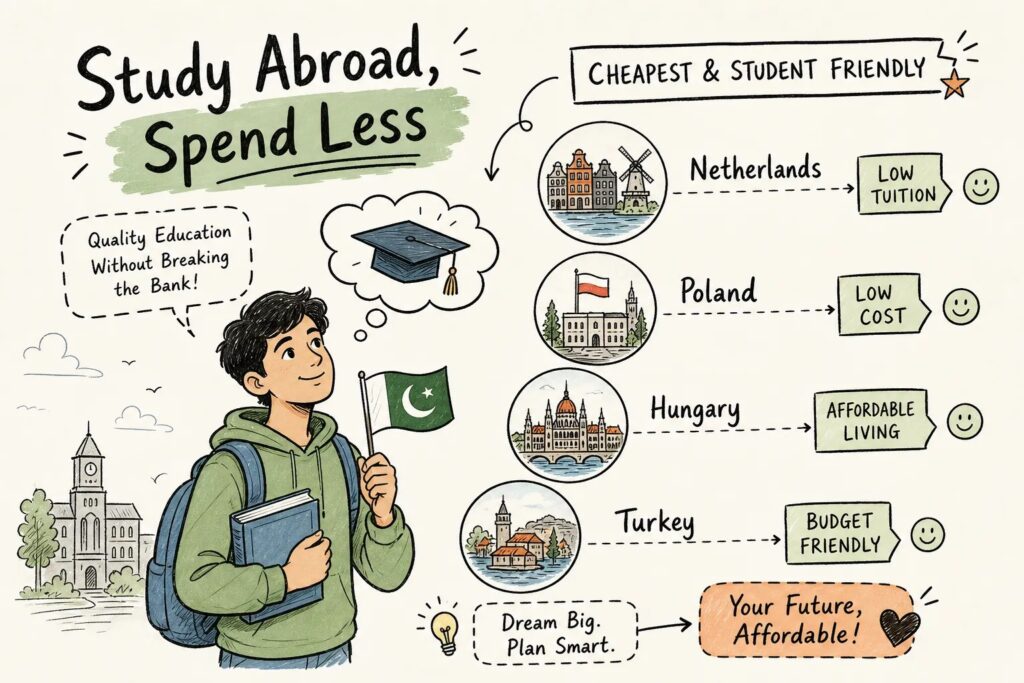
Which country is cheapest to study abroad from Pakistan, that is the question most families eventually arrive at after spending months agonising over the UK versus the USA. They compare league tables, estimate tuition in pounds and dollars, and then freeze when the actual numbers do not add up. What they have missed entirely are the countries where internationally recognised degrees cost a fraction of what the UK or the US demands.
At MUSAFAT Student Consultants, after more than 22 years of guiding students from Gujranwala and across Punjab, this question comes up constantly: where can a Pakistani student study abroad without exhausting the family’s savings? The honest answer depends on your academic level, your language flexibility, and whether you factor scholarships into the budget. This guide gives you real numbers in PKR and a clear framework for shortlisting the right destination before the September 2026 intake window closes.
Why most students get the cost calculation wrong
Most families compare tuition fees and stop there. That is the wrong approach. A country charging zero tuition can still cost more than one charging $3,000 a year if city-level living expenses are high. The only number that matters is your total annual cost: tuition, accommodation, food, transport, visa fees, and return travel combined.
With the Pakistani rupee’s exchange rate volatility in 2026, a destination that looked affordable two years ago may have shifted significantly. For everything in this article, use these PKR benchmarks as your reference: the budget tier sits at PKR 1.5M, 3M per year total; mid-range sits at PKR 3M, 5M per year; anything above PKR 5M per year falls in expensive territory for a family paying out of pocket. Every country comparison below maps back to these three tiers.
Which country is cheapest to study abroad from Pakistan? Turkey and Georgia lead on value
Annual costs for a full academic year
Turkey is commonly cited as one of the more affordable study destinations for Pakistani students, and the numbers support that reputation. Public university tuition for Turkish-medium programmes ranges from $500 to $2,000 per year (approximately PKR 139,000, 556,000), while English-medium programmes at public Turkish universities typically land between $1,000 and $4,000 annually. Combined with monthly living costs of $300, $500, a student at a public Turkish university can budget between PKR 1.3M and PKR 2.5M for a full year, placing it firmly in the budget tier. (Figures are based on a PKR/USD rate of approximately 278, reflecting 2026 mid-year rates; always verify the current rate before finalising your budget.)
Georgia sits slightly higher but remains very accessible. Tuition for general and medical degrees at accredited Georgian institutions ranges from $3,500 to $6,500 per year. Living costs in Tbilisi and Batumi mirror Turkey, at roughly $300, $500 per month. A realistic annual budget for Georgia lands between PKR 2M and PKR 3.5M depending on the programme, overlapping the budget and lower mid-range tiers. On language requirements, some Georgian universities accept alternative proofs of English proficiency or offer preparatory programmes, check admission requirements per university, as policies vary. On visa processing, student visa timelines vary; verify current processing times directly with the Georgian embassy or consulate in Pakistan before planning your application.
Scholarships and work rights
Turkey offers one advantage that changes the entire financial picture: Türkiye Bursları, the Turkish government scholarship, covers full tuition, accommodation, health insurance, a monthly stipend of up to 9,500 TL for PhD students (6,500 TL for master’s, 4,500 TL for undergraduates), and a return flight. The application deadline falls in February each year, the 2026 window closed in late February, and Pakistan receives a dedicated annual allocation of seats. For students who qualify, Turkey moves from the budget tier to essentially free.
On work rights, Turkey allows international students to work part-time, up to approximately 24 hours per week, after completing their first year of undergraduate study. Graduate students can work from day one. Georgia has no formal part-time work permit structure for international students; most manage by budgeting carefully from family remittances or stipend savings, which the low cost of living makes feasible.
China and Cyprus: strong academics at prices that make sense
What does a year actually cost?
China is one of the most consistently affordable destinations for Pakistani students, particularly for MBBS, engineering, and business programmes. Tuition at public Chinese universities ranges from $2,000 to $6,000 per year (approximately PKR 556,000, 1,668,000). Living costs in second-tier cities such as Wuhan, Chengdu, or Xi’an sit at $300, $500 per month, significantly lower than Beijing or Shanghai. For most programmes, a student budgeting carefully can expect to spend between PKR 1.5M and PKR 3.3M per year in total.
Cyprus occupies a different position. Tuition at public Cypriot universities for non-EU international students runs from €3,000 to €8,000 per year, while private universities charge €7,000 to €12,500. Monthly living costs average €700 to €1,100 depending on the city, with Nicosia and Limassol sitting higher than Larnaca or Paphos. In PKR terms, a full year in Cyprus typically falls between PKR 3.5M and PKR 6M, placing it in the mid-range to expensive tier. The draw is EU-adjacent degree recognition and fully English-medium instruction, which carries genuine value in the European job market.
Scholarship access by destination
The Chinese Government Scholarship (CGS) is one of the strongest fully funded options available to Pakistani students. It covers full tuition, accommodation, health insurance, and a monthly stipend of up to 3,500 Yuan. Applications run on two tracks: embassy-direct and university-direct, with most openings around March each year. Students who secure CGS study in China at no personal cost. Cyprus offers merit scholarships at the university level, but no major government-funded programme exists specifically for Pakistanis. Students targeting Cyprus are largely self-funding, so the cost-benefit calculation must account honestly for the degree’s value relative to the out-of-pocket investment.
Germany and Hungary: tuition-free but not expense-free
The truth about free tuition in Germany
Germany’s public universities charge no tuition for international students across 15 of its 16 states. The only cost is a semester contribution of roughly €150, €400, covering administrative expenses and often a public transport pass. In PKR terms, that is approximately PKR 50,000, 125,000 per semester, negligible by comparison. The annual academic cost is, for practical purposes, zero.
The blocked account requirement is where things get complicated. Before a German student visa is approved, applicants must demonstrate €11,904 (approximately PKR 3.6M at mid-2026 rates) sitting in a German blocked bank account. This money is not lost, it is released monthly at €992 during your studies. But it is a significant liquidity commitment, and for many Pakistani families, producing PKR 3.6M as a frozen lump sum is a genuine barrier even if the amount will eventually be returned. DAAD scholarships address this for postgraduate students by providing €1,000 per month plus tuition coverage, but without DAAD, you need that liquidity in place before your visa is issued.
Hungary’s Stipendium Hungaricum: the underused option
Hungary’s Stipendium Hungaricum is one of the most comprehensive fully funded programmes available to Pakistani students. It covers full tuition, accommodation worth HUF 40,000 per month, a monthly living stipend of HUF 43,700, and medical insurance. Pakistan receives an annual allocation for this programme, and applications open in January, February each year. Competition is real, but the seats exist and Pakistani students win them regularly.
Students who do not secure the scholarship face English-medium tuition fees of roughly $5,000, $8,000 per year at Hungarian universities. Combined with living costs, that places self-funded Hungary firmly in the PKR 3M, 5M mid-range tier. The scholarship, however, transforms Hungary into a cost-free option for qualifying students. That gap is why applying for Stipendium Hungaricum before committing to anything else is worth the six to eight weeks it takes.
Scholarships that can reduce your cost to near zero
Several government-funded programmes directly target Pakistani students, and winning any one of them changes the financial equation entirely. These are not backup options. For a budget-conscious student, securing any of the following makes the destination essentially free, bearing in mind that visa fees, pre-departure travel costs, and certain conditional expenses remain the student’s responsibility:
- Türkiye Bursları (deadline: February): covers tuition, accommodation, health insurance, monthly stipend, and a return flight to Turkey.
- Stipendium Hungaricum (deadline: January, February): covers tuition, accommodation allowance, monthly stipend, and medical insurance for Hungary.
- Chinese Government Scholarship (opens: March): covers tuition, accommodation, health insurance, and a monthly stipend of up to 3,500 Yuan.
- DAAD (Germany): provides €1,000 per month for postgraduate students, covering living costs and tuition support.
On the Pakistani side, HEC’s overseas scholarship programme funds master’s and PhD students at top-ranked international universities. Punjab’s PEEF PhD scholarship covers tuition, room and board, airfare, and health insurance at QS top-50 institutions. Students who qualify through HEC or PEEF can target more expensive destinations, including the UK and Germany, without personal financial burden, because the funding comes from the Pakistani government’s side of the equation.
Matching a destination to your actual budget and profile
The right country is not the one with the lowest tuition. It is the one where your total first-year cost sits within your family’s realistic budget after any scholarship you have secured. Students with PKR 1.5M, 2.5M per year available should focus on Turkey (public universities) and China (second-tier cities). Students with PKR 3M, 5M per year can include Georgia, Cyprus, and Germany with the blocked account in place. Students willing to invest six to eight months in a scholarship application should pursue Türkiye Bursları or Stipendium Hungaricum before finalising any country decision.
The numbers in this article are starting points, not guarantees. Exchange rates shift. University fee structures change each intake cycle. Scholarship seat allocations vary by year. At MUSAFAT Student Consultants, every student goes through a structured counselling session where their academic profile, financial situation, and target degree level are mapped against current intake data before any application goes out. That process prevents the most common and costly mistake in study abroad: committing to the wrong destination with an under-prepared file.
The bottom line: which country is cheapest to study abroad from Pakistan?
No single country is cheapest for every Pakistani student. Turkey and Georgia are the most accessible for tighter budgets, with Turkey offering the added advantage of a strong government scholarship pathway. China delivers solid value with a clear funded route through CGS. Germany is genuinely tuition-free if you can meet the blocked account liquidity requirement. Hungary’s Stipendium Hungaricum can make your entire degree essentially cost-free for qualifying students.
The calculation that matters is not tuition alone. Add living costs, visa fees, travel expenses, and any blocked account requirements, then subtract any scholarship you have secured. That final number is what your family is actually committing to. If you want an honest breakdown tailored to your specific academic profile and budget, MUSAFAT Student Consultants has been doing exactly that for Pakistani students since 2004. Reach out before the September 2026 intake cycle closes. The window is shorter than most students realise.
Frequently asked questions
Which country is cheapest to study abroad from Pakistan in 2026?
Turkey and China are consistently among the most affordable options, with total annual costs falling between PKR 1.3M and PKR 3.3M at public universities in second-tier cities. Georgia is close behind, particularly for medical programmes. All three offer funded scholarship routes that can reduce personal costs to near zero.
Which country is cheapest to study MBBS from Pakistan?
China and Georgia are the two most common choices for Pakistani students pursuing MBBS abroad on a budget. Chinese public universities offer accredited MBBS programmes with tuition of $2,000, $6,000 per year, and the Chinese Government Scholarship can cover the full cost. Georgia offers medical degrees at $3,500, $6,500 per year at accredited institutions recognised by Pakistan Medical Commission.
Can Pakistani students study in Germany for free?
Public universities in 15 of Germany’s 16 states charge no tuition to international students. However, students must deposit €11,904 into a blocked German bank account before their visa is approved, equivalent to roughly PKR 3.6M at mid-2026 rates. That liquidity requirement is the main barrier for Pakistani applicants, not tuition itself.
What are the best scholarships for Pakistani students studying abroad?
The four strongest government-funded options are Türkiye Bursları (Turkey), Stipendium Hungaricum (Hungary), the Chinese Government Scholarship, and DAAD (Germany). On the Pakistani side, HEC overseas scholarships and PEEF PhD scholarships fund students at top-ranked universities globally.