
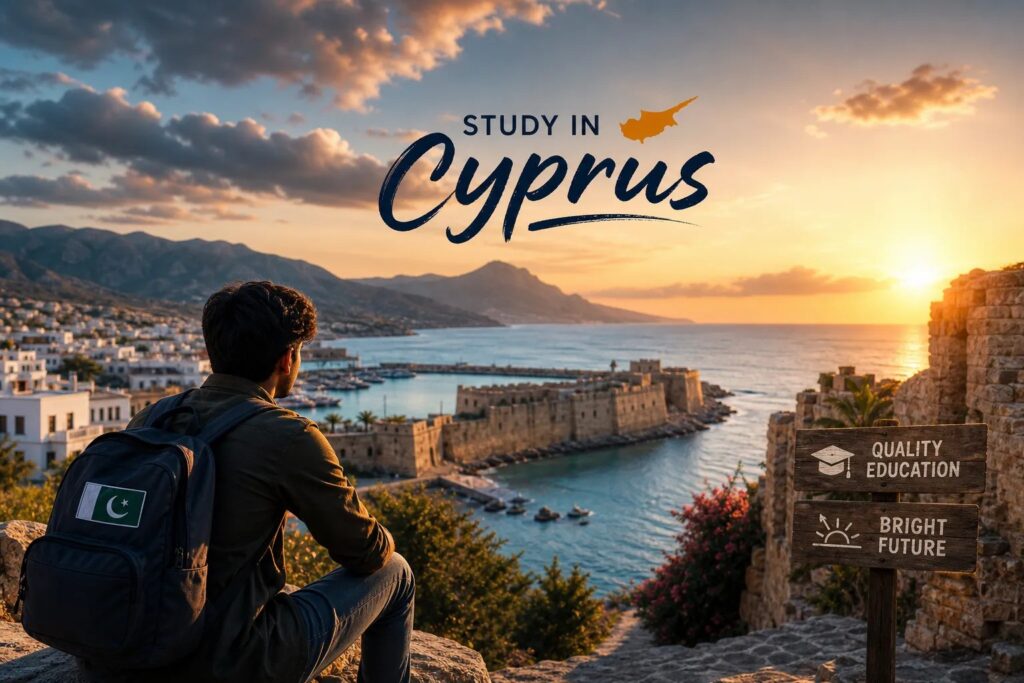
Is Cyprus a good option to study abroad from Pakistan? It is a question that comes up more and more in our consultancy. Cyprus has appeared on the radar of Pakistani students looking for an affordable European degree, and enquiries have been rising steadily, a trend we see directly in the volume of cases arriving at MUSAFAT Student Consultants. Cypriot university marketing has grown noticeably more active at education fairs and on social media in Pakistan, the brochures look polished, and the tuition fees seem reasonable on paper. The question worth asking is whether that attention is deserved or driven by clever advertising.
This guide covers the four things that actually matter when evaluating Cyprus as a study destination from Pakistan: what it costs, how the visa works, whether your degree will be recognised, and who Cyprus genuinely suits. At MUSAFAT Student Consultants in Gujranwala, we have guided Pakistani students through Cyprus admissions and visa applications across multiple intakes. We have seen firsthand which parts of the process work smoothly and which ones create expensive delays. This is not a promotional piece for Cyprus. By the end, you will know whether it fits your specific situation.
What studying in Cyprus actually costs
Tuition fees: public universities vs private institutions
The two public universities, the University of Cyprus and the Cyprus University of Technology, charge a fixed €6,834 per year for non-EU undergraduates. That predictability is genuinely useful for financial planning. The catch is that English-taught undergraduate programmes at these institutions are limited, with most options concentrated at postgraduate level.
Most Pakistani students end up at private universities, where the majority of English-taught degrees are offered. Tuition at institutions such as European University Cyprus, Frederick University, and the University of Nicosia ranges from €7,800 to €11,000 per year for standard undergraduate degrees. Medicine at European University Cyprus is a significant outlier, running between €19,000 and €25,000 annually. Postgraduate fees across institutions range from €4,100 to €10,300 depending on the programme and institution.
Monthly living expenses: what the numbers actually look like
Budget between €700 and €1,100 per month for living costs. A shared room costs €350 to €600 in most cities; a studio in Nicosia runs closer to €800. Food comes to roughly €200 to €300 per month if you cook regularly, transport costs around €30 to €40 with a student bus pass, and utilities add another €70 to €100 on top of rent.
Nicosia and Limassol sit at the higher end of that range. Larnaca and Paphos offer more manageable costs. To put this in context: Cyprus is roughly 30 to 40 per cent cheaper than the UK, where students typically spend between £1,200 and £1,800 monthly, but 30 to 40 per cent more expensive than Türkiye, where monthly costs run between €400 and €700. Cyprus is a mid-range European option, not a budget destination.
Is Cyprus a good option to study abroad from Pakistan? What recognition actually means
Universities offering genuinely English-taught programmes
The key private institutions for Pakistani students considering Cyprus are the University of Nicosia, European University Cyprus, Frederick University, Neapolis University Paphos, and UCLan Cyprus. UCLan Cyprus deserves specific mention: its degrees are awarded by the UK’s University of Central Lancashire, carrying the same recognition as the main campus. All of these institutions are accredited by CYQAA, the Cyprus Agency of Quality Assurance and Accreditation in Higher Education, and follow the Bologna Process, which means their degrees are automatically recognised across EU member states.
What Pakistani students need to verify before enrolling
EU recognition is not the same as HEC Pakistan recognition. For general degrees in business, IT, or social sciences, CYQAA-accredited universities are broadly accepted internationally. For professional degrees in medicine, engineering, or pharmacy, you need to confirm recognition specifically with HEC Pakistan and the relevant professional council, for medicine, the current regulatory body is the Pakistan Medical Commission (PMC), which replaced the Pakistan Medical and Dental Council.
Before paying any tuition deposit, verify the institution against the HEC list of recognised foreign universities. Do not rely on the university’s own claims about recognition. Contact HEC directly or search their database at hec.gov.pk. This step matters most for medical and allied health sciences students, where a mistake at the enrolment stage is a very costly one.
The Cyprus student visa process: what Pakistani applicants need to know
How the application actually works
The Cyprus student visa process works differently from most destinations. The university submits the application on your behalf to the Civil Registry and Migration Department in Cyprus, you do not apply at an embassy in Pakistan. The sequence runs as follows:
- Secure your acceptance letter from the university.
- Pay your tuition deposit.
- Submit your documents to the university.
- The university lodges the application with the Migration Department.
- You receive an Entry Permit.
- Travel to the Cypriot Embassy in Amman, Jordan, for visa stamping.
- Fly to Cyprus.
- Register at the Migration Department for biometrics and a local medical test.
- Collect your residence permit card.
Based on 2026 experience, processing typically runs between eight and sixteen weeks once a complete application is submitted, with cases during the peak September intake commonly reaching three months or beyond. Incomplete or incorrectly attested documentation is the most common cause of delays. Working with an experienced consultancy reduces that risk substantially, our team at MUSAFAT Student Consultants checks each document set against the Migration Department’s current requirements before submission, which cuts down the back-and-forth that catches unprepared applicants off guard.
The Amman requirement and the document checklist
Pakistani students no longer get visa stamping done locally. After receiving pre-approval, you travel to the Cypriot Embassy in Amman, Jordan, for the physical visa sticker to be placed in your passport. This adds time, cost, and logistical planning to the process. Factor it into your budget from the start; ignoring it creates a real disruption at the worst possible moment.
The core document checklist includes:
- A valid passport
- Attested academic certificates
- An official acceptance letter
- Bank statements showing a minimum of €7,000 to €10,000
- Medical certificates covering HIV, Hepatitis B and C, TB, and Syphilis
- A Police Clearance Certificate that has been Apostilled or consular attested
- Health insurance of at least €30,000 cover
- Passport photos
Medical certificates must be issued within four months of application; the PCC and bank letters within six months. Missing these windows means restarting that document entirely, which pushes your entire timeline back.
North Cyprus vs South Cyprus: a distinction that matters
South Cyprus, the Republic of Cyprus, is an EU member state. Its universities are CYQAA-accredited and their degrees carry full EU recognition. The legal framework for international students is straightforward. North Cyprus, the Turkish Republic of Northern Cyprus, is recognised only by Türkiye. Universities such as Eastern Mediterranean University (EMU) and Cyprus International University (CIU) operate there. North Cyprus institutions offer lower tuition fees, EMU charges approximately $4,000 to $5,000 per year, but degrees from these universities do not carry EU recognition. The visa and residency process is also entirely separate from the Republic of Cyprus system.
South Cyprus is the stronger choice for students who plan to work or pursue further qualifications in the EU after graduation, or for professional degrees where international recognition is the priority. North Cyprus suits students who prioritise lower tuition, are comfortable with the Turkish Cypriot academic environment, and whose career plans centre on returning to Pakistan, where HEC recognition is the primary concern. Students considering North Cyprus for medicine or dentistry should verify HEC and PMC recognition rigorously before enrolling. Both EMU and CIU appear on HEC’s recognised list, but programme-specific confirmation is still necessary before committing.
Scholarships and part-time work: what’s genuinely available
University tuition waivers: automatic and merit-based
Many private universities offer automatic 50 per cent tuition waivers for new international undergraduates. Four North Cyprus institutions, Cyprus International University, Near East University, Eastern Mediterranean University, and Cyprus West University, apply these automatically on enrolment without requiring a separate scholarship application. Merit-based waivers at the University of Nicosia go up to 50 per cent for students with a GPA of 3.9 or higher, and Cyprus Aydin University offers 70 to 85 per cent waivers for all international students. A Pakistani student with strong grades who applies to the right institution can bring the annual cost of a private Cypriot degree down significantly, in some cases into a range comparable to studying in Türkiye, though exact post-waiver costs vary by programme and should be confirmed directly with each institution.
Government-level scholarship options exist but are limited. The Cyprus Aid programme provides opportunities for students from developing countries. The Cyprus State Scholarship Foundation awards €3,000 to €4,000 per year based on academic performance. Erasmus Mundus joint degree programmes are available for postgraduate students, though most deadlines for the 2026 intake have already passed. Students targeting 2027 should begin researching these from October 2026 onwards.
Working while studying: the legal framework
International students in Cyprus are legally permitted to work up to 20 hours per week during the academic term and full-time during official university holidays. This is a real option for managing living costs and is worth planning around from the start. For engineering and medicine students, programme intensity makes consistent part-time work difficult in practice. Most scholarships cover tuition only, not accommodation or food, so a clear plan to fund living expenses through part-time work or family support is a practical necessity for the majority of students.
The honest verdict: is Cyprus a good option to study abroad from Pakistan?
Cyprus works well for a specific type of Pakistani student. If you want an English-taught, EU-recognised degree at a cost significantly below the UK, do not qualify for highly competitive scholarships in Germany or Finland, and can manage the Amman visa step practically, Cyprus is a workable option. Students applying to UCLan Cyprus get a UK-awarded degree with full UK recognition at a lower cost than studying in the UK itself. That is a specific, concrete advantage worth taking seriously.
Students who need fully funded scholarships will find Cyprus limited. The government scholarship pool is small; Finland, Germany, and Türkiye offer more robust publicly funded options. If your career plan involves staying in Cyprus after graduation, post-study work rights are not as clearly defined as they are in the UK or Germany. That is a real limitation and should not be brushed aside when making this decision.
So, is Cyprus a good option to study abroad from Pakistan? For the right student profile, one that prioritises EU recognition, English-taught programmes, and a mid-range budget, the answer is yes. But it is not the right fit for everyone. If you are unsure whether your academic background, budget, and career plans align with what Cyprus actually offers, the fastest route to clarity is a direct conversation with a consultancy that has placed Pakistani students there. Speak with the team at MUSAFAT Student Consultants in Gujranwala, share your profile and budget, and get a straight assessment of whether Cyprus suits your situation, or whether a different destination is a stronger match. Book your free consultation here.