
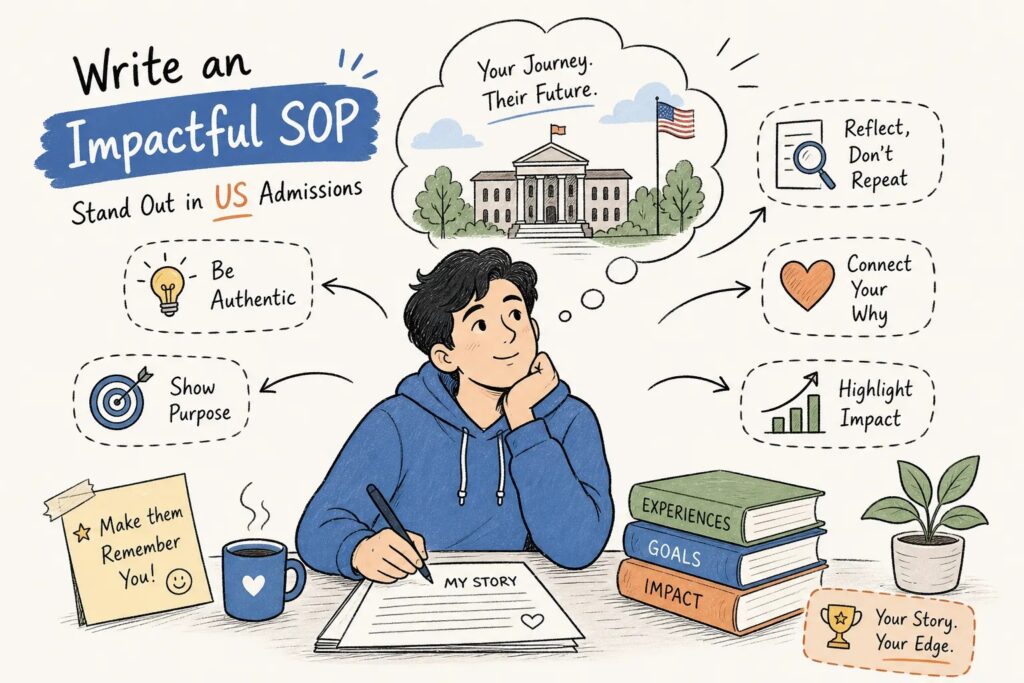
Most applicants spend weeks obsessing over their IELTS score and transcript, then dash off their Statement of Purpose the night before the deadline. That single document, however, is often what decides whether the rest of your application gets a serious read. These SOP writing tips for US admissions address precisely that gap, helping you understand what US admissions committees actually look for, and how to give it to them. Committees use the SOP to answer one core question: is this person ready to do graduate-level work at our specific programme?
This guide gives you a structured, practical breakdown of what actually works when writing an SOP for US university admissions: the right format, the opening that earns the next paragraph, how to sequence your evidence, and the mistakes that quietly cost strong candidates their seat. Many applicants find that working with an experienced adviser, such as the team at MUSAFAT Student Consultants, helps them produce more coherent SOP narratives, because structured feedback before submission is far more useful than a rejection letter after. By the end of this article, you will have a clear plan for every section of your SOP.
1. What US admissions committees actually want from your SOP, key writing tips for US admissions
An SOP is not an autobiography, and it is not a résumé translated into prose. It is a structured argument that answers three questions: Do you have the intellectual curiosity to pursue graduate study? Do you have the research readiness to contribute? Does this specific programme fit your stated direction? Once you internalise that framing, everything else in this guide follows logically. Every sentence you write should push that argument forward, or it should not be there.
Personal statement vs SOP for US admissions: the key difference
Many Pakistani applicants conflate these two documents, and the mistake costs them from the opening line. A personal statement focuses on who you are as a person, your character, your narrative, your life experiences. An SOP focuses on what you intend to do academically and why this specific programme is the right place to do it. Submitting a life narrative when the committee expected a research argument signals that you have not read the requirements carefully, and that is not the first impression you want to make.
Most US research-oriented graduate programmes, particularly STEM and MS/PhD tracks, ask for an SOP rather than a personal statement. Some humanities and professional programmes may request a personal statement instead, so always check the specific department’s admissions page before you begin writing.
SOP format and word limit: the current standards
When no word limit is specified, target 800, 900 words. That is the sweet spot: enough room to make a complete argument without exhausting the reader. Master’s programmes generally expect 700, 1,000 words; PhD programmes often run to 1,000, 1,500 words to accommodate research background and faculty alignment in full. Use 11, 12pt font, single spacing, and one-inch margins.
If a programme specifies a word limit, respect it without exception. MIT often requires a “Statement of Objectives” and caps some departments at two pages. Stanford enforces a strict two-page limit. Harvard’s requirements differ by department, with each providing its own specific prompt. If a department’s page is ambiguous, check their FAQs or contact the admissions office directly. Always verify on the department’s admissions page, not the university’s general homepage.
2. How to open your SOP in a way that earns the next paragraph
The opening paragraph carries disproportionate weight. Admissions readers process hundreds of documents; a generic opener signals an underprepared candidate within two sentences. Your goal is to signal research thinking immediately, not to warm the reader up with pleasantries. Based on reviews of accepted PhD applications, the strongest openers almost always fall into one of three patterns.
Three opening structures that work
The Research Question Hook opens with the intellectual problem driving your degree. Example: “How do distributed systems self-heal in response to failures without human intervention? This question has shaped my research for the past three years.” It works because it frames you immediately as someone already thinking like a researcher, not a student hoping to become one.
The Catalyst Moment describes a specific, recent experience where a technical challenge crystallised your research direction. Example: “When our protein separation protocol failed for the seventh consecutive time last spring, I realised the problem was not technical; it was systematic.” It demonstrates problem-solving instinct without the childhood nostalgia that committees have grown tired of reading.
The Direct Research Statement is upfront and professional: “I am applying to the PhD programme in Civil Engineering at MIT to work with Professor Ahmad on seismic risk modelling in high-density urban environments.” Faculty can immediately assess alignment, which is precisely the efficiency admissions committees appreciate.
What kills an opening paragraph
“I have always been passionate about…” is the single most common rejected opener. Childhood stories, dictionary definitions, and vague declarations of fascination with a subject all signal the same thing: the applicant has not yet defined their research identity. The opening should be one tight paragraph only, and every word should earn its place before the body begins.
3. Building the body: how to sequence your evidence
After the opener, the body carries the proof. The question is not how much experience you have; it is how you order and frame it so it reads as a coherent argument rather than a career timeline. Committees are not looking for the longest list of achievements. They are looking for the clearest case that you are ready to contribute.
Balancing research experience and professional background
Relevance beats volume. There is no target number of research hours. For PhD applications, roughly 70% of the body should cover research and academic background, with the remaining 30% on motivation and goals. For MS applications, professional experience can carry more weight if it demonstrates transferable research skills: hypothesis testing, data analysis, systematic problem-solving.
Frame professional experience using the STAR format (Situation, Task, Action, Result). This gives each description a clear outcome and connects it to research capacity rather than job function. State the principle first, then apply it: a software engineering role becomes relevant when you describe how you identified a data integrity problem, designed a test framework, and used the results to propose a structural fix.
Connecting past experience to future goals
Every piece of evidence in the body must point forward. The connective tissue between paragraphs is not chronology; it is logic. Each experience, whether a research project, a thesis chapter, or a professional role, should be shown to have developed a specific skill or surfaced a specific question that now motivates graduate study at this programme. If a paragraph does not serve that function, cut it without hesitation.
4. Demonstrating programme fit and faculty alignment
Generic SOPs that do not name faculty, courses, or lab focuses are among the most cited reasons for rejection among otherwise competitive applicants. Fortunately, it is also the most straightforward section to fix, a one-sentence acknowledgement of a professor’s specific recent work can change the committee’s perception of your application entirely.
How to research faculty before you write a single sentence
Start with the department’s faculty page, not the university homepage. Read recent publications, from the last two to three years, from two to three professors whose work overlaps with your stated research direction. Reference their work specifically in your SOP, not to flatter them, but to show that you understand what they are working on and where your interests genuinely intersect.
For PhD applications, naming faculty you want to work with is not optional; it is the minimum signal that you understand how graduate research supervision works. Misidentifying a faculty member, or naming someone who left the department two years ago, is an automatic red flag that suggests you have not done basic due diligence.
University-specific requirements to check before submitting
MIT, Stanford, and Harvard each have different requirements, and those requirements vary further by department within each university. Harvard’s Graduate School of Arts and Sciences enforces a 500-word limit for most programmes. MIT’s Chemistry department allows up to 1,500 words. Stanford caps most programmes at two pages and wants programme fit reasoning, not a life timeline. Always verify on the specific department’s admissions page before you write a single word, department limits change, and the general university homepage is rarely up to date.
5. SOP mistakes that quietly cost strong candidates their seat
These are the errors admissions officers cite most often when downgrading otherwise competitive applications. None of them are difficult to fix once you know what to look for, but all of them are surprisingly common in submissions from strong candidates who simply did not get feedback before submitting.
The generic SOP trap and the autobiography mistake
Submitting the same document to multiple programmes without tailoring it is the most common fatal error. It signals disorganisation and a lack of genuine interest in any specific department. The second mistake is writing a chronological life story: the SOP is not a personal journal, and every sentence must earn its place by advancing the argument for your admission, not documenting your personal journey.
Structural and evidence errors that undermine credibility
The mechanics that signal carelessness include typos and grammatical errors, ignoring stated word limits, proposing research the department does not conduct, misidentifying faculty, and listing achievements without explaining contribution or impact. Each of these reduces the committee’s confidence in your attention to detail, precisely the quality graduate research demands from day one.
6. From first draft to final version: revising with purpose
A finished draft is not a final SOP. The revision stage is where most applications either sharpen into competitive submissions or stagnate into average ones. Treating your first draft as the last is one of the most expensive mistakes you can make in the application process.
A practical revision checklist before you submit
Work through these questions before you consider the document ready:
- Does the opening immediately signal a research focus rather than a life narrative?
- Does every body paragraph connect a past experience to a future goal?
- Are two to three specific faculty members named with a clear rationale?
- Is the word count within the programme’s stated limits?
- Has every cliché been replaced with a concrete, specific example?
- Does the conclusion state what you will contribute to the programme, not just what you hope to gain?
When to get expert feedback on your SOP
Self-review has limits, especially when you are too close to the material to spot structural gaps. Working with an experienced adviser makes a qualitative difference. MUSAFAT Student Consultants offers SOP review and writing support that goes well beyond surface-level proofreading, drawing on extensive experience in both education counselling and immigration law to help students construct a narrative that is compelling, coherent, and honest, qualities US admissions committees weigh seriously.
A structural gap you cannot see after ten drafts becomes obvious to a reader who has reviewed hundreds of accepted and rejected applications. That kind of targeted, experienced input is qualitatively different from asking a friend or family member to proofread, and the difference tends to show in the final submission.
Final thoughts: SOP writing tips for US admissions
The sequence is straightforward: understand what committees want, open with purpose, build the body as a logical argument, tailor every submission to specific programmes and faculty, eliminate the most common errors, and revise with a structured checklist. A strong SOP does not require perfect grades or a flawless research CV; it requires clarity, specificity, and honest self-presentation.
Students who treat these SOP writing tips for US admissions as a strategic framework, rather than a last-minute formality, consistently submit documents that reflect their actual ability. Those who treat the SOP with the same discipline they gave their IELTS preparation tend to submit work that genuinely represents the candidate they are. Use this guide to revise your draft, apply each tip methodically, and submit with confidence.